Archive for the ‘Politics and Message’ Category

At Start of Second Term Obama Declares “We Are Made For This Moment”

Wednesday, January 23rd, 2013

20130123-104103.jpg

After delivering a second inaugural address fused with measured confidence, President Obama beams at the huge, cheering crowd that greeted him along the Pennsylvania Avenue parade route. Photo/Keith Schneider

WASHINGTON — Four years ago, when crisis lay like a dark shadow across the land, and President Obama’s first inaugural address served as a kind of pep talk to refute what he called “the nagging fear that America’s decline is inevitable,” this week’s inspiring and dignified Inaugural ceremonies seemed so unlikely, if not utterly impossible.

In 2009, America did indeed feel like a nation slipping backwards. We all know the evidence. Job losses. Bank failures. Foreclosures. Terrorist attack. Wars prompted by a campaign of lies and deceit. An opposition party, driven by fanatic inflexible ideology, dangerously intolerant, and determined to wreck the country.

We were a country afraid of the future and bent by the potent winds of economic transition that so confused us we chose to cower instead of compete.

On Monday, though, the thoroughly confident president, buoyed by an improving economy, and advancing against a weakened Republican opposition in retreat, declared without any irony:

“America’s possibilities are limitless, for we possess all the qualities that this world without boundaries demands: youth and drive, diversity and openness, an endless capacity for risk and a gift for reinvention. My fellow Americans, we are made for this moment and we will seize it, so long as we seize it together.”

Those words ring true to me. The first weeks of 2013 feel much different than the first weeks of 2009. Or the last months of 2012, for that matter. Some of that has to do with the economy. The United States now enjoys a globally competitive edge in agriculture, energy, the Internet, transportation, advanced manufacturing, and health care and medical research. As foundations for a new era of prosperity, the success of these seven sectors are unmatched by any other nation.

(more…)

The Wreckage Wrought By A Marauding Minority

Wednesday, December 26th, 2012

20121226-105311.jpg

Along the Champs Elysees on Christmas Day, nobody worried about getting gunned down in the street, or about a marauding minority political party bent on wrecking the nation. Photo/Keith Schneider

PARIS — Along the Champs Elysees’ on Christmas night, an angels’ envy of rope-thin LED halos — colors shifting from red to blue to white — circled the trees and lit the broad boulevard where thousands of people strolled carefree. Nobody worried about the sick and the deranged wielding assault weapons capable of mowing children down like wheat toppled by a stout wind. People stood in line at a theater, clearly unconcerned that the movie inside could be the last one they watched.

Paris, where I’ve alighted this week, is the largest city (2.2 million residents) in one of the world’s largest democracies (population 65.6 million). And while there are issues aplenty here, neither the city nor the nation are undermined by a marauding minority bent on wrecking order and stability from within.

That is not true at home. In the United States, this was a Christmas of consideration for what we’ve allowed ourselves to become. The murders of 20 children in Newtown, Connecticut was a chilling disaster for the country. Newtown crystalized the accumulation of tragedies that have weakened the nation – terrorist attack, financial meltdown, climate-warming fires and floods, mass murder, governing deceit and fecklessness. More significantly, the massacre clarified the principal cause — a reckless and dangerous minority, armed with a governing strategy constructed from the raw materials of greed and fear, and firing with indiscriminate recklessness the bullets of inflexible ideology.

The central issue for America’s intelligent, world-aware, reality-respectful president and his progressive supporters is pretty straightforward: How to stamp out the renegade threat. That campaign, it seems to me, encompasses four essential components:

(more…)

In Newtown Massacre, the Manifest Danger of Deceit and Delusion

Saturday, December 22nd, 2012

20121223-065654.jpg

In India, and around the world, people now question the credibility and character of American governance. Photo/Keith Schneider

NEW DELHI, India — America seems, finally, to be getting it. The Newtown massacre changes things. Just how much and how fast is unpredictable. But we are different today than we were on December 13, the day before the killings.

The age and number of children murdered. The blood-exploded serenity of a wealthy New England town. The bizarre and mendacious response from assault weapons advocates who say that the solution is to put more guns in schools. There’s no argument that America’s new perspective is informed by these essential factors.

Something more enduring looks to be unfolding, though. What’s caused Americans to psychically engage the tragedy at Sandy Hook Elementary School in a way that we rarely experience is this: The murders of 20 first graders exposed the dementia of how America allowed a minority to endanger our nation and our lives. The horror of that morning in Connecticut clarifies and crystalizes in the most awful way the manifest risk to the United States of the right’s psychotic governing strategy.

I draw this conclusion not as a partisan but as a diligent reporter whose perspective is shaped by a capacity to gather facts, recognize trends, and produce cogent narratives. My track record is pretty good but not perfect. Four years ago, with the collapse of the banking sector, I thought we’d moved past the ugly politics of polemics, hate, and inflexible ideology. Instead, it got worse.

More than a decade of Republican dogma (and feckless Democratic opposition) has produced mess after mess, tragedy after tragedy, a string of body blows to the nation that tell a mean story — a terrorist attack, a war fostered by a lie, an economic collapse, two cities drowned by climate change, dysfunctional state and federal governments, regular mass murders. Each event, building on the last, provides irrefutable evidence of negligence, a pathology of policy making and governance that we now see is explicitly aimed at tearing our country to tatters, and that is putting Americans in peril.

The Newtown massacre, both inexplicable and horribly familiar, shook the country in a different way. Terrible as it was, the massacre could mark the moment that America, like the sci-fi hero held in a drug-induced coma administered by the evil overlord, regains its senses and saves the federation. Newtown, Connecticut could be the place, and the deaths of so many children could be the distinguishing event that prompted America to mean it when it said, “Enough!”

Until December 14, America wasn’t really ready to do that.

(more…)

Newtown Massacre Is Part of Global Trend: Protect The Rich, Crush The Children

Sunday, December 16th, 2012

20121216-133629.jpg

In Sichuan Province, southwest China, boys leave classrooms at the end of the day in a country where school can be hazardous. Photo/Keith Schneider

RAIPUR, Chhattisgarh, India — News of the Newtown massacre reached this city of jammed streets and honking bedlam as part of the shock wave that struck the United States, and then swept around the world. As the ritual of sorrow and weeping commenced in America and here, the next thought that came to my mind was this: Reality infiltrated an American community of wealth. Children were murdered in a town ripe with people who believed they’d safely distanced themselves from threats with their money and their votes.

Question: What are they — what are we — going to do about it?

We all know the basic details, the arc of this familiar story in America. The deranged killer, the son of the gun-loving mother whose arsenal apparently supplied the murder weapons. The gun laws that are steadily being weakened or unenforced. The idiots who call for more concealed weapons in the streets and the schools.

We aren’t willing yet to recognize or respond to a separate truth. It is this. In the United States and in other nations — China and India most prominently — elected and appointed leaders are so ready to serve the interests of the rich while children are getting slaughtered.

American social networks noted the Chinese man that last week attacked elementary school children with a knife, injuring but not killing 22 students. The assault continued a trend of adults slashing school children in China that authorities seem unable to interrupt. But the knife attacks divert attention from China’s more serious problem involving the well-being of its rich and its children.

As China amasses stupendous wealth and engages in infrastructure construction at a pace and scale unrivaled by any nation — roads, rail, ports, pipelines, energy plants, water works, housing and office development — a primary principle of its leadership is to coddle the wealthy and grow rich. For instance, the family and wife of Prime Minister Wen Jiabao, according to a revealing article in the New York Times, amassed a $2.7 billion fortune.

Meanwhile poorly engineered and constructed schools collapse in earthquakes, killing thousands of children. The air in Shanxi Province, a major coal mining and coal combustion region, is so bad that rates of severe birth defects are rising. Large numbers of parents of disabled or deformed children, in a country with a one-child-per-family rule, are abandoning those infants to orphanages or good samaritans. The provincial and central governments, so intent on advancing the interests of the mining company executives by issuing permits and signing contracts, are doing next to nothing on behalf of the pollution or the birth defects. The rich, meanwhile, are either sequestered in neighborhoods behind protective walls or live outside Shanxi.

India is no different.

(more…)

In Obama Election Victory A New Test of “Governmental Progress Of Humanity”

Thursday, November 8th, 2012

In Marietta, Ohio, where many authors of the Northwest Territories Ordinance settled, and in the state that twice secured President Obama’s election, a historical marker reminds Americans of our political intelligence. Photo/Keith Schneider

In 2008, on the eve of his election to the presidency, Barack Obama greeted a huge and bouyant crowd in Chicago with this invocation to unity:

“This is our time – to put our people back to work and open doors of opportunity for our kids; to restore prosperity and promote the cause of peace; to reclaim the American Dream and reaffirm that fundamental truth – that out of many, we are one; that while we breathe, we hope, and where we are met with cynicism, and doubt, and those who tell us that we can’t, we will respond with that timeless creed that sums up the spirit of a people: Yes We Can.”

Early Wednesday, after he’d swept through the swing states, caused a Rovian fit on Fox’s election night coverage, and was elected to his second term, President Obama reminded us again about his grace, his temperament, his fairness. It’s why the majority of Americans hold Obama — a bit worn, a little chastened, still determined — in such regard:

“Tonight, despite all the hardship we’ve been through, despite all the frustrations of Washington, I’ve never been more hopeful about our future. I have never been more hopeful about America. And I ask you to sustain that hope. I’m not talking about blind optimism, the kind of hope that just ignores the enormity of the tasks ahead or the roadblocks that stand in our path. I’m not talking about the wishful idealism that allows us to just sit on the sidelines or shirk from a fight.

I have always believed that hope is that stubborn thing inside us that insists, despite all the evidence to the contrary, that something better awaits us so long as we have the courage to keep reaching, to keep working, to keep fighting.”

Walt Whitman saw Abraham Lincoln as “the grandest figure on the crowded canvas of the drama of the 19th century.”  I keep coming up with an image of Lincoln when I consider Obama. The pictures of the president returning to Washington yesterday reminded me of the Civil War president – slim, resolute, shoulders bent with burden. Like Lincoln, Obama presides over a nation divided, fighting a pitched ideological war, much of it centered around racism and intolerance, and its blistering heart firmly beating in the states of the Deep South.

(more…)

President Obama’s Hard Victory and Momentous Challenge: “A Country That Moves With Confidence”

Wednesday, November 7th, 2012

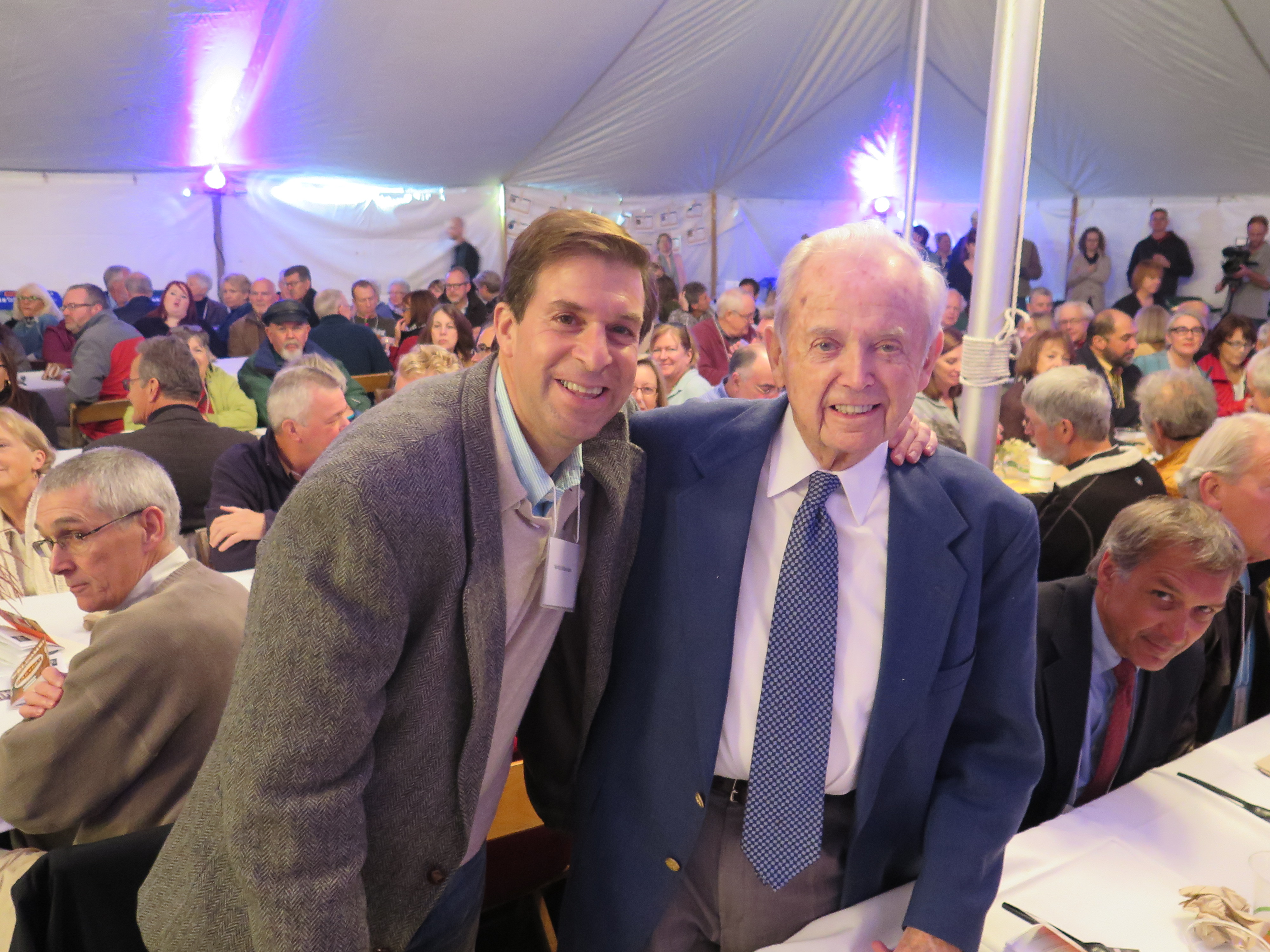
The early returns prompted some pulse taking in Benzie County, Michigan. Here with (left to right) Jim Dulzo, Dennis Pace, me, Judy Bosma Olson. Photo/Keith Schneider

Maybe, for just a moment last night, like when the early returns from Virginia put Mitt Romney well ahead of President Obama, I wondered whether we’d have a new White House occupant.

Then fresher election results from Virginia, and from Pennsylvania, Michigan, Wisconsin, New Mexico, Colorado, Ohio, Iowa, and finally Florida showed Obama earned a clear victory.

The president’s supporters, very plainly, are thrilled, as they should be. But there is no glee for the president. He knows what he faces in the swift currents of economic, diplomatic, and environmental transition threatening to ruin the country. And in the determined work of the deranged and delusional right to stop the nation’s progress and seize power.

In his victory speech — delivered well after midnight and Lincolnesque in its gravity, poetry, and healing spirit — Obama recognized many of the risks to the United States, and yet again reached out to his embittered opposition for the sake of the country.

“This country has more wealth than any nation, but that’s not what makes us rich. We have the most powerful military in history, but that’s not what makes us strong. Our universities, our culture are all the envy of the world, but that’s not what keeps the world coming to our shores. What makes America exceptional are the bonds that hold together the most diverse nation on Earth, the belief that our destiny is shared — that this country only works when we accept certain obligations to one another and to future generations, so that the freedom which so many Americans have fought for and died for come with responsibilities as well as rights, and among those are love and charity and duty and patriotism. That’s what makes America great.”

I woke this morning fully anticipating the sound of splashing ideological poison in the studios of the cable news shows. Right on cue Republican leadership responded to Obama’s appeal with ugliness and contempt. House Speaker John Boehner and Senate Minority Leader Mitch McConnell essentially said there would be no change in their strategy of obstruction. In a typical remark from a Republican pundit, Mary Matalin scowled on CNN and hissed that the only mandate Obama earned was “free contraception and taxing the rich.”

My second thought was what are we, the citizens of the United States, going to do about it? Because, friends, this ain’t play time. There are two ways to look at this moment.

(more…)

Election Day 2012 in Benzonia, Michigan

Tuesday, November 6th, 2012

In Benzonia, Michigan election day 2012 meant 25 minutes to register, fill out the ballot, and have your vote counted. After months of a campaign that confirmed how divided we are, the act of joining with a community to vote for president is the single most inspiring feature of this wearying election season. Photo/Keith Schneider

It takes a transcendant candidate — a Bill Clinton, a Ronald Reagan — to beat an incumbent president. Mitt Romney, who’s repudiated his signal achievements as a governor and shifted views as often as the game plan strategy required, certainly is not that. So I anticipate that Barack Obama will win a second term today, an honor that he has earned and deserves.

Still, we are a dangerously immature country. How does a president govern a nation that is so well set up to argue? The answer: he really can’t.

It takes a near-revolution to do anything of substance. Passing a national health care program birthed a radical right wing of the G.O.P. that made compromise and consensus dirty words. Changing the influence of unions and collective bargaining rights in state government generated weeks of protest and an unsuccessful gubernatorial recall in Wisconsin. Try to finance a high-speed rail network in the Midwest to speed travel and develop new corridors of commerce and two conservative governors refuse to take the money. Develop technology to produce record levels of natural gas, a much cleaner fuel than oil or coal, and reduce U.S. climate changing emissions to the lowest levels in a generation, and the major environmental organizations attack the breakthrough as too dangerous to pursue.

Our new national DNA is “do nothing anywhere.” We are so unwilling to take risks. We are so afraid of seeing hard choices and big threats as the ready bricks to build new towers of opportunity. So we fight and make stopping stuff from happening instead of finding ways to solve differences to make the country better.

Yesterday in Traverse City I talked about this with Jeff Smith, a friend for years and the accomplished editor of Traverse Magazine. I suggested we needed a party of radical pragmatists that could clear political space for people to learn from each other, develop trust, and actually implement hard decisions that matter. For instance, there’s a big stretch of scientific, resource, and economic ground between the coal industry that wants to remove mountaintops in Appalachia and the green community that wants to stop hydro-fracking to develop natural gas. When it comes to the proven risks to air, water, land, and health, a few deep shale wells in Ohio look to me like a much safer option than a mountaintop removal in West Virginia.   “I know,” he said. “We need a place for people in the middle to get mad about how the ideologues on both sides control the debate.”

(more…)

Gas Hits $5 A Gallon in Washington, D.C.

Tuesday, May 10th, 2011

gas-price $5 in Washington

WASHINGTON – The price of gasoline crested to more than $5 a gallon this weekend in Washington, D.C. Along with stressing the majority of Americans completely dependent on their cars, the price rise also will prompt a new level of political agitation and policy nuttiness in the nation’s energy sector.

You’ll recall that the last time gasoline prices rose to such heights in 2008 America elected a black president and the financial sector collapsed. Expect responses of equal import in 2011 and 2012 because the price of gas is the one significant measure of American political, social, and economic discomfort that no one can control, least of all the energy industry. The price of gas is tantamount to a measurement of America’s blood pressure, a signal of comfort or distress.

I’m both distressed and hopeful. Here’s why.

No doubt. I’m a card-carrying member of the American driving majority for whom $5 gas is a genuine pain. Like millions of other Americans my allegiance to the principles of choice and mobility, which lie at the foundation of our economy and way of life, led me to settle in rural northwestern Michigan. When I’m not bicycling in the summer, or writing at home in the winter, almost every excursion away from my house in Benzonia involves a trip by car. I drive a four-year-old Mercury Mariner hybrid, which gets 26 mph in the cold and over 30 mph in warm weather. I drive about 20,000 miles a year, and my monthly fuel bill is now is about $300. I spend over $100 a month for insurance and $500 monthly on the loan. Total cost of operating my car is over $1,000 a month now, $12,000 a year, which means I have to earn about $16,000 before taxes to keep me moving.

I can do that. I make a decent living. But for two-parent, two worker households in my region that own two cars and drive a combined 50 to 100 miles per day to commute to work, $5 gas is a family emergency. Such families typically earn $3,000 to $4,000 a month after taxes in our region on $9 to $12-an-hour jobs. Family fuel expenses that are climbing above $500 a month, and heading to $750 a month, explain why foreclosures are again on the rise, along with assault and divorce.

The hopeful side of me says that Americans are smart enough to understand that high gas prices are another unmistakable signal of what author James Kunstler calls the “long emergency” facing America. Gas prices can’t be controlled by Washington or Houston or any oil company boardroom. They represent the unavoidable fury of history and economics, the velocity of change stirred up by nations and trends operating far from our borders, particularly the power of China to influence markets globally.

The solution to gas prices is a shift in how America powers itself, governs itself, thinks about the future and reacts to the market trends of this century. Instead of highways invest in transit. Instead of petroleum, develop and use electric vehicles. Instead of spreading communities far apart, get accustomed to knowing your neighbors and draw closer together. Instead of drill baby drill, think baby think.

We haven’t done that. Instead we’ve argued about gay marriage or lied about where President Obama was born or worried that liberals were taking the Christ out of Christmas. That path only leads to even higher gas prices, more fruitless work to hold onto ways of doing things that don’t work, and the lengthening of the already too long American emergency.

– Keith Schneider

Amid Turbulence A Path For Climate Action

Wednesday, November 10th, 2010

bill-gates

Maybe things aren’t as dismaying as we thought a week ago. Or just a little less in the dismay department.

In the last few days, two of the prominent names in American politics and business appeared to reach consistent conclusions about governing, technology, and the warming climate.

On Friday, Karl Rove told an audience of natural gas developers in Texas that “climate is gone” as a Congressional issue. And this week, in a Rolling Stone interview, Bill Gates said it will take a breath-taking leap in innovation to meet rising global energy demand and still cut climate-changing pollution. “To have the kind of reliable energy we expect and to have it be cheaper and zero carbon,” said the Microsoft chairman, “we need to pursue every available path to achieve a really big breakthrough.”

Rove and Gates view the crisis from alternate sides of the political spectrum, of course. But in succinctly describing the problem they also indirectly set out a path for climate activism that involves much greater grassroots agitation to win elections, and higher levels of publicly-funded support for clean energy research and development.

Tactics
Both facets of that tactical strategy are within reach. In Washington, the results of the election, while damaging, also left enough sympathetic lawmakers in place to make some progress on the clean energy investment front. Democratic lawmakers intent on making a difference on climate and energy retained their chairmanships in the Senate. And of the 56 members of the Congressional Sustainable Energy and Environment Coalition, just seven House and one Senate member lost their bids for reelection. “It should be clear,” said Sam Ricketts, the coalition’s executive director, “that a vote for cap and trade and ardent support for a cleaner environment were not the target of voter anger that many opposed to these policies might lead you to believe.”

In addition, the most important and telling vote for climate action in the country was the strong majority result to enforce the emissions reduction and energy efficiency goals of AB32, California’s climate law. In a game changing marriage of superior campaign financing, message development, and grassroots activism, climate advocates and clean energy venture capitalists outspent, out-organized, and soundly beat the oil industry in a crucial vote.

A New Opening
Climate activists in and outside Washington, who nearly a year ago anticipated a big diplomatic advance in Copenhagen, are justifiably worn by the reverse momentum in the 11 months since. But in the past week, my conversations around the U.S. indicate a resolve among activists to dig deeper and be prepared for a new opening.

That could come sooner than any of us think.

No matter how tightly the fossil fuel industry wraps itself around lawmakers in state capitols and on Capitol Hill, there is still the one motivating electoral factor it cannot control – the American response to rising gasoline prices. The global knife edge that describes the tightening supplies and increasing demand for oil will inevitably tip toward $4-a- gallon gas or higher, say energy industry analysts. When that happens, perhaps in the next year, climate activists need to be ready to identify the culprits who blocked the cheaper and cleaner alternatives and the jobs, prosperity, and safety they would have produced.

– Keith Schneider

U.S. Election Casts Long Shadow On Climate Action

Wednesday, November 3rd, 2010

New Apollo Program, Ted Strickland, Clean Energy

Tuesday’s election wasn’t a complete rejection of climate action and the promise of the low-carbon economy. Indeed, in the decisive defeat of California’s Proposition 23 and the re-election of Senator Barbara Boxer, both ideas have salience in the nation’s largest state. Nevada Senator Harry Reid was re-elected and his party retained control of the Senate with several races still undecided.

In deciding to outspend the oil industry by a three-to-one margin, investors and executives in California’s clean energy and clean-tech companies succeeded in defeating Prop 23, which would have suspended California’s four-year-old climate action law, and hurt the state’s expanding market for clean energy and energy efficiency tools and practices. Now that the battle is won, California will continue to attract billions of dollars in research and start-up funding and retain its stature as one of the world’s principle centers of clean energy innovation.

Moreover, along with Democratic Senator Boxer’s victory, which appears to ensure she retains the chairmanship of the Senate Environment and Public Works Committee, another climate advocate, Democratic Attorney General Jerry Brown, was elected governor.

Big Message: Dissatisfaction
The unmistakable outcome of the mid-term election, though, was frustration about the economy. What’s not as clear, said many climate and environmental advocates, was how much of a dark shadow that cast on climate action politics and clean energy development. “There was no mandate on turning back the clock on environmental protection. Polls galore show continued and strong public support for making continued progress to protect our health and boost our economy,” said Heather Taylor-Miesle, director of the Natural Resources Defense Council Action Fund. “Americans want us to unleash our ingenuity to develop clean-energy alternatives while combating climate change.”

There is no doubt, though, that achieving those goals got harder. Republicans, too many of them campaigning on messages that denied the scientific authenticity of climate change, and raising doubts about the cost of moving away from fossil fuels, swept House races, gaining 60 seats. Republican in the next Congress will have a 239-196 majority.

Politico reported this morning that at least 30 Democratic House members who voted for the 2009 House cap and trade bill were defeated. The White House, though, asserted that many of those races involved freshman Democratic lawmakers who’d won in 2008 in traditionally Republican districts.

The NRDC looked at the results from a different perspective and concluded that of the Democrats who voted for the House energy and climate bill who were up for re-election, 162 out of 195, or 83 percent won or are winning. Of the Democrats who voted against the bill and were up for re-election, 21 out of 36, or 58 percent lost.

Republican candidates in every region also criticized the $100 billion in clean energy, efficiency, and rail investments in the 2009 stimulus as an ill-advised government gambit to “pick winners and losers.” Voter tallies in every region except California clearly indicated that message also resonated. Virginia Democratic Representative Rick Boucher, a ranking member running for his 15th term, lost to Republican Morgan Griffith, who persistently raised” the stimulus and Rep Boucher’s cap and trade vote as a threat to the state’s coal mining industry.

Florida Republican Charlie Crist, who as governor encouraged solar and the alternative energy development as a safeguard to climate change, was soundly beaten in the Senate race by Tea Party candidate Marco Rubio, a clean energy opponent who denies industrialization is warming the planet. Minnesota Democratic Representative James Oberstar, an 18-term lawmaker, a premier public transit and rail advocate, and chairman of the House Transportation and Infrastructure Committee was beaten by a Tea Party candidate, Chip Cravaack.

And in Ohio, Democratic Governor Ted Strickland (speaking in pix above from a 2009 Apollo Alliance news conference), who led his state through a grueling effort to approve one of the nation’s best renewable energy standards and prompted billions in new manufacturing sector development in wind and solar markets, was defeated by former Republican Representative John Kasich. Kasich vowed during the campaign to roll back the renewable standard.

As I’ve noted, next year will be tough for climate action in Congress and the states. There may be some relief in knowing that a few House climate bill supporters won close races, including Democrats Brad Miller of North Carolina and and John Yarmuth of Kentucky.

“Speaking of the lion’s den – he did this in the heart of Kentucky, a leading coal producer,” said Jeremy Symons, senior vice president for conservation and education at the National Wildlife Federation.

– Keith Schneider