Archive for the ‘U.S. Fossil Energy Boom’ Category

So Much Fracking Wastewater in the Ohio River Valley, Companies Want To Transport It By Barge

Friday, April 12th, 2013

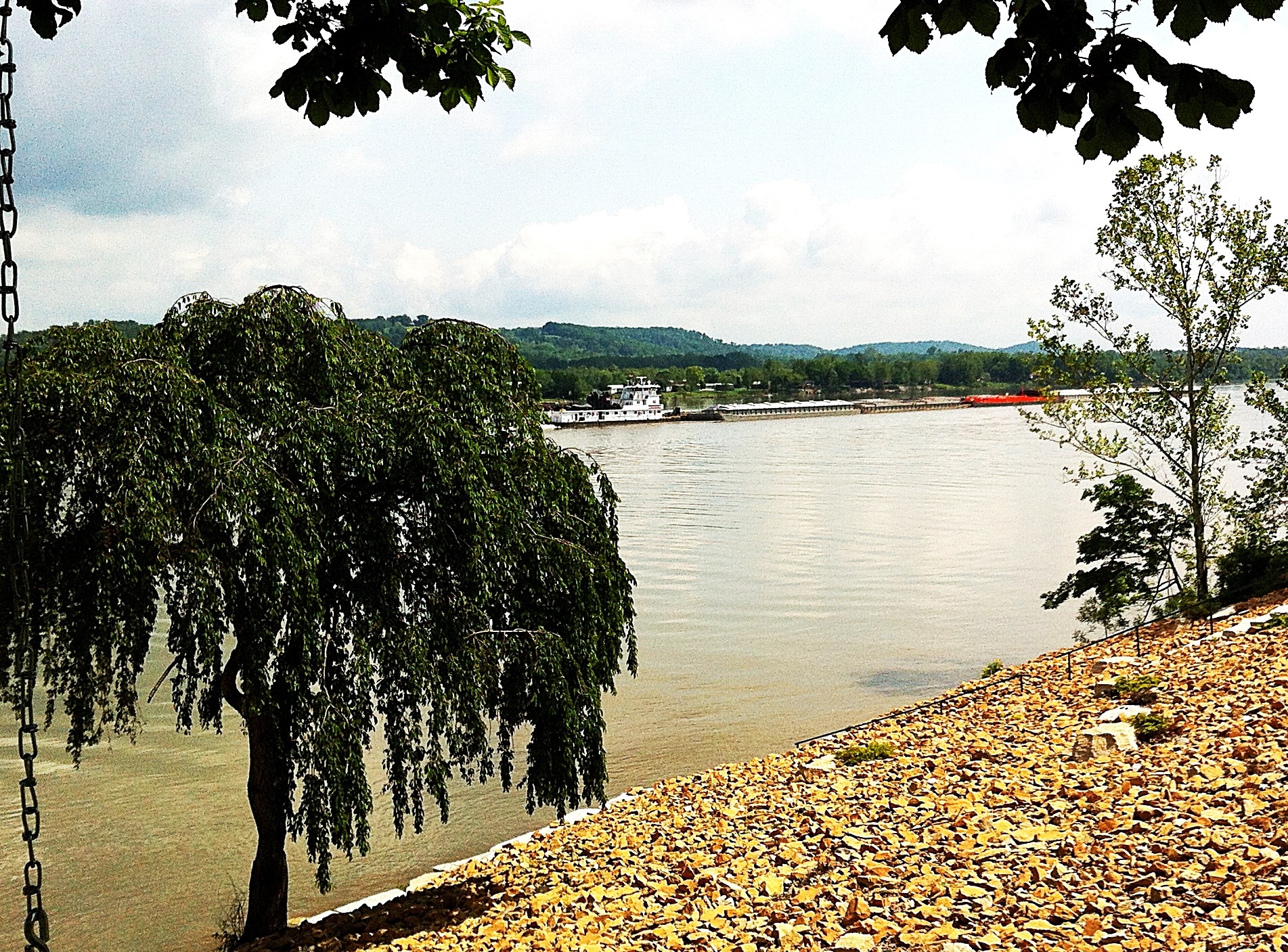
The Ohio Valley barge industry wants to transport fracking wastewater, an addition to the mix of minerals, steel, coal, grain, oil and other bulk materials transported on the Ohio River. Here, a barge moves downriver near Wellsville, Ohio. Photo/Keith Schneider

Last month, while nosing around the new Utica shale gas fields of eastern Ohio, I learned that the Obama administration was preparing to consider a proposal from the U.S. Coast Guard that would allow barge operators to transport wastewater from shale gas fracking operations on inland waterways. Earlier this month the Coast Guard delivered the proposal to the White House Office of Management and Budget. Sometime later this year the agency is likely to make the transport plan available for public review.

Regardless of the specifics, the idea that fracking wastewater ought to be considered a bulk commodity — like coal, gasoline, oil, cement, grain, chemicals and steel — reflects the expanding dimensions of the nation’s shale fields and the growing quantity of the contaminated water that the development produces. The river that very plainly will receive most of the attention in frackwater transport is the Ohio and its upriver tributaries, which drain nearly half of Pennsylvania’s watersheds, and most of eastern Ohio’s.

Thousands of deep shale gas wells are being drilled in both regions. Producing natural gas, and more valuable natural gas liquids, involves blasting the shale with millions of gallons of water mixed with chemicals and sand under extremely high pressure. Some three million to 10 million gallons go down the well. About 20 percent, according to industry technical reports, comes back up. And it’s nasty stuff — saturated with salts and metals and solids.

Water is the shale gas and shale oil industry’s soft underbelly. The companies knew that well before the fracking revolution started. During the early George W. Bush administration Vice President Dick Cheney convened meetings with industry executives who identified the federal Safe Drinking Water Act as an impediment to a swift start to horizontal drilling/fracking technology they believed would alter the nation’s energy outlook. The administration proposed and Congress quietly enacted waivers to the law that allowed the industry to keep the identities of the fracking chemicals secret and bypass permit requirements.

Citizens, though, took notice all over the country. Reports of leaks, groundwater contamination, and health consequences as a result of exposure to wastewater and drilling operations have become numerous. States have been roused to fill some of the safety gaps that the federal government avoided. Wyoming, Texas, and other states require companies to disclose the ingredients in their fracking fluid. Ohio and Pennsylvania issued tougher standards for constructing wells in an effort to prevent damage to drinking water.

The next big area of water concern is the sheer volume of wastewater. A new wing of the oilfield service industry, spurred by public concern, generated tougher standards that are leading to water recycling in Pennsylvania and Ohio. The competition for water during the deep 2011 and 2012 droughts in the interior prompted similar interest in Texas and Colorado for wastewater recycling. Halliburton, the big oilfield service company, is a leader in developing mobile recycling systems that clean up dirty water to a standard that makes it reusable for new frack jobs.

I crossed the path of a mobile recycling plant that Tervita operates for Chesapeake’s frack jobs in eastern Ohio. The plants save water, and reduce truck traffic. Solids separated from the wastes are said to be transported to local licensed dumps, though the Ohio Department of Natural Resources says it doesn’t track such shipments.

Most fracking wastewater is pumped down the hazardous waste injection wells that operate around the country. As to where fracking wastewater might be heading on barges? Probably not upriver on the Ohio. Two years ago Pennsylvania outlawed treating frack wastewater in public water treatment plants.

– Keith Schneider

Frack Or Not To Frack? That’s Just One Question

Thursday, March 28th, 2013

20130328-161007.jpg

At the corner of US 31 and County Line Road in Benzie County, one of the more than 9,000 Antrim Shale natural gas wells drilled in Michigan since the late 1980s. Michigan’s Antrim Shale was among the first natural gas reserves in the U.S. developed from hydrocarbon-bearing shales. Photo/Heather Rousseau

BENZONIA, MI — It’s apparent why a great number of Americans wonder about the risks of fracking and whether states and the federal government ought to shut the technology down. The breakthrough that now enables developers to recover oil and natural gas from hydrocarbon-rich shales 6,000 to 10,000 feet beneath the surface is potentially fraught with danger.

No new technology comes without assorted risks, especially one as environmentally significant and economically powerful as fracking. But along with the risks come benefits. The question is whether the U.S. has the capacity to significantly reduce the threats through regulatory safeguards, or is there one or more aspects of the technology that are so inherently dangerous that fracking should not be allowed at all?

Answering the question involves distinguishing the difference between “potential” and “actual” risks and benefits. On the potential side of the discussion, the risks seem fearsome.

The fracking process blasts millions of gallons of water mixed with chemicals down a well at ultra-high pressure to shatter the rock and release the fuel. Anecdotal evidence, and several instances of contamination confirmed by the federal Environmental Protection Agency, point to a risk that fracking can contaminate freshwater aquifers much closer to the surface. It’s not clear yet how significant that risk is, though the EPA is studying the issue and preparing to issue a definitive report next year.

Public health authorities in Pennsylvania also are starting to study the consequences of fracking to human health, and are focusing on air pollution. Big diesel engines operate at the well sites, and it takes roughly 2,000 truck trips to transport water, fuel, and equipment to each well. Vehicular collisions, moreover, have taken the lives of dozens of truck drivers and motorists in North Dakota and Pennsylvania.

Fracking takes millions of gallons of water at each well and is leading to confrontations over water supply on the Great Plains and desert Southwest. Disposing wastewater and fluids from the process has led to spills in North Dakota and Wyoming. Pumping the wastes down deep disposal wells also has caused small earthquakes in Ohio, Arkansas, and Texas. The concentration of wells in a region, all tied together by new roads, pipeline corridors, and assorted processing and pumping stations, has significant implications for the uses of land, particularly if the development occurs in a forested area like Michigan.

Other potential risks identified by expert panels as varied as the U.S. General Accounting Office and the Society of Petroleum Engineers include the toxicity of the chemicals used in the process, the level of methane (a potent greenhouse gas) that can escape the well as “fugitive” emissions, and the hazards of the drilling process; in China the shale reserves contain high concentrations of hydrogen sulfide, an acutely poisonous gas.

(more…)

U.S. Energy Boom: Reprieve and A Reckoning, Says NYT’s Friedman and ModeShift’s Schneider

Wednesday, August 8th, 2012
North Dakota is producing more than 600,000 barrels of oil daily, second most in the U.S. behind Texas. A tanker truck loads oil aboard a tanker train near Williston, ND. Photo by Keith Schneider

Over the weekend Tom Friedman of the New York Times wrote a good piece, Get it Right on Gas, about the short-term promise and potentially long-term economic and environmental peril prompted by the U.S. energy boom. Friedman’s article made quite a few of the same points I made in March in a ModeShift piece, New American Energy Boom: A Reprieve and a Reckoning.

The Reprieve:

Friedman: “The enormous stores of natural gas that have been locked away in shale deposits across America that we’ve now been able to tap into, thanks to breakthroughs in seismic imaging, horizontal drilling and hydraulic fracturing, or “fracking,” are enabling us to replace much dirtier coal with cleaner gas as the largest source of electricity generation in America. And natural gas may soon be powering cars, trucks and ships as well. This is helping to lower our carbon emissions faster than expected and make us more energy secure. And, if prices stay low, it may enable America to bring back manufacturing that migrated overseas.”

Schneider: “The boom in oil and gas production represents a generation-long economic reprieve for the United States. Almost every  analysis by the U.S. Department of Energy, the U.S. Geological Survey, and by the major oil and gas companies projects that the production trajectory for domestic oil and gas production will steadily increase for 20 years, maybe longer. More than $100 billion annually in capital investments is pouring each year into energy-producing states for exploration and drilling equipment, new pipeline construction, refinery expansions, and for pumps and trucks and transport depots to move fuel to market. Dense pockets of new job growth in oil and gas production, processing, and services have formed in a dozen energy-rich states, helping to lead the U.S. out of the recession.”

The Reckoning:

Friedman: “Natural gas is still a fossil fuel. The good news: It emits only half as much greenhouse gas as coal when combusted and, therefore, contributes only half as much to global warming. The better news: The recent glut has made it inexpensive to deploy. But there is a hidden, long-term, cost: A sustained gas glut could undermine new investments in wind, solar, nuclear and energy efficiency systems — which have zero emissions — and thus keep us addicted to fossil fuels for decades.”

Schneider: “The risks of perpetuating America’s fossil fuel economy are equally momentous, producing a new era of national reckoning. Ample natural gas supplies and low prices are dampening demand for wind, solar, geothermal, and other non-polluting sources of energy.  One result is that clean energy manufacturing plants are closing in the Midwest, Rocky Mountain states, and California. Two solar producers in Michigan, for instance, have shut their doors in the last year.

Public investment in non-fossil fuel innovation is uncertain. It’s not at all clear yet whether Congress will renew the tax credits that expire later this year and that have spurred wind and solar use and manufacturing.

If the U.S. spends another generation in an oil and gas coma, choosing not to pursue alternatives with the fierce commitment to success that propelled the Apollo program to land a man on the moon, it will end up even more economically stretched and politically unstable than it is today.”

See more of my reporting on the U.S. energy boom here.

– Keith Schneider

The U.S. Energy Boom and Ohio in The New York Times

Tuesday, June 5th, 2012

20120605-190549.jpg

My interest in the Ohio River Valley, as readers of ModeShift well know, is keen. Today, the New York Times published my latest piece about the billions being invested in mineral leasing for oil and gas drilling.

Tomorrow, in the NYT Business section, is another piece I did on Cincinnati’s improved economy and surging riverfront development.

You may recall this article on Owensboro Kentucky’s improved prospects for the NYT late last year.

I did this piece in April on Ohio’s soaring steel industry in the NYT:

And I laid out some of my basic thoughts about what’s happening in the six-state, 981-mile river valley here on ModeShift a few weeks ago:

My clear sense and reporting shows a region critical to the American nation and U.S. economy for 250 years that is recovering fast from two generations of disinvestment and decay. The entire river valley is emerging with a 21st economy that is based on:

1. Out of the box municipal tax increases and other urban investment policies that are improving the region’s biggest downtowns, all of which are growing again with new residents and businesses.

2. Striking gains in the fortunes of the higher education and medical sectors that have turned out to be the largest, or among the largest employers in the big and small cities.

3. Environmental protection and conservation gains that have improved air and water quality and conserved urban riverfronts and wildlands. The Ohio River Valley is impressively beautiful.

4. Global trade in farm commodity and fossil energy markets that have fostered regional booms in agriculture and oil and gas development that look to endure for years because of Asia’s (read China here) steadily rising demand.

I’ll be looking at China’s influence on the Ohio River Valley later this week.

– Keith Schneider

Behind New Generation Mineral Leases: More Money, Less Hazards

Friday, May 11th, 2012

Arthur and Sharon Stottsberry in Marietta, Ohio a day before receiving a $280,000 mineral lease bonus check from Eclipse Energy. Photo/Keith Schneider

CALDWELL, Ohio — The day before they received a $280,000 check for leasing their oil and gas development rights to Eclipse Energy, Arthur and Sharon Stottsberry stopped in Marietta to remind their attorney that they had almost an acre more to lease. I caught up with the Stottsberrys as they were leaving Jennifer Garrison’s office, as ebullient and keyed up as a retired senior couple from this part of southeastern Ohio is likely to get at this stage.

“Saturday morning we’ll have that check in hand,” said Mrs. Stottsberry. “And then we’ll believe it actually happened. We haven’t planned much about what to do. But when the check comes we’ll plan. The most important thing is I want to make sure my grandkids do well.”

As she described the mix of tempered elation and modest disorientation that comes with a financial windfall, Mr. Stottsberry stood quietly by his wife’s side clutching the lease agreement that made much of the couple’s new prosperity possible. What’s more, that same agreement also contains enforceable safeguards for their water.

Jennifer Garrison, former Democratic state representative from Marietta, and the lead attorney developing mineral leases that ensure wealth and minimize environmental risk. Photo/Keith Schneider

The 24-page contract, largely designed and negotiated by Garrison, is a manifest of financial and environmental protection details that is pushing the old business of leasing oil and gas drilling rights into new legal and regulatory territory.

Until very recently most oil and gas leases in Ohio were a few pages long, spelling out standard royalty rates, modest bonus payments per acre of leased minerals, and no protections for water and land. They were most often hammered out by energy companies working one-on-one with mineral owners, many of them unskilled in the back and forth of negotiation, and unprepared emotionally to press for the best deal.

Over the last year, though, eastern and southeastern Ohio have emerged as a new stage in the shale  gas and shale oil production boom that has engulfed at least a dozen other states across the country. America’s deep shales are yielding a bonanza of oil and gas that is rewriting what the United States thought it knew about energy supplies. And it’s prompting a fresh reckoning with the potential hazards of hydrocarbon development, especially water supply and contamination.

Ohio’s deep Marcellus and Utica shales are said by state and federal geologists to contain trillions of cubic feet of gas and billions of barrels of oil. The early production logs in Ohio indicate that Utica shale wells are capable of producing millions of cubic feet of gas and hundreds of barrels of oil a day.

The mineral leases that Garrison negotiates with energy companies reflect the high public expectations about financial returns from Ohio’s new  energy fields. Her clients are receiving up to $5,250 an acre in bonus payments for a five-year lease. They also receive 20 percent royalties on gas and oil production. The lease signed by the Stottsberrys is one of two that Garrison has negotiated on behalf of nearly 300 clients who own 13,000 acres of mineral rights in two southeastern Ohio counties.

Still, drilling for energy that lies in solid rock about a mile beneath the surface takes millions of gallons of water injected into wells to fracture the formations and release gas and oil. Across the Ohio River, in the four-year-old shale gas fields of Pennsylvania and West Virginia, landowners have reported instances of water contamination near wells that have been “hydrofractured.” State regulators and the federal Environmental Protection Agency are investigating the causes. New state and federal regulations to protect water and air are starting to take effect in Texas, North Dakota, Pennsylvania and other states where shale oil and gas production is soaring.

Garrison’s clients, among them the Stottsberrys,  heard about the contamination incidents and expressed considerable resolve to prevent such damage on their land. The result is that her leases contain provisions for testing water before and after drilling occurs to make sure none of the chemicals used in the production process have contaminated drinking water. The leases also bar energy companies from drawing water for fracking from any water source on the leaseholders land. If there is a problem with the water, moreover, energy companies are required to address it immediately and provide a fresh water supply to the landowner. These provisions go well beyond existing Ohio regulations.

“My job is to represent landowners,” Garrison told me. “The mineral lease is the law of the land. We try to help landowners get what they want in their leases. And they wanted to make sure their water was safe.”

– Keith Schneider


Anadarko is probing Ohio's gas-bearing Utica shale with this rig in Noble County. Photo/Keith Schneider

China Demand For Food and Energy Is Raising Prices and Consumer Ire in U.S.

Friday, April 27th, 2012

One of the world's largest open pit coal mines, Daqing Shan, east of Baotou, Inner Mongolia. Photo/Keith Schneider

Dude! What’s up with the law of supply and demand?

The United States Department of Agriculture projected earlier this month that national harvests of wheat, corn, and soybeans — the foundation ingredients of the have-it-your-way American diet — will be strong this year. But prices for bread, meat, and milk at my local Glen’s store here in Frankfort, Michigan are going up by the week.

Meanwhile, the Energy Information Administration reports that U.S. oil consumption is 10 percent lower than it was seven years ago. Net oil imports now make up less than 45 percent of the nation’s petroleum consumption, the lowest level in nearly 20 years. In other words we’re using less, and importing much less. But the BP station in town is selling gasoline for nearly $4 a gallon.

Guess what? Without some very sharp departures in our strategy of feeding and fueling ourselves, there ain’t a lot we can do about it. Reason. Rising commodity and energy prices are more prima facie evidence of America’s diminishing influence in global markets, and the rise of — guess who? — China.

Though we clearly don’t like it, the hard truth is that China is writing the new law of American supply and demand.

Going to China, Again
Next month, along with colleagues at Circle of Blue, I make my fifth extended trip in 20 months to report on the confrontation between energy, food, and water in the world’s largest nation, largest energy consumer, largest grain producer, and second largest economy. With each trip it becomes steadily clearer that China has no intention other than serving the goal of its rocket-ride economic growth. And that means reaching deep into its own resource base, and the markets of every other nation on Earth, including the United States. Result: Americans complain about rising prices and national drift, and seriously consider electing candidates for president who are anti-science and anti-education.

Meanwhile China constructs a sophisticated 21st century powerhouse economy.

Here’s what some of that looks like in numbers. Two years ago, driven by China’s demand for petroleum, Asia passed North America as the world’s biggest oil consumer, according to the EIA.  Consumption in Asia grew by 146 percent from 1980 to 2010. Asia now consumes 29 percent of the world’s petroleum as opposed to 27 percent in North America. In 2000, North American demand was 31 percent of world consumption, Asia 26 percent.

Here’s what it looks like in oil, gas, and coal export projects to serve China’s energy demand:  Kinder Morgan Energy Partners LP, a big energy transport company, said earlier this year that it wanted to spend $5 billion to double the size of its Trans Mountain pipeline that carries tar sands oil from northern Alberta, Canada to Vancouver and Washington’s Puget Sound. Enbridge, a Canadian transport company, wants to build another pipeline of similar size to carry tar sands oil to a Pacific loading facility in Kitmat, British Columbia.

Both projects are essentially meant to serve China, which invested $15.7 billion from April 2010 to January 2012 in tar sands oil projects, part of a huge industrial landscape where tar sands mining and processing now yields 1.6 billion barrels of synthetic petroleum a day. Production is expected to nearly double to 3 million barrels a day by 2020.

Similarly in the United States, according to the EIA, China has invested more than $4 billion in companies developing and transporting oil and natural gas from North Dakota, Pennsylvania, Colorado, and other states developing deep oil and gas-bearing shales.

Meanwhile, Oregon’s Governor John Kitzhaber asked the federal government earlier this month to conduct an environmental study of projects to ship strip-mined coal from Montana and Wyoming to China through ports in Oregon and Washington. Burlington Northern would be a big beneficiary of any contracts that transport 150 million tons of western coal to be burned for electricity in coastal Chinese cities.

China, by the way, also is sponsoring the same kind of coal mining and transport project in Australia, which is building new port facilities to ship over 100 million tons of coal a year, according to a new report from Circle of Blue.

Behind the big plans for coal imports lies China’s overwhelming demand, which is expected to reach over 4 billion metric tons a year by the end of the decade. In 2010, the country produced 3 billion metric tons of coal annually, more than three times higher than U.S. production, which is falling due to competition from lower priced and cleaner natural gas.

China’s concerns about water supply and its increasing demand for grain also has helped to prompt a huge trade in farmland around the world. According to GRAIN, a respected Barcelona-based research organization that tracks global land sales, two of the largest companies involved in buying farmland are Chinese, the Chongqing Grain Group and the Beidahuang Group.  Last year, for instance, Beidahuang spent $1.5 billion for control of 330,000 hectares in Patagonia to supply China with soybeans and corn. GRAIN also reported that in 2010 Chongqing spent $300 million for 100,000 hectares of Brazil’s farmland to produce soybeans.

An Eyewitness View of China’s Energy Thirst
Here’s what China’s energy demand looks like on the ground:

In all of China, there are few places where the extravagance of the confrontation between rising demand for energy and food, and the country’s steadily diminishing reserves of freshwater are more visible than Baotou, Inner Mongolia. The fast growing industrial city of 1.5 million, which sits on the northern bank of the Yellow River, owes its existence to the close ties between ample coal reserves, access to water, and thousands of farmers who ensure there is enough to eat.

There is no randomness to these relationships. Coal, produced in the nearby mountains, powers the Baotou Steel Group’s 49-square-kilometer plant, which employs 50,000 people and manufactures 10 million metric tons of steel products a year. New water-saving technology enables the plant to recycle 98 percent of its process water in a region that receives mere millimeters of rain a year.

One of six blast furnaces at the Baotou steel works. Photo/Keith Schneider

More water-efficient farm practices, due to the competition for water that farmers are steadily losing to energy producers, keep food production high enough in the Yellow River basin.

But while these ties are not random, neither are they firm and secure. Baotou’s population growth, and its surging economy are putting enormous pressure on energy supplies and farm production – the largest consumers of water – in a region that is steadily losing moisture.

Coal producers and utilities, the most politically powerful industrial sectors in the Yellow River basin, negotiate agreements that assure they have adequate water from the river for mining, processing, and cooling.

Steel company executives, mindful of the persistent drought in the region and the river’s declining flow, keep a close eye on the Yellow River water gauges to assure themselves they have enough to run the plant. Farmers plant and sow their crops in irrigated fields that year by year receive less water.  And the Yellow River itself transports much less water than it did in 2000. In short, the converging trend lines – rising demand for energy and food, declining quantities of fresh water – are challenging the durability of Baotou’s new prosperity and undermining China’s economic security as well.

The question for China and the rest of the world is how aggressively China will continue to pursue its rapid economic growth, and thus its rapacious national and global campaign for resources? One answer lies east of Baotou, past thousands of plastic-sheeted vegetable greenhouses and kilometer after kilometer of brittle-brown farm fields,  where hundreds of coal trucks swarm the entrance to the Daqing Shan open-pit coal mine, one of the largest in the world.

 A Huge Open Pit Mine
On one side of a row of booths, manned day and night by young inspectors, a crush of empty coal-hauling trucks, black and belching diesel fumes, inch steadily forward like a pod of Emperor penguins shifting to a new feeding ground.

On the other side of the booths an even larger pack of loaded trucks, each carrying 80 metric tons of coal, lurch and squeal in a formation so tight that front and rear bumpers nearly touch.

One by one, in a frenzy of honking horns and growling diesel engines, trucks pass through the gates. Some head empty, single file, up a menacing narrow road to the mine. The others, so fully loaded that chunks of coal tumble to the ground, make their way to a processing station that is reachable on a two-lane highway so blasted by their weight that the pavement is all pitted buckles and cracked swales.

Pushing men and machines in the Daqing Shan coal mine. Photo/Keith Schneider

More than 1,000 fully-loaded trucks pass the weigh station daily, 82,000 metric tons every 24 hours, more than 30 million metric tons a year. Along with the truck drivers, hundreds of other men work in the mine, which is so deep that the yellow-painted mining equipment at the bottom looks like grubs digging in the dirt.  Along the route up and beside the coal-dust roads in the mine, broken down trucks lie like dead beasts—tipped over, collapsed from fractured axles, charred from brake fires.

By one measure, Daqing Shan is a stunning display of China’s determination to fuel its modernization. By another measure, the mine—which stretches miles in every direction—is a grim tableau of just how torturous fueling China’s surge to global economic influence has become.

In 2010, China produced more than three billion metric tons of coal from existing mines that are nearing capacity. More than 80,000 coal trains a day haul a total of 1.8 billion metric tons of coal annually on China’s railways, according to national records. The railways are choked with coal now.

Trucks, as a result, now carry much of the rest of the country’s coal—more than one billion metric tons—from northern mines, causing traffic snarls that take hours to clear and turning paved roads to deeply rutted and barely passable trails. Even though Daqing Shan contains hundreds of millions of tons, the limit of how much coal can be transported to market each year is close to being reached.

– Keith Schneider


U.S. Energy Boom Lifts Ohio’s Steel Industry: Latest New York Times Article

Wednesday, April 25th, 2012

Long billets of steel the color of the sun are poured, turned, and pounded in a fury of smoke and flame at the Timken steel plant in Canton. Photo/Keith Schneider

CANTON, Oh. – Orders for steel from domestic and export markets plunged so low in May 2009 that the Timken Company’s mill here on Faircrest Street operated for just four days that month. Nearly three years later, with demand for steel soaring and the Faircrest mill operating around the clock, Timken started construction in early March on a $200 million, 83,000-square-foot addition to boost the plant’s production.

Just as Ohio’s presidential election has accurately predicted the winner since Lyndon Johnson was in the Oval Office, the condition of Ohio’s steel sector is a useful state and national economic indicator. The Ohio steel industry, led by a drilling boom in the gas and oil industry, and reviving demand for cars and light trucks, is growing again.

“The need for specialty steel, much of it for oil and natural gas producers, is high in the United States and around the world. We see demand in that market continuing to be healthy for quite some time,” said Salvatore J. Miraglia Jr., the president of Timken’s steel group.

Last month I visited Ohio to report for The New York Times on the consequences of the oil and gas boom to Ohio’s steel industry. This article is the draft that I sent the Times, which published the article today. 

Timken’s new building, which will rise 26-stories from its base 80-feet below the surface, will sharply expand the plant’s capacity to cast steel billets to be made into parts for drilling platforms, heavy equipment, and other oil and gas industry tools. Two other new buildings also are underway at the 27-year-old mill – a  $35 million, 13,000-square -foot addition to house a new forge press, and a $25 million 14,600-square-foot installation for adding to molten metal the minerals and other compounds that add strength to finished steel.

Across Ohio, other steel manufacturers also are expanding operations. In October United States Steel opened a $100 million, 325,000-square-foot mill at its Lorain plant to manufacture steel pipe for the drilling industry. Vallourec & Mannesmann, a French manufacturing company, is completing a new $650 million, 1.1 million-square-foot steel pipe mill in Youngstown, and is building a separate $57 million, 200,000-square-foot mill nearby to add threads to the pipes. Both plants serve the oil and gas sector.

United States Steel’s Lorain Plant
United States Steel is collaborating with its Japan-based partner, Kobe Steel, to build a $400 million, 454,000-square-foot addition to the PRO-TEC plant in Leipsic, south of Toledo, to serve the growing market for high-tensile lightweight steel used by makers of high-mileage, fuel-efficient vehicles.

United States Steel's new Lorain pipe finishing plant in Ohio. Photo/Keith Schneider

“We haven’t had this kind of expansion in steel since the 1980s,” added Eric Burkland, the president of the Ohio Manufacturers’ Association. “It’s a tremendous turnaround.”

All together, the new production projects account for nearly $1.5 billion in spending on construction and equipment in Ohio’s steel industry, and over 2 million square feet of manufacturing space. When all the projects are completed later this year and next, the four plants alone will add roughly 630 new manufacturing jobs and are likely to help shrink Ohio’s jobless rate, which was 7.5 percent in March. That is below the 8.2 percent U.S. rate, and down from a statewide peak of 10.6 percent in July 2009.

The projects also will help Ohio’s steel sector, the nation’s second largest behind Indiana, to exceed the annual production — 14 million to 15 million tons – achieved in the years prior to 2009 when production dropped to 4.8 million tons, and investment in plants was just $166 million, according to the Ohio Steel Council, a state trade group.

One reason for the industry’s revival, said Mr. Burkland, was anticipated: the recovery of the auto industry. “People feel more confident and they are buying cars again,” he said.

Auto Industry Revives
The national auto sector, a big buyer of steel, is expected this year to deliver 13.8 million cars and light trucks, and could reach 14 million to 15 million deliveries by 2014, according to monthly sale figures and industry estimates. Industry sales peaked at 17 million in 2005, but plunged to 10.9 million sales in 2009 in the heart of the Great Recession. The Ohio Department of Development, in a February 2011 report, said 72,000 people are employed in the state’s car and light truck vehicle assembly plants, and dozens of parts manufacturing plants.

But the huge surge in oil and gas drilling in the U.S. and the swift rise in the market for steel pipes and oilfield equipment, has come as a surprise. The clanging of long lengths of steel pipes being heated and cooled, pounded and straightened inside United States Steel’s Lorain Tubular Operation’s new pipe finishing plant provides a rare inside view of the industry’s revival in Ohio.

The bright lights and charged furnaces, the powerful hiss of cold water on hot steel, and the jarring din that makes ear plugs mandatory safety equipment, describe a company and an industry leveraging investments few thought possible only a few years ago.

“We’re shipping pipe to drillling operations in Pennsylvania, North Dakota, Texas,. China. All over the country. All over the world,” said John Wilkinson, the plant’s interim manager. “Some of it is being used here in Ohio.”

New production practices have made it practical to tap the dense and deep hydrocarbon-rich shales that lie beneath much of the Great Plains, Gulf Coast, Rocky Mountain West, and mid-Atlantic states, and they are being tapped at a frantic pace. Last year, according to the Department of Energy’s Energy Information Administration, the number of oil and gas drilling rigs in operation across the U.S. reached an average of 1,876 a month. That is the highest rig count since 2008. More than 45,000 oil and gas wells were drilled in the U.S. in 2011, and a third of the nation’s natural gas is generated from shale.

Beneath 17,000 square miles of eastern and central Ohio lie two layers of deep gas and oil-bearing shale, the Marcellus and the Utica. Some $3 billion, according to the Ohio Department of Natural Resources, is being spent in Ohio now on drilling and production, processing, transport, steel plant expansions and other supply chain manufacturing to serve the fossil fuel sector.

Lots of Steel Drilling Pipe
It takes a lot of steel to tap reserves that generally lie a mile or more beneath the surface. Each of the 4.5 -inch diameter, 50-foot long drilling pipes rolling off the production line in Lorain weighs 850 pounds. Drilling vertically to the depth of the shale in Ohio, and horizontally through it to tap gas and oil typically takes 2,000 to 2,500 lengths of pipe or some 100 tons of steel.  As of April 8, Ohio had issued 207 shale drilling permits. Early production results indicate Utica wells are capable of producing millions of cubic feet of gas and 500 barrels of oil daily.

Thousands more deep shale wells are expected in Ohio, perhaps as many as 1,600 new wells a year by 2015, according to the Ohio Oil and Gas Energy Education Program, an industry financed research and education group.

David Mustine, the general manager of JobsOhio, a state economic development group, points out that natural gas is a favored fuel for heating steel and that the new supplies are lowering prices, and saving steel plants millions of dollars a years. “Drilling for natural gas has given Ohio steel producers a larger market for their products and a competitive advantage on cost,” said Mr. Mustine.

In Canton, Timken executives expect to complete all of the Faircrest mill’s additions by 2014, and production will increase to 925,000 tons annually from 750,000 tons this year.  Mr. Miraglia said 425 people work at the plant and that state-of-the-art automation in the new buildings will likely mean adding few if any new jobs.  Behind  him long billets of steel the color of the sun were being poured, turned, and pounded in a fury of smoke and flame. “This is the largest investment made in this plant since we built it,” Mr. Miraglia said.

– Keith Schneider


Timken is expandiing production at its Faircrest Mill in Canton. Photo/Keith Schneider


The Global Fossil Energy Boom: Perspective From China

Tuesday, April 17th, 2012

China's energy demand is soaring to support massive new development, like this apartment complex under construction in Xi'an, a city of 8.5 million and the capital of Shaanxi Province. Photo/Keith Schneider

All those natural gas wells that are popping up by the thousands across the United States — they’re starting to appear in China, too. The global fossil energy boom, which in China has mostly meant soaring production of coal, is now beginning to include natural gas. And American and European multinationals are providing financing, equipment, and technical assistance.

The U.S. Energy Information Administration projects that China’s recoverable shale gas resources total 36 trillion cubic meters, or all but 9.5 percent of the shale gas reserves in Asia. China’s Ministry of Land Resources puts the reserves at 25 trillion cubic meters.

Given those resources, and the capacity to develop them, Chinese authorities are intent on doubling natural gas production over the next three years, boosting the fuel from 4 percent of China’s energy to 8 percent, according to the central government’s most recent five-year plan.

According to Ksenia Kushkina, a researcher at the Russian Academy of Sciences who made a presentation in Washington earlier this month, Shell and PetroChina completed the first horizontal well in Sichuan Province, in southwest China, in April 2011. The two companies drilled a dozen more since then, and plan 20 to 25 more wells in the field outside Chengdu. Exxon/Mobil and Sinopec completed a well in Hunan Province in January. Hess and Sinochem are working in Anhui Province. Dart Energy and CBM Henan have a joint agreement to explore for gas reserves in Henan Province.

Pete Marsters in Chengdu in April 2011. Photo/Keith Schneider

Pete Marsters, a colleague and friend who’s studying in Chengdu, is closely following the development of shale gas resources in Sichuan. He sent this assessment yesterday: “What is going on now in shale is a test phase. China is setting up a lot of test wells in a lot of shale blocks (Sichuan, Anhui, Jiangsu, Zhejiang, among others) to, in my opinion, see which will be the easiest to bring to scale commercially.

“There are still a lot of questions to be answered before the large-scale feasibility of shale in China is determined. The first of which is economics.  So far,  wells here cost more than double those in the U.S. due to supply chain issues, newness of the industry in China, and the difficult nature of geology here (much deeper and more complex shales). Additionally, the ultimate productivity of Chinese shales is still up in the air.

“Then there are the water issues. At this stage and specifically in Sichuan, water doesn’t seem to be the main hurdle as resources are relatively plentiful. A large portion of China’s shale, though, is in extremely dry areas. This will be a future issue once the “easier” shales have been successfully tapped.  There is a lot of money for foreign firms to come here, share technology, and help assess China’s shale potential. They are going gangbusters to do it (Chevron,Shell, Dart, Total, EOG, etc.).”

– Keith Schneider

Global Shale Gas Reserves Are Huge Says Energy Department

Monday, April 16th, 2012

Next to North America, Asia has the largest shale gas resources in the world, led by China's apparently immense reserves.

A year ago, while touring and speaking in China, I landed for a day in Chengdu to meet with a young official at the U.S. Consulate and tour one of China’s rare organic farms. At breakfast in one of the city’s newest hotels I noticed a group of young American men, tall and robust in a Midwestern sort of way, and invited myself to their table. They were members of an executive team, dispatched from Caterpillar’s corporate headquarters in Peoria, Illinois to sell American-made construction and mining equipment to the first generation developers of China’s deep shale gas resources. Outside Chengdu, in Sichuan Province, said one of the men, Royal Dutch Shell is working with U.S. Energy Department technical experts to show the Chinese how to tap the shale gas reserves in an 81,000-square-mile basin. Exxon is working with provincial authorities to tap reserves in regions in central and western China.

I already knew that bit of information. And I didn’t learn much more. After introducing myself as a journalist from Circle of Blue, a Michigan-based news and science organization specializing in coverage of water, food, and energy issues, the table quickly emptied.

In the months since, though, new data is making it into the public realm that describes just how much natural gas — and oil — is contained in shale in China and in other nations, and just how intently the world’s developing and industrialized nations are going after it. One measure of the new riches is Caterpillar’s bottom line. Last year the company had record revenues of $60.13 billion, 41 percent higher than sales in 2010. Profits were $4.93 billion, up 83 percent from 2010. This year, the company projects its total revenue could reach $72 billion.

Caterpillar’s prospects for serving the energy industry are likely to remain keen for decades. In its latest assessment, the Energy Information Administration, a research unit of the U.S. Energy Department, projects that Asia’s shale gas reserves total 39.8 trillion cubic meters, second only to the 45.7 trillion cubic meters that the EIA says are contained in North American shale reserves. In all, the agency says, nearly 180 trillion cubic meters of recoverable shale gas reserves exist around the world, or a 60-year supply at current levels of use. In 2010, the world consumed about 3.1 trillion cubic feet of natural gas, about 20 percent of that in the U.S.

Whether all of that gas can be tapped is a big issue. The biggest impediment for the time being is water. Just as in the U.S. and Canada, the centers of shale gas development, each of the wells must be hydrofracked using millions of gallons of water treated with an alphabet soup of chemicals. Moreover, much of the water used to pulverize the shale to open the gas-bearing cracks must be brought to the surface. That water is substantially contaminated and poses a serious pollution threat. In the U.S., wastewater from fracked wells is generally disposed in deepwater injection wells. In China, engineers are considering treating and recycling fracked wastewater because much of China’s shale gas reserves lie beneath the desert provinces of the north and west, where water already is scarce and confrontations for the available supply already exist between the country’s coal sector, farmers, and cities.

Still, China is intent on pursuing its own “all of the above” energy strategy to fuel rapid economic growth. It’s the global leader in wind, solar, and hydro development. It’s the world leader in coal production for power and chemicals. And it is planning to more than double its natural gas production by 2035, principally from developing the country’s shale gas reserves.

China also is gathering its financial might to invest in U.S. shale gas and shale oil plays, where it is learning the production practices that have produced a fossil energy boom in North America. Since 2008, and with increasing focus in recent years, China and other foreign investors have poured almost $25 billion into American shale oil and gas development, according to the Energy Information Administration.

– Keith Schneider

Major foreign investors in U.S. shale gas and oil development.

Fossil Fuel Boom Is One of Several Trends Leading Ohio River Cities Back To Economic Relevance

Thursday, April 5th, 2012
Gas drilling, fossil fuel boom, upper Ohio River, rust belt

After decades of job loss, income erosion, and industrial obsolescence, the cities and states of the Ohio River valley are leading an economic revival. Here the river flows near New Martinsville, West Virginia. Photo/Heather Rousseau

Thomas Jefferson once said, ”The Ohio is the most beautiful river on earth. Its current gentle, waters clear, and bosom smooth and unbroken by rocks and rapids, a single instance only excepted.”

Downriver from Louisville, Kentucky, where the 1,000-mile long Ohio River reaches its widest points, and the mirroring waters slip by miles of unbroken hardwood forests, it’s possible to witness some of the very same beauty that inspired Jefferson.

The Ohio is much in my mind of late. A year ago I spent time in Wellsville, Ohio, south of Pittsburgh, where a West Coast developer proposed a multi-billion dollar industrial plant to convert coal to liquid fuels. Last summer, I spent weeks in Owensboro, Kentucky to report on the mid-sized river city’s authentic work to understand and react surprisingly well to the new market trends of the 21st century. I visited Louisville, one of the largest Ohio River cities, where Mayor Greg Fisher is leading a downtown reconstruction program, and the city just joined with Bruce Katz and the Brookings Institution’s peerless metropolitan research and planning group to foster a new economic strategy for the city and the region.

Change in total number of manufacturing jobs in metropolitan areas, 1954-2002. Maroon=greater than 58% loss Red=43%-56% loss  Pink=31%-43.2% loss Yellow=8.7%-29.1% loss United States average: 8.65% loss.

Last month I was in Sardis, Ohio and New Martinsville, West Virginia to report on the massing industrialization by the energy industry to drill the drill the deep shales on the Ohio side of the river for oil and gas. The Pennsylvania side has been a heavy drilling zone for four years, which is one of the reasons that the February unemployment rate in the Pittsburgh metropolitan region was 6.7 percent. That’s nearly two percentage points below the national average.

Cincinnati is redeveloping its historic Over-the-Rhine neighborhood, fostering the development of state of the art marketing and communications enterprises, and is building a streetcar line.

What a change in direction. For two decades at the end of the 20th century, the cities and states of the upper Ohio River were the pitted and marked buckle of the nation’s rust belt. The map at right illustrates the obsolescence and job loss that separated Cleveland, Pittsburgh, Wheeling and the smaller cities along the upper Ohio from the rest of the nation. Downstream, Cincinnati and Louisville also slipped into a generation or more of disinvestment and downtown decay.

That is no longer the case in Pittsburgh, now a showcase of research and innovation; Louisville, with its beautiful historic neighborhoods and great downtown university that make it one of the sweetest places to live in the country, or Cincinnati, a laboratory of social innovation. Further downriver, the soaring commodity markets for farm products are elevating the moods of Indiana and Illinois river cities. Even the wrecked river towns of Ohio and West Virginia, where steel and chemical plants fell victim to globalization, are finding themselves engulfed by an energy boom that is bringing $billions in new investment in energy processing, production, and transport infrastructure.

The Ohio River has few equals as a metaphor for the nation’s condition or spirit. During days of settlement it was the water highway, used by millions of Americans, to migrate into the Midwest and West. During slavery, it was the last physical barrier that brave men and women crossed to freedom. In the mid-20th century, it generated the energy, made the steel, built the cars, and supported the metropolitan regions that supported America’s drive-through economy of suburban convenience. Its cleanup in the 1980s and 1990s heralded the new era of environmental economics, especially those factors associated with metropolitan redevelopment. And its industrial decay was a foreshadowing of the immense transition and costs of keeping pace with the rest of the world, particularly Asia.

History, as viewed by most Americans, is one or two straight story lines in which a central character working with a select group of leaders makes the right choices and everything is closed so neatly. In reality, history is more like a slow-moving weather system in which people and institutions are often blown about like leaves in a storm. The revival of the Ohio River Valley today tells us something important about the people and river communities finding new paths to well-being, and about the country. Perhaps we are doing more as a nation than we give ourselves credit for, and certainly that appears to be the case in this pummeled American river valley, to understand the influence of  events and the need to establish a more dynamic foundation for making and acting on big ideas.

– Keith Schneider

Kentucky BioProcessing, a high-tech producer of plant-based pharmaceuticals, in Owensboro, Kentucky. Photo/Craig Schneider, Power Creative