Archive for the ‘China Water, Energy, Food’ Category

Hope For China’s Deep Shale Gas Development Impeded by Technical Reality

Thursday, January 10th, 2013

20130110-123939.jpg

Wei-201H3, the first deep shale, horizontally-drilled, hydrofracked natural gas well in China. Photo/Keith Schneider

Atmospheric concentrations of carbon dioxide are climbing, in large measure because of China’s production and combustion of more than 3 billion metric tons of coal annually, or nearly four times as much coal as the United States produces and burns. One of the solutions — though it is attracting rigorous opposition in the U.S. — is replacing coal with cleaner-burning natural gas.

Even with protests over fracking, natural gas is replacing coal in the U.S., where technical advances in drilling and production technology are yielding a motherlode of oil and gas from the country’s deep shale reserves.

With technical assistance from the Obama administration, China is busy probing its deep shale natural gas reserves, too. Last year I investigated how well Chinese shale gas development was proceeding, spending more than a week in Sichuan Province, where much of the new development is occurring. My conclusion: China’s hope to replace some of its climate-changing coal production with natural gas is just that, a big hope. Impediments abound. My report is part of Circle of Blue’s path-breaking Choke Point: China project.

XINCHANGZHEN, China— Liu Zhongqi’s mud and brick home is set in a cluster of hillside houses in the village of Lao Chang, a serene half-circle of settlement on the west side of this misty Sichuan Province valley.

A few steps away is a flooded paddy, about half the size of an American front lawn, where Liu raises rice. Next to that is a slightly larger and deeper pond where he produces fish. And just beyond Liu’s fishpond is something very new here and potentially momentous: Wei-201H3, one of China’s first horizontally drilled and hydro-fracked deep shale natural gas well.

The completion of Wei-201H3 in January 2012 — and the earlier development of two other deep shale wells, drilled within a half-kilometer of Liu’s home — introduced more than the sounds of diesel engines and other industrial dissonance. The new wells, Lao Chang residents told Circle of Blue, have wrecked the pastoral iconography of this valley, a place where repetition and water wove together a centuries-old rural mosaic of green fields and dark ponds.

“They came here one day,” Liu said. “It’s been hard. Very hard.”

The same can be said for China’s nascent shale gas industry. In November 2009, U.S. President Barack Obama and Chinese President Hu Jintao signed a bilateral agreement to deploy U.S. expertise to develop China’s deep shale gas reserves and Chinese capital to finance the much more mature American shale gas sector. The bilateral pact, formalized in a Beijing ceremony that attracted global media attention, also spurred Chinese and Western energy companies to develop partnerships and dispatch crews and rigs to drill experimental deep shale natural gas wells in bucolic and densely populated Sichuan valleys like this one.

The goal here — and in half a dozen other energy-rich provinces — is two fold:

1. Reach a national production target of 6.5 billion cubic meters (229 billion cubic feet) of shale gas by 2015.

2. Duplicate the American shale gas boom.

The hope is that by increasing shale gas production, China can begin to wean itself off of coal, as the United States has begun to do. Since 2005, tens of thousands of U.S. deep shale gas wells, drilled in a dozen states, have driven U.S. energy costs down, fueled manufacturing job growth, reduced reliance on coal as a fuel source for generating electricity, and helped U.S. climate-changing carbon emissions to drop to the lowest levels in a generation.

“We’re just starting to understand what we need to develop shale gas,” said Zhang Mi, chairman and president of the HongHua Group, a manufacturer of drilling rigs based in Chengdu, a city of 14 million residents about 140 kilometers (90 miles) north of Lao Chang . “Exploration is in the experimental stage. From my perspective, Sichuan is China’s Texas for shale gas development.”

But many of Sichuan’s field engineers, analysts, industry executive, and resource managers say there is convincing evidence that China’s shale gas industry is developing at a much slower rate than either Chinese or American leadership had anticipated — in other words, it is hard to see how China expects to even come close to meeting its 2015 production goal. China’s shale gas sector is buffeted by uncertainty about the quality of China’s shale reserves, concerns about scarce freshwater supplies, competition from other energy sources, the potential safety threats posed by a byproduct poison gas, and emerging civic distrust. As a result shale gas development has yet to move any faster than a very slow crawl.

See the entire article here at Circle of Blue.

– Keith Schneider

20130110-125714.jpg

Lui Zhongqi, with his wife, near the deep shale well that he says is disrupting his life, and harming his food production.Photo/Keith Schneider

China Is Whipping Boy In Presidential Debates

Thursday, October 18th, 2012

In You Yi, site of China’s largest farm, the biggest and most modern American tractors are displayed as evidence of the commitment to match U.S. farm productivity. Photo/Keith Schneider

It’s not like the Chinese aren’t listening when President Obama and Mitt Romney accuse them of stealing American jobs, subsidizing exports to the U.S., and cheating on the real value of the yuan.

They hear the critique and they’re annoyed for good reasons.

But if the president and Romney really want to address China as a threat to the U.S., they ought to be talking about a different set of issues, like the resource-wasting, pollution free-for-all that is testing global resources, wrecking the global environment, and threatening public health in and outside China. More on that later, but see this article for Circle of Blue that introduces these ideas in our new project on water, energy, and grain that we started to post this week.

On Chinese indignation: Last month I was the dinner guest of Lei Zhongmin, a professor of economics and environmental management at the Qingdao Institute of Science and Technology. At age 60 Lei is taller than most Chinese men, slim, dark-haired, gracious, and intellectual. He’s taught environmental and energy policy and management for three decades, and is among the institute’s most prominent and respected faculty members.

Lei, though, treated our dinner as an opportunity to lecture an American journalist. His complaint: the distasteful way that China is treated as a scapegoat, a nation to be feared and distrusted, during presidential elections. “Why,” he asked, “do they do that?”
(more…)

Urumqi’s Bus Rapid Transit Lines Are Steps In Right Direction

Saturday, September 29th, 2012

20120929-192012.jpg

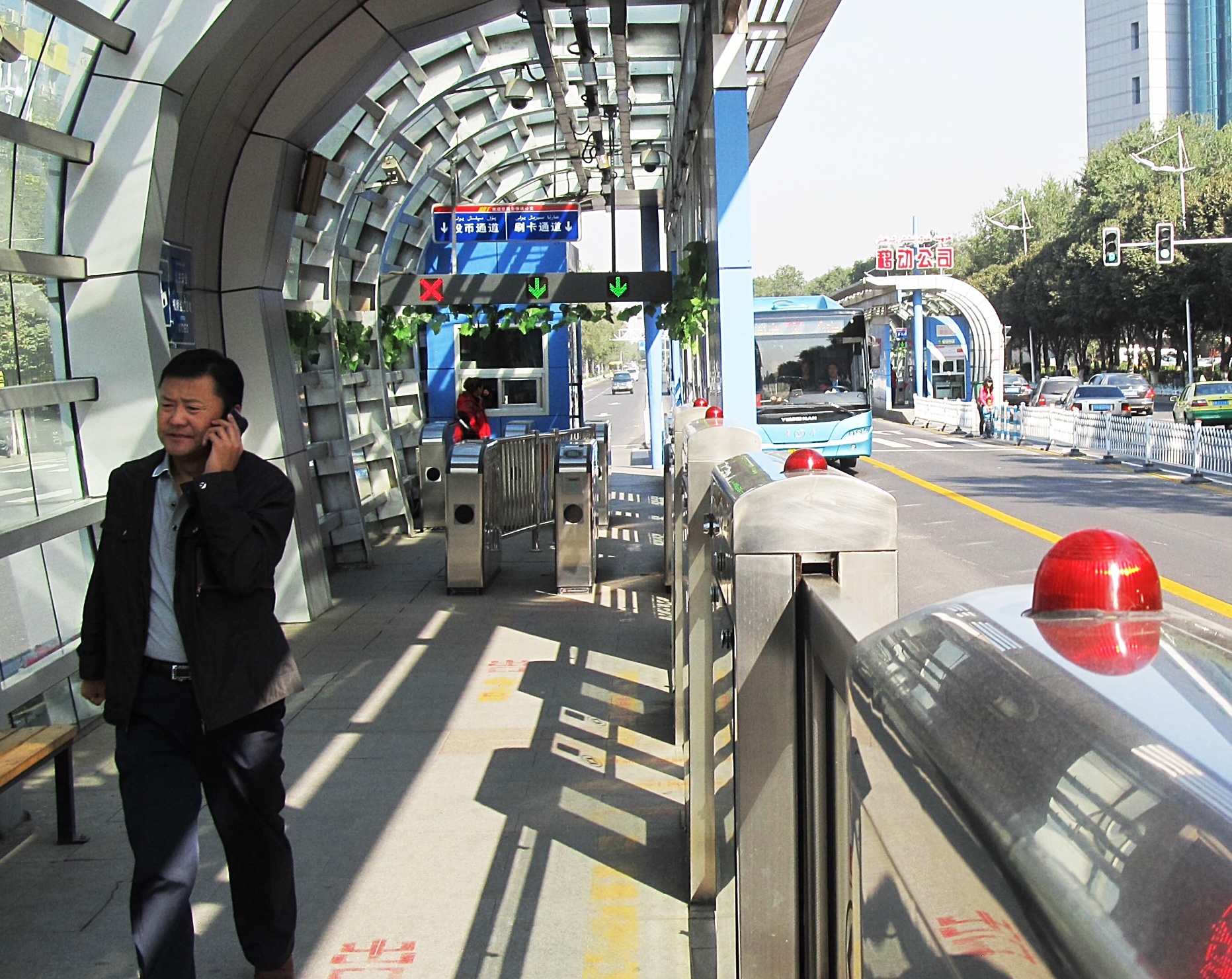
Urumqi, the largest city in the Xinjiang-Uyghur Autonomous Region, last year opened a 42-kilometer bus rapid transit network, fueled by natural gas and composed of three lines and 55 station stops. It’s a beautiful thing in a traffic-jammed city with risky levels of air pollution. Photo/Keith Schneider

URUMQI — The first time we boarded the bright orange articulated Line 3 buses of this desert city’s year-old Bus Rapid Transit network, we got lost. As an American writer intensely interested in new forms of urban transportation I assumed that the BRT system here was like the ones I’d ridden in Cleveland and Pittsburgh — a single line delivering passengers point to point.

Wrong. Last year Urumqi opened China’s newest, and one of its most expansive BRT systems. There are three interconnected lines, spanning 42 kilometers and 55 station stops, that encompass much of this restless city, a 24-hour swarm of cars in crowded streets. We backtracked that first day, and ended up taking a cab a short ride to the hotel. Every other time we rode the BRT, for 1 RMB or just over 16 cents a ride, we hit every station we needed to.

Ever since Curitiba, Brazil opened the world’s first BRT system in 1974, Bus Rapid Transit has been installed in over 100 cities worldwide. There are 30 lines now in 19 U.S. states, and many more are planned or under construction, including a 9.6-mile line in Grand Rapids, Michigan.

Here in China, though, cities didn’t just build single lines; they built BRT networks. Freed from the democratic give and take of debate about costs and subsidies and NIMBYism and all manner of other impediments characteristic of transit planning in the United States, China pressed ahead with some of the best BRT systems in the world. Since the first Chinese BRT network was opened in Kunming in 1999, China built 13 others, including the newest and one of the largest here.

Urumqi, like other Chinese cities expanding at rates never before seen in history, needed no other justification for its BRT system other than as a new means for moving people around a modernizing city smothered in traffic. City planners, apparently anticipating BRT, designed major tree-shaded avenues that are eight to 12 lanes wide.

The two center lanes, dedicated solely to buses, are separated from the others by white metal barriers. Modern glass and stainless steel station stops are spread about every half-kilometer. Buses are so numerous the wait time typically is less than a minute. There is really nothing rapid about buses that move at a top speed of about 55 kilometers an hour. But because of the startling levels of traffic day and night the BRT delivered us to destinations at least as fast, and often significantly more quickly than riding in a taxi.

What also intrigued me about the BRT system here was how it exemplified the modest but still gathering momentum of Urumqi’s work to be more innovative in contending with the limits to its development, particularly those that focus on the contest between the rapidly expanding population and industrial sectors, and the tight water supplies and filthy air.

(more…)

China’s Marine Aquaculture Shellfish Industry: Really Big and Apparently Safe

Thursday, September 27th, 2012

20120928-135651.jpg

On a still Aoshawei Bay, lines of marine shellfish bouys stretch shore to shore. Photo/J. Carl Ganter, Circle of Blue

QINGDAO — At dawn the surface of Aoshawei Bay is a grid of black spots, line after line, straight as the rays of the rising sun, from one shoreline to the other. The spots are bouys that support the submerged platforms and thick netting that grow scallops and clams, oysters and mussels, and enclose immense mats of edible kelp. The bouys, tended by fishermen in wooden boats gray and weathered by decades of use, are the most visible features of an aquatic food factory that employs thousands and feeds millions in this province of 96 million people.

And as my colleague Carl Ganter and I learned during an eye-opening interview with Yi Zhou, one of China’s top marine ecologists, Aoshawei Bay is an especially productive pearl in a string of clean Pacific coast bays that form the tidal infrastructure for Shandong Province’s marine aquaculture industry, the largest producer of farmed shellfish on Earth.

“Thirteen million tons a year,” exclaimed Yi Zhou, a professor of marine aquaculture and ecology at the Institute of Oceanology, a research unit of the Chinese Academy of Sciences located on a shoreline campus here. “Chinese marine aquaculture produces 13 million tons of shellfish a year, more than any other country. Seventy percent is produced in Shandong.”

Yi Zhou explained this to us in a second floor conference room overlooking one of Qingdao’s broad sand beaches and in the lovely late afternoon light. Carl, a photographer and co-founder of Circle of Blue, has been to China 10 times. This is my sixth trip in less than two years. Both of us are accustomed to China’s off-the-chart scale and dimension in almost everything. So 10 million tons of shellfish produced in nearby coastal waters, including this city’s own Laoshan Bay, wasn’t surprising.

What came next was.

“Is it safe to eat?” I asked.

Zhou expected the question. “Yes,” he said. “Very safe.”

In the next 45 minutes, and calmly responding to a fusillade of questions, Zhou explained the gathered facts, largely confirmed by science journals and other Qingdao environmental professors, about production practices that have helped make Shandong’s marine aquaculture industry an apparent model of local food production that is ecologically sustainable and safe. (more…)

China’s High-Speed Trains Seen As National Pride and Safety Risk

Saturday, September 22nd, 2012

20120922-153751.jpg

China plans a 16,000-kilometer high-speed rail network. Already, 13,500 kilometers have been built, including the line between Beijing and Qingdao. Photo/J.Carl Ganter, Circle of Blue

QINGDAO — It’s 670 kilometers, about 420 miles, between Beijing and this Pacific coast city of glass towers, 10-lane boulevards, sandy beaches, and 8 million metropolitan residents. On China’s high-speed white and blue bullet train, the trip takes four hours and 20 minutes. Whoosh!

In the United States, meanwhile, the idea of high speed trains sounds like this — Screeeeeech!

Where I live in the American Midwest two of our governors, Republicans from Wisconsin and Ohio, view passenger rail service as such a distasteful example of public investment that both refused to accept more than $1.2 billion that the Obama administration offered three years ago. The money was intended to generate jobs and begin building an authentic network of high speed rail lines and fast trains that reached from Minneapolis east to Detroit, Cleveland and Pittsburgh, and south to Cincinnati, Columbus, and St. Louis — with Chicago as its active hub.

The decision by the two states recalls a similarly short-sighted and ultimately egregious strategic error made in the 1970s by elected officials in the Detroit region. President Gerald Ford, a Michigander from Grand Rapids, carved $600 million ($2.4 billion in 2012 dollars) from the federal transportation budget and offered it to Detroit and its surbuban counties to construct a regional rapid transit system. The mostly white suburbs turned the money away, largely for reasons of race.

The decision ranks at the very top of the reasons that Michigan’s largest city and its surrounding suburban counties are having such a hard time attracting businesses and new residents. The Detroit area — the nation’s eighth largest market with over 5 million residents — remains the largest metropolitan area in the United States without a rapid transit network.

As I asserted repeatedly during my days as a writer with the Michigan Land Use Institute, Detroit has no chance of being competitive in this century until it builds a rapid transit system. Aside from providing all residents more energy-efficient transportation options, subways, commuter trains, light rail lines, and trolleys are now must-have civic equipment to attract and retain bright young minds. Young adults don’t care much for driving, dislike owning expensive gas-guzzling and hard-to-park cars, and are content to save money and feel good for the little bit they are doing to contain greenhouse gases.

Here in Qingdao, the major boulevard running parallel to the city’s ocean shoreline is periodically interrupted by construction sites, where men and machines are building a new subway system and underground station stops. The city’s big passenger rail station sports an immense white canopy, unfurling like a huge sail, that shields the new high-speed rail platforms from rain and intense summer sun. In the last two years I’ve boarded brand new subway lines in Beijing, Shanghai, Chengdu. I’ve boarded high-speed trains in Tianjin, Harbin, Shenyang, Xinjiang, Beijing, and Shanghai.
(more…)

Danger in Attacking China Is The Big Hurt It Would Put On US

Friday, September 14th, 2012

20120915-094427.jpg

China’s steady growth relies, in part, on its capacity to build new rail lines, a transportation option available here in Beijing and throughout the country. Photo\Keith Schneider

BEIJING — The Bureau of Labor Statistics, one of the U.S. government’s marvelous data gathering groups, has spents months making public facts about job and business growth that tell an unexpected story about the American economy. Two of the biggest generators of new jobs and rising incomes in the United States — the Great Plains and the Ohio River Valley — were regions all but given up for dead a generation ago.

The northern Great Plains in the 1980s became the focus of a proposal to transform millions of acres into a treeless wilderness “buffalo commons.” The Ohio River Valley was the site of epic dismantling of the country’s industrial manufacturing rust belt infrastructure.

In the last two years I’ve traveled and reported extensively from China, the Great Plains, and the Ohio River Valley. The three regions are tied to each other in ways apparent and distinctly possible only in the 21st century. And two of the regions — the Great Plains and the Ohio River Valley — would be grievously injured if the United States actually makes good on the rising chorus of threats, particularly from the Republican nominee, to pursue sanctions against China for alleged currency and trade infractions.

I write from China, at the start of my sixth trip here in 23 months. A little more than a week ago I was in Indiana and Kentucky. Late last year I was in North Dakota and Montana. In every one of these places there is new prosperity, new jobs, and new connections that are linked to China’s expanding economy, and especially to this nation’s rising demand for oil and for grain.
(more…)

In Hunt For China’s First Shale Gas Wells, An Encounter With The Police

Tuesday, June 19th, 2012

Liu Zhongqi, a farmer near Weiyuan, confronts PetroChina managers about damage to his farm from a new shale natural gas well. Photo/Keith Schneider

XINCHANGZHEN, China - The default position when confronted by the police, in the United States or anywhere else, is to follow directions and be respectful. So when two police officers in a white and blue van blocked our vehicle, then deliberately strolled over to the driver’s side window to ask for my passport and the national identification card of my translator, I reminded myself that they’re just cops. Do as they say.

It was Thursday afternoon, hot and muggy in a central Sichuan Province valley west of Weijuan, a city of 200,000 people. I’d come 140 kilometers south from Chengdu to find this valley, heavily settled by dusty roadside towns and dense corn fields and rice paddies, to see China’s first two producing shale gas wells.

In the United States, horizontal drilling and high pressure hydrofracking in deep gas- and oil-bearing shales is generating a production and economic boom that is rewriting what we thought we knew about energy supplies. In November 2009, during his visit to Beijing, President Obama and Chinese President Hu Jintao signed an agreement to dispatch American technical expertise to help China understand and develop its shale oil and shale gas resources.

A young police officer reviews my passport in Sichuan Province. Photo/Keith Schneider

A month later, on December 8, 2009, PetroChina, in partnership with Royal Dutch Shell, started drilling the first shale gas well here, designated Wei-201. It was completed on July 31, 2010, according to a sign at the well site.  On May 5, 2011, the two companies started a second well, Wei-201H3 (see pix below). It was finished on October 2, 2011. Wei-201H3 is also the first shale gas well in China to use horizontal drilling technology.

If China succeeds in developing its shale reserves — they are said by the U.S. Department of Energy to be even larger than the American shale gas reserves – the beneficial consequences to climate emissions, global energy security, and the Chinese and U.S. economies would be profound. That scenario would also place the Wei-201 and Wei-201H3 wells in the pantheon of historic sites for seminal breakthroughs in energy production, something akin to Stagg Field at the University of Chicago, where the first nuclear chain reaction occurred on December 2, 1942.

Later this summer, in a report for Circle of Blue, I’ll disclose the details of China’s shale gas development that I collected during the week I spent in Sichuan Province. Naturally, as part of that research, I was intent on seeing the historic energy development sites with my own eyes.

A blue and white sign on the main highway points visitors west, directing them to proceed about .8 of a kilometer along a narrow and deeply rutted dirt road to the two well sites, which are about a quarter-mile apart. It was plainly clear, though, that not everyone is welcome.

About fifteen minutes after I arrived, in the company of Wu Jing Yang, my 26-year-old  researcher and translator, six brand new and spotless white and black Toyota SUV’s rolled up on us. The vehicles swept into a half circle and stopped. The doors opened simultaneously and out stepped 13 PetroChina managers, each of them wearing Communist red jump suits with yellow/gold piping. I counted a dozen men and one woman. The leader, a man named Li, questioned Wu Jing, asking her why we were there and whether she regarded herself as a Chinese citizen. He eyed my camera and ordered me to stop using it. I listened to their increasingly urgent conversation while making eye contact with the other PetroChina managers. They grinned at me and seemed almost embarrassed by their supervisor’s belligerence.

“Tell him there’s a sign directing us in here,” I said to Wu Jing. “There’s nothing around that says we can’t be here.”

Just about then I heard a commotion behind me. An old fish and rice farmer, carrying an herbicide sprayer on his back, had walked over from his rice paddy and was confronting two of the PetroChina managers. “What company are you from?” he demanded. Wu Jing disengaged from her conversation with Li to translate. “Since this well was put here, my fish have gotten some sort of sores on them. My land isn’t producing as much. I tried to call to report these conditions. Nobody will help.”

As the farmer’s voice rose, insistent and indignant, supervisor Li’s face hardened and his eyes flashed anger. “You must leave now!” Li said to me and the farmer. “You are not allowed here.”

The farmer left first and I followed him to his rice paddy. I learned his name was Liu Zhongqi, and that like other residents of the neighborhood of stone and wood houses closest to the well, he wasn’t happy. The development of the well and the construction of the 4-acre wellpad was viewed as a big disruption in their community.

Supervisor Lee saw my conversation with Liu and stormed over in a gust of waving arms and verbal bluster. He demanded I leave.  I complied and headed to the Wei-201 well to take pictures. It is located about a quarter-mile to the west and is reachable through a narrow road and tunnel that runs beneath an unopened freeway under construction in the region. About five minutes after we arrived at the well, another PetroChina employee rolled up on a motor bike and asked us to leave.

I replied by asking him where he was from (the area, he said),  how long he’d worked for PetroChina (nine years),  and how much gas the well produced daily now (he wasn’t sure). He smiled and then pointed down the road. “You can’t be here,” he said. Then he took his cell phone out of his jumpsuit pocket and dialed the police.

The two officers met us in the center of the village. Their police van blocked the muddy road. One officer directed us to follow them back to the station house in town, about a 15 minute drive. On the way over, I removed the photo card from my camera just in case they got aggressive and took the camera.

I needn’t have worried. They escorted us to a second floor office, where sunlight streamed in from a big west-facing window. A third young officer took my passport and Wu Jing’s I.D. card, methodically filled in boxes on a single sheet form, and engaged Wu Jing in lighthearted chatter. His only question for me was why I was in the area. I replied that the two wells were significant to China’s economy and energy supply, and that the world was interested. Wu Jing translated and he seemed satisfied with that response. The officer handed my passport across the desk and pronounced us free to leave.

It was plain to me that he and his colleagues had met their mission — to accede to the demands of PetroChina, a state-owned and influential company, to temporarily remove us from the well sites. On the way out I asked another officer if I could return to the village to talk to some of the residents. He said that would not be a problem. “But no pictures,” he warned. Yes sir, I said. We shook hands.

– Keith Schneider

The police blocked the road and directed us to follow them to the station house. Photo/Keith Schneider


Wei-201H3, the first horizontally drilled shale gas well in China. Photo/Keith Schneider

Bill, Monica, and Hillary: A Chinese Artist’s Homage

Sunday, June 17th, 2012

Bill Clinton hoists a lush Monica Lewinsky to lust land. A friend asked,"He's not that well built is he?" Photo/Keith Schneider

CHENGDU, China — Peter Marsters, a colleague, friend, and Fulbright Fellow studying at Sichuan University, led me to the basement of the Shangri-La Hotel here the other night. “You have to see this painting of Bill Clinton and Monica,” he said.

The back story is that a Chinese artist and friend of the hotel owner painted an homage to Bill, Monica, and one of America’s great political sex scandals. The hotel owner displays the painting in a lower level hallway of one of Chengdu’s best hotels that’s said to be near the entrance to a brothel.

I had no time to verify or vouch for the accuracy of the back story. But the painting, about six feet tall, is genuine. I especially admire the Hillary figure scrambling in the rear — beseeching, aghast, embarrassed.

– Keith Schneider

TIC – This is China

Sunday, June 17th, 2012

A popular ad for toilets seen around Chengdu in 2012. Photo/Keith Schneider

CHENGDU, China — There’s no place that I’ve been in China — and I’ve visited 13 provinces — where cell phone service isn’t excellent. Cell phones connect in deep mountain highway tunnels in Sichuan, in the dry mountainous valleys of Gansu, and in the subways of Beijing, Chengdu, and Shanghai.

But the Internet? Awful everywhere. Slow. Blocked. Unreliable.

How does a nation so intent on taking its place at the head of global leadership deliberately bypass the Internet, the biggest and most important global market of them all?

The answer: TIC. This is China.

China confounds. But after spending 100 days here in the last 20 months, interviewing hundreds of Chinese during five research trips, the illogical features of this swarming society appear utterly logical. What makes no sense to a westerner gradually develops cogency. It’s what I’ve come to call TIC. This is China. To wit:

The Street
China’s driving culture is berserk. It’s an authentic expression of survival of the fittest. China’s dining culture, on the other hand, is a joy. People you’ve just met treat their guests to sumptuous meals attended by wait staff ready to assist with every need. So here’s the confounding part.

Outside the dining, trucks have the right of way over cars. Cars over motorcycles and scooters. And all motorized vehicles have command over people. Mothers with small children in tow will be run over if they get caught in the broad boulevards when the light turns. In heavy traffic if there’s a space, vehicles will rush to fill it, like water flowing to a dry spot. Crossing the street, with or without the light, is a clear and present danger. Drivers will run you over.

Inside, hosts shower their guests with food and attention.

When the meal ends, hosts get into their cars. Guests leave on foot. If the walking guests cross one of China’s broad boulevards and happen to cross the path of a driving host they could get run over. TIC: This is China.

The Toilet
China’s toilet culture is bizarre. Clearly, the wretched condition and stupefying stench of public Chinese toilets represents 1) China’s tolerance for filth, and 2) the country’s distaste for regular bathroom scrubbing. Most strange: you never know what horror awaits if you need to take a leak. Outside Batou, Inner Mongolia, we stopped for lunch in a clean restaurant at the center of a bustling desert town. The toilet: so unspeakably bad I couldn’t use it. On the other hand, in Heilongjiang, we stopped at a gas station. I prepared for the worst and was stunned when the toilet, managed by an old man and his mate, was clean, and smelled so fresh I thanked them. TIC: This is China.

Breakfast
The filthiest hotel room I’ve ever encountered in 40 years of travel on four continents was in Xinxiang, a big city in Henan Province in central China. The hallways were covered in a film of coal dust. The carpet in the room, cigarette burned and stained with all manner of brown and black smudges, was covered with crumbs and micro-litter and ashes. A vaccum hadn’t touched that floor in weeks.

For the grand price of 350 RMB, almost $60 and one of the most expensive room charges we experienced on this trip, breakfast was included. I told my Chinese researcher there wasn’t a chance I’d attend the breakfast, which generally is served in China buffet style. She laughed. It’ll be alright, she said. Turns out it was. In fact it was the best hotel breakfast we encountered in 17 days on the road.

In Qingdao, we checked into a much better and cleaner hotel where room charges were 25 percent less. The breakfast, though, was meager. Some soup. A few colorless vegetables that were cooked too long. Boiled eggs. Go figure. TIC.

Translation
English translations are always fun in China. On this trip, I visited the Heilongjiang provincial government’s headquarters in Harbin. The building was fronted by a granite monument and a sign promoting virtue, hard work, and “pragmaticalness.” (see pix below)

Food Safety
Chinese friends never have to convince me about the doubts they already have about the quality and purity of the food. Every trip I endure two weeks of stomach churning discomfort, the result of my delicate American intestinal flora and fauna meeting spices and odd foods I only encounter here. You go to seafood restaurants in Qingdao where the chefs display 50 different plates of prepared foods, not one of which you recognize as something you’d ever seen eaten.

Food safety, nevertheless, has elevated to one of the top public concerns in China because of a spate of contamination incidents involving baby formula, pork products, dairy products, and grain. Still, with a country so disturbed by the safety of its food, you wonder why street food is so popular? People line up ten deep for street barbecue, steamed fish, vegetables, and a host of offerings I didn’t recognize but looked as though they’d been wriggling and crawling at some point in their development. TIC

– Keith Schneider

English translations are fun in China, such as this government sign in Harbin, the capital of Heilongjang. Photo/Keith Schneider

Chengdu’s Modern Beauty — Bustling, Not Bursting

Wednesday, June 13th, 2012

20120613-232214.jpg

CHENGDU, China — Sichuan University, one of China’s best, held its graduation today. The campus, which is green and shady and is woven into this giant city’s central business district, much the way NYU’s campus is sewed into lower Manhattan, was abuzz with young energy.

Not far away, the Fuann River (see pix below) flows through the city, contained in an engineered channel bordered on each side by river-length walkways, parks, and shade trees. At night, the city’s many tall and modern office buildings are lit with LED colors that cascade and swirl, defining the edges of some buildings in thin reds and blues, and bursting upon others in electric purple and yellow and orange.

Thousands of people stroll the riverside walks. The parks are full of dancers, women line dancing to Chinese rock, part of their daily exercise. The young men moonwalking to Chinese and American rap.

One of the irrefutable personal measures of a great city is how well it treats runners. I pack running shoes and shorts on my trips and exercise almost daily with a good run. In the United States, New York, Chicago, San Francisco, Boston, Washington, Portland, and Seattle rank high by this measure. All have incorporated trails and parks and safe running routes into their recreational infrastructure and quality of life.

Overseas, Sidney, Barcelona, and Copenhagen rank high in my running index.

China’s big cities don’t generally measure up as running meccas. The air is usually terrible. The traffic is heavy and dangerous. On the other hand, there’s always interesting stuff going on to keep your mind busy. And drivers are so aggressive that it’s really easy to get hit if you’re not vigilant. Beijing is big and traffic-choked and its linear parks are either too distant or crowded to run in. Running on the streets of Harbin and Shenfang in northeast China was similar. Parks were few and busy streets kept my mind alert. Tianjin also was dusty and paved to excess.

Still, there are three cities that meet the Keith index for a good city run. Qingdao, a coastal city, is beautiful and has a 40-km walking/biking trail that skirts the rocky Pacific shoreline. A riverfront walkway lines both sides of the Huangpu River in Shanghai’s Bund business district.

And the third is here in Chengdu, where parks are more numerous, the Fuann River walk is first rate, and the shaded campus of Sichuan University a treat to run through. Near downtown is the Quanzhi Lanes (see pix below) a neighborhood of narrow pedestrian-only streets full of good restaurants and interesting shops.

This my second visit in a year to Chengdu. It’s pretty clear to me that this orderly, impressive, and prosperous city will soon join Beijing, Shanghai, and Hong Kong as a must-see destination for travelers to China.

– Keith Schneider

20120613-235000.jpg

20120613-235132.jpg

20120614-000606.jpg