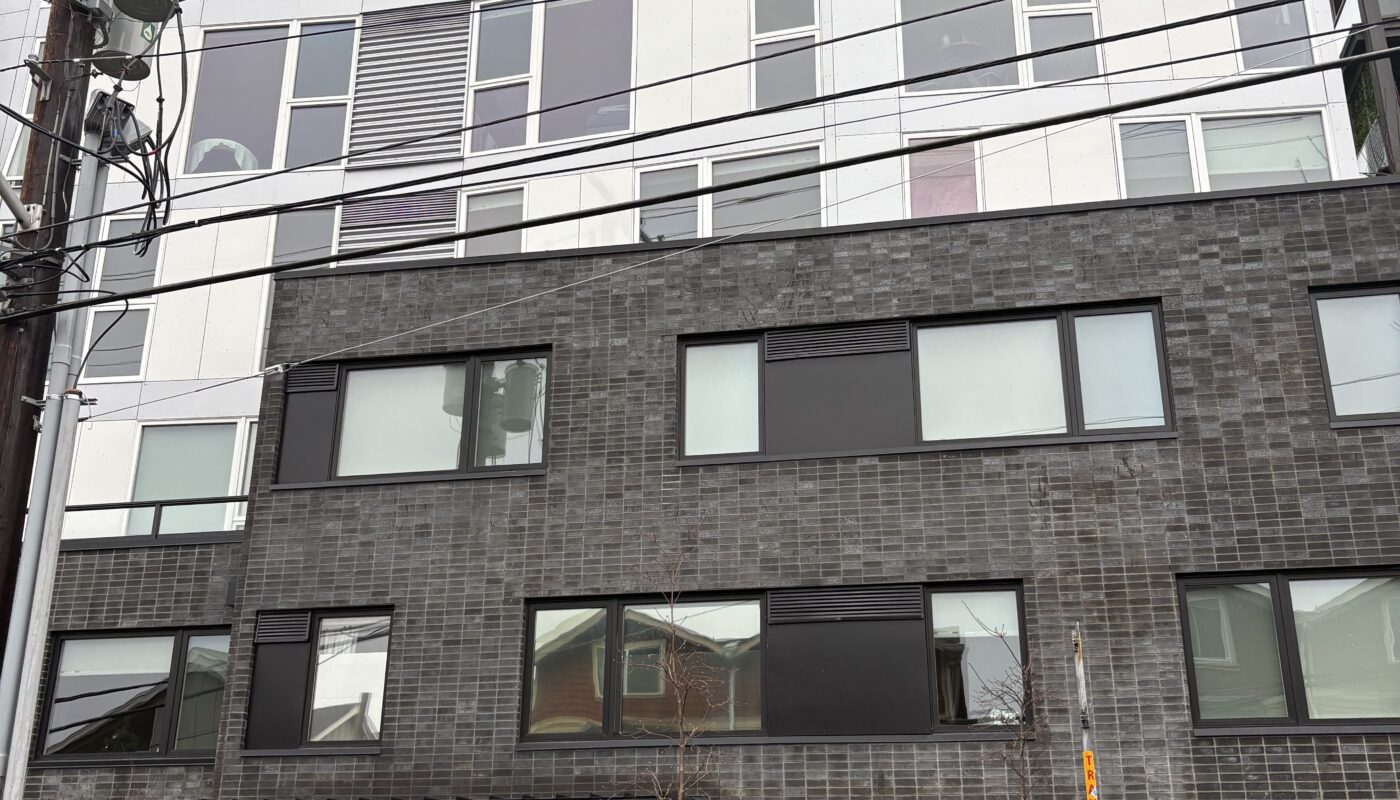
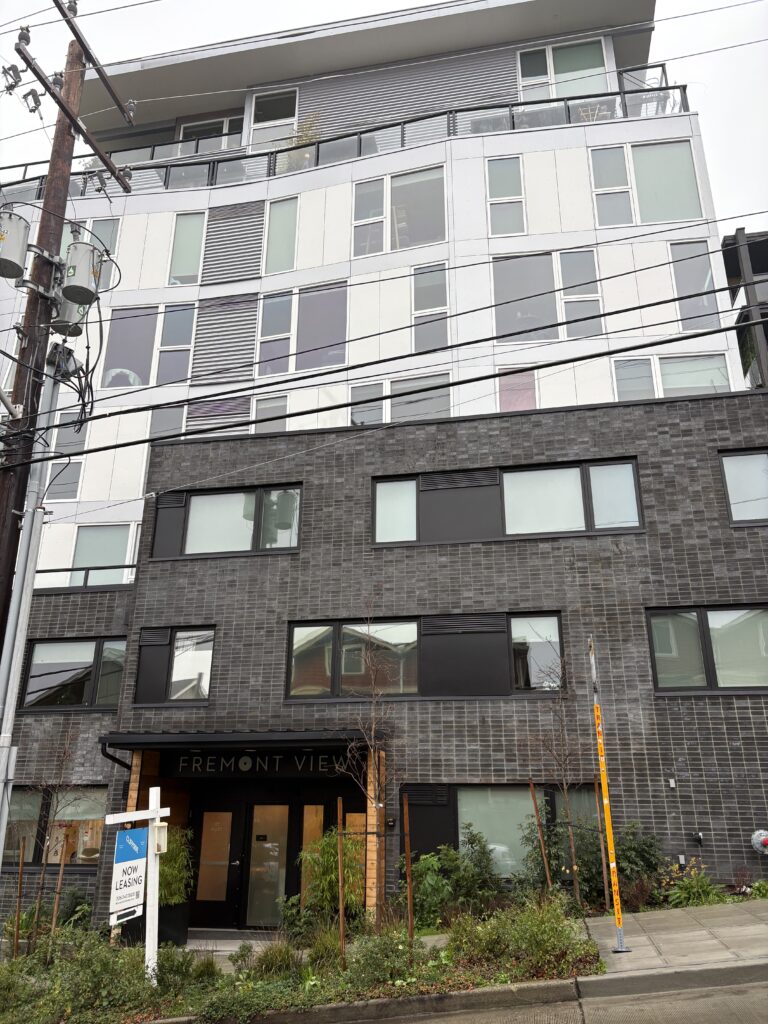
building with an elevator and two exits. Photo/Keith Schneider
SEATTLE – One of this Pacific Coast city’s newest apartment buildings is the eight-story Fremont View.
Set in Seattle’s bohemian Fremont neighborhood, the $12.75 million project encompasses 29 airy and well-lit apartments that rise from a tight 9,600-square foot city lot. What makes such a tall and compact multi-family residence possible is a crucial design feature allowed by Seattle’s building code: the apartment’s single staircase.
Until 2024 allowing one staircase in multi-family buildings more than three stories tall was illegal in almost every other city in America except New York City and Honolulu. The advantages, say architects and builders, are reduced costs and more opportunities to build housing in American cities.
Those advantages are reflected in Fremont View. Its single staircase eliminates the cost of a second staircase and hallway between staircases. Without a hallway and second stairwell more space is available for well-lit residences, four to a floor, and most of them are corner apartments. Fremont View encompasses 22,400 square feet, compact enough to be built on a single city lot, reducing the cost and time to assemble multiple parcels required for constructing larger and taller conventional double staircase apartments.
“The single stair is really vital to the survival of small developments in cities,” said Carey Moran, the Seattle designer of Fremont View. “To accommodate two stairs, you’re crushing the development with hallways.”
The idea of deregulating building codes and allowing small and tall urban apartment is spreading fast.
Other States Are Acting
Washington state’s code change goes into effect in July to allow so-called “single staircase apartments” up to six stories, and limited to four residences per floor, in all of its cities outside Seattle. “We have a law here, the Growth Management Act, which draw relatively strict boundaries around urban areas and says this is where you develop,” said Washington state Senator Jesse Salomon, who led the legislative effort to approve single staircase apartments beyond Seattle. “Single stairway is one significant avenue to promote infill. That’s the motivation.”
In past two years Colorado, Connecticut, Maine, Montana, New Hampshire, Oregon, and Texas also approved the single staircase code change for small, multi-family buildings four to six stories tall. In 2024, Tennessee approved the new stairway code, which eliminates requirements enacted in the early 20th century for two staircases in apartment buildings taller than three stories. Fire officials around the country say they are satisfied safety will not be compromised. In July, Washington State will join them. California, Hawaii, New York, Minnesota, and Virginia are conducting studies exploring the code change. Connecticut approved changing its fire safety code in 2024 to allow four-story single staircase buildings in 2027, but reversed its decision this year.
Colorado’s new law allows a single staircase in apartments up to five stories in Denver and 11 other cities with more than 100,000 residents. The Colorado code, like others across the country, limit the number of apartments to four per floor. Gov. Jared Polis, a Democrat, actively promoted the change, asserting in an interview that it will “reactivate the urban core.”
He added: “We wanted lower costs, smaller footprints, more natural light. It just allows for much more flexibility. We embrace the creativity of architects and the design community to help bring more and better ways of living to Coloradans in our cities.”
The gathering national momentum to build tall and compact urban apartment buildings is led by a small group of architects and housing advocates around the country who identified outdated building codes as one of the primary impediments to building affordable housing.
Though business leaders have asserted for decades that regulations undermine efficiency and profits, few regulatory systems are as complex as the building codes that govern housing construction in U.S. cities. These dense, highly prescriptive requirements, meant to improve safety, apply to every feature of new construction – wiring, plumbing, materials, windows, doors, framing, heating, cooling, and much more. Architects and developers say the codes are a major factor in rising construction costs that push them to build high-end projects and contribute to the country’s housing shortage.
“Housing is the largest building sector in the US,” wrote the authors of a report in 2023 by Harvard’s Joint Center for Housing Studies. “Yet it might well be the one that imposes the greatest constraints on design and innovation.”
Activists Around The Country
“The Seattle building code in 1917 was 216 pages,” explained Michael Eliason, a Seattle architect and housing researcher. “Today it is 990 pages long.”
Mr. Eliason, an expert in building codes around the world, has been one of the most influential advocates for reforming them in the United States. He started his work in Germany in 2019 where he took a job with a firm that won a design competition for an 11-story tower with a narrow footprint and one staircase. He learned that apartments as tall as six stories, or even taller, are designed with single staircases. That is common for most apartments all over Europe and Asia.
“I turned to my boss,” Mr. Eliason recalled. ”Something is wrong here. Where’s your other stair? And he’s looking at me, and said, ‘What are you talking about? If there was another stair there wouldn’t be any room for the homes.”
“That was the moment. Okay, codes in other countries are radically different than codes in the U.S.”
U.S. codes mandating two staircases in apartments taller than three stories stem from big fires in New York and other cities more than a century ago that killed scores of people. Before that single staircase apartments were common, especially in the tenement buildings that still exist by the thousands in New York City.
Requiring two staircases in apartments with more than three stories pushed developers to construct bigger apartment buildings that did not fit on small city lots because of the cost of the second staircase and the loss of livable space in the central hallway that connects the staircases. The dual staircase code section also produced dreary housing choices for U.S. residents. Apartments that opened off central corridors have few windows, like a big hotel room, that restrict daylight.
In 1977, Seattle recognized the expanding market for more urban housing and joined New York City in allowing tall single staircase apartment buildings. Mr. Eliason was prolific in magazine articles, videos, and social media in calling for other cities to embrace the same design standard for small apartment building.
One of the architects drawn to Mr. Eliason’s work was Sean Jursnick, a housing architect in Denver with SAR+ who played a big role in convincing Colorado to adopt the single staircase code. Mr. Jursnick visited Seattle, talked to Mr. Eliason and other architects, and developed an online map that identified more than 60 single staircase buildings in the city and nearly the same number being proposed. “The idea really clicked with me,” said Mr. Jursnick. “All the design issues I face when designing housing, and all the benefits that can be unlocked by allowing a different housing type.”
Fire Safety
In approving single staircase codes states had to solve the primary impediment to change: fire safety. New design practices and fireproof materials, sprinkler systems, and wider stairways have largely answered those concerns. A seminal study on fire death rates published last year by Pew found that “allowing these buildings to have only one staircase does not put residents at greater risk: Single-stairway buildings as tall as six stories are at least as safe as other types of housing.”
The Pew study is helping Minnesota draw closer to approving new single staircase apartment buildings up to six stories. Tom Pitschneider, the fire marshal in Shakopee, a rural town southwest of Minneapolis, participated in the technical advisory group that studied and recommended the new code. “We adopted the change,” he said in an interview. “It gave us some additional protections that we feel are right for Minnesota. You have to consider, though, that there are challenges in firefighter response to a single stair. We’re going up the same way residents are trying to escape.”
Having succeeded in convincing states and cities to rewrite the staircase code, housing advocates are now setting their sights on simplifying other code requirement they view as unnecessarily expensive and antiquated. Two targets are rising to prominence – codes overseeing elevators and codes for plumbing.
Stephen Smith, executive director of the Center For Building in North America, a New York City-based research and advocacy group, leads that work. Mr. Smith, who lives in an 11-year-old single staircase building in Manhattan, asserts, for instance, that American elevators are constructed and installed at three times the cost of elevators in other parts of the world. He and state Sen. Salomon are collaborating to pass a law in Washington to reform the elevator code.
“In a way it’s all about deregulation,” said Mr. Smith. “I know that’s a touchy subject with some people.”
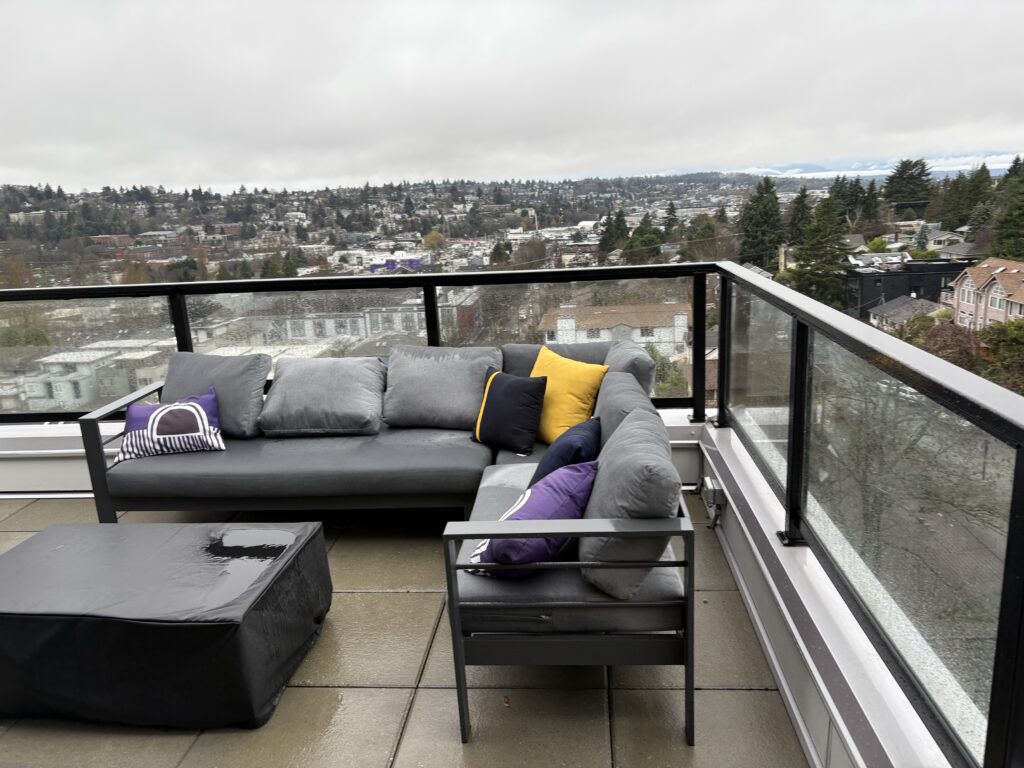
Here in Seattle, Fremont View’s residents are treated to striking views of the city and Mount Ranier. Constructed on steep hillside, and opened in October 2024, its rentals range from 430-square fo0t studios to 923-square foot two-bedroom apartments. Rental prices range from $1,700 to $4,000 a month.
The apartment’s eight-story height was made possible by Ms. Moran’s deft design, which allowed Edward Krigsman, the developer, to stack one four-story single stair apartment building on a second four-story single stair apartment building.
Seattle authorities approved Ms. Moran’s plan because it included two exits. One allows residents to enter and exit at the front of the apartment on N 39th Street. The second is located at the rear of the apartment, 50 feet higher, where the parking lot is tied to a small street. Both are served by an elevator and a single staircase.
A version of this article was published on March 4, 2026 in The New York Times.
— Keith Schneider