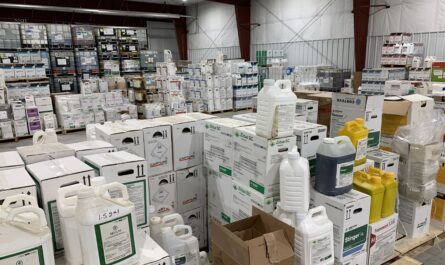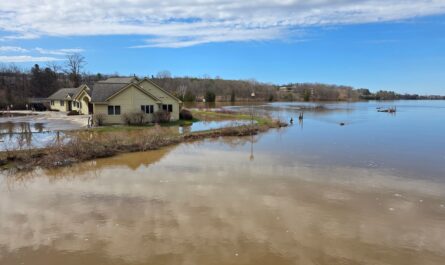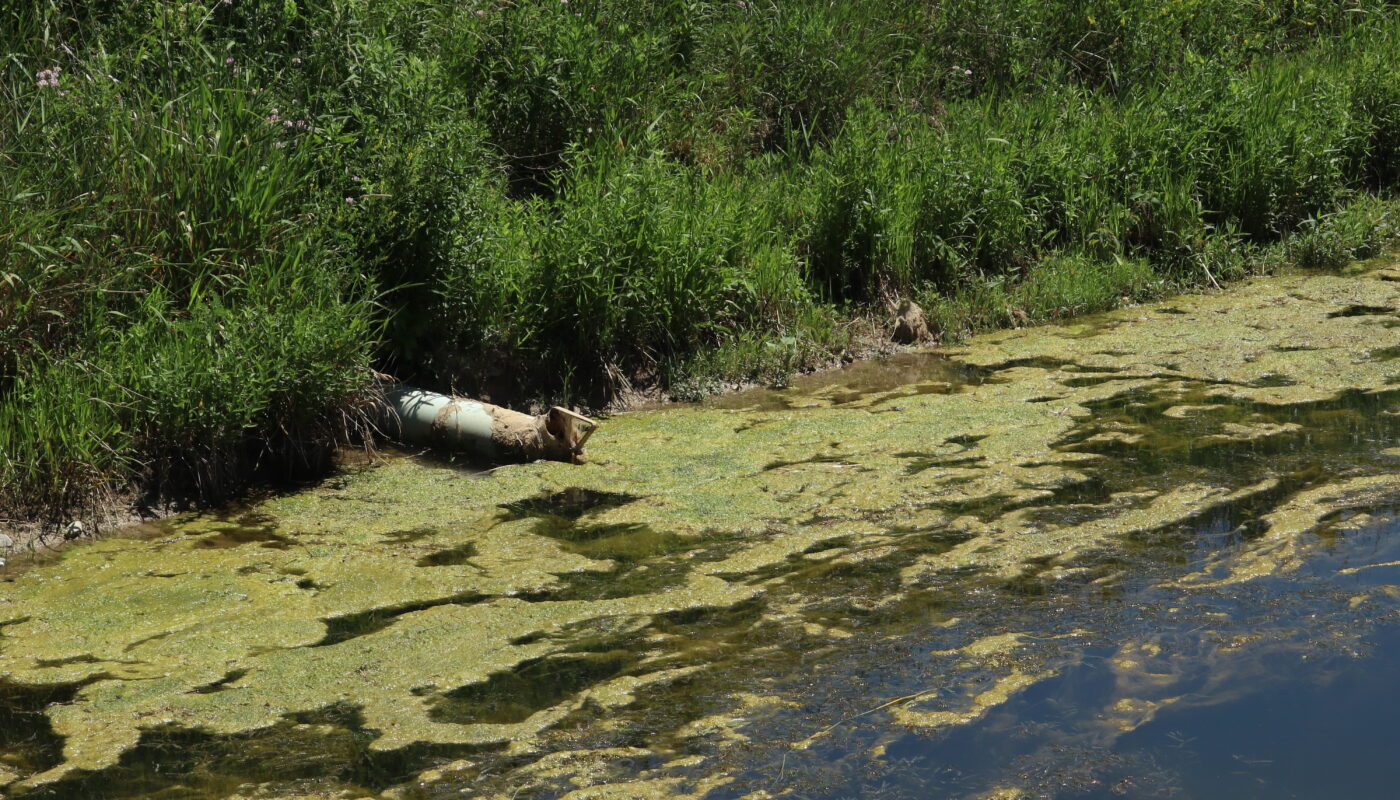

of Lake Erie’s toxic algae blooms. (Photo/Keith Schneider)
Back in 2003, when researchers began predicting with excellent accuracy how much of western Lake Erie would be coated with the green slime of a toxic algae bloom, there were important points to be made.
The annual forecasts, largely funded with $20 million annually from the National Oceanic and Atmospheric Administration, provided water quality regulators and public health authorities in the U.S. and Canada real-time assessments on where the poisonous algae, which is capable of killing dogs and sickening people, could wash up on public beaches.
The forecasts were prime evidence of whether federal and state environmental specialists were making any progress on limiting the torrent of phosphorus and nitrate pollution from agriculture that causes the blooms.
Forecasters got so good at predicting the expanse of the Lake Erie bloom that they decided earlier this decade to make a show of it and livestream the annual forecast, which is now held on South Bass Island, offshore of Toledo. This year, according to the forecast announced in June, the Lake Erie bloom will be “moderate,” neither as large as some years since 2011, nor as small as others since 2016.
Yes, the forecasting is an impressive display of computer modeling and scientific acumen. But here’s the rub for Lake Erie and for iconic water bodies around the country – Chesapeake Bay, Gulf of Mexico, Lake Okeechobee, Saginaw Bay, and eight others – where NOAA and its state and university contractors are conducting similar annual measurements of harmful algal blooms: The forecasts have become irrefutable evidence of immense ecological negligence. They are an annual accounting of government’s persistent inability to control discharges of farm fertilizer and manure that now are the largest source of water contamination in Lake Erie, the other Great Lakes, and in streams, rivers, lakes, and bays across much of the rest of the country.
Given the deplorable regulatory record that has made agriculture the largest source of America’s water pollution, how useful is toxic bloom forecasting at this point? It is important for water utilities and beachgoers, but how much more do we need to know about how irresponsible the nation has been in allowing agriculture to pollute at will?
Those questions are not idle musings. They will be answered this summer by Congress, which is considering President Trump’s proposal to cut NOAA’s budget by $2.1 billion, a 31 percent reduction. Much of the money under the president’s proposal would be carved out of the Office of Oceanic and Atmospheric Research, which funds the algae bloom forecasting.
Because of NOAA’s bloom forecasting, we know that ever larger quantities of commercial fertilizer and livestock manure spread on farmland are draining into the nation’s waters. The consequences are ugly.
After spending billions of dollars to improve waste water treatment, and measuring declines in nutrient contamination, progress has stalled in the Chesapeake Bay because agricultural discharges are increasing and uncontrolled. In 2010, the Environmental Protection Agency set a 2025 deadline for Bay states to get serious about cutting pollution. The deadline is passing and the goal is unmet.
Similarly, the “dead zone” at the mouth of the Mississippi River in the Gulf of Mexico is immense. Lake Champlain, which is the watery border between New York and Vermont, is contaminated with huge toxic blooms. So is Lake Okeechobee in Florida. In Iowa, there’s hardly a safe lake for swimming in summer because of toxic algae.
What works best to control farm nutrient pollution is significantly reducing how much fertilizer and manure is spread on farmland. It’s a solution, though, that has evaded federal and state regulators for decades.
Instead they’ve proposed, developed, and put into action “best management practices” that are voluntary. The federal government has spent tens of billions of dollars, much of it from the U.S. Department of Agriculture, to coax farmers to use them. They include limiting plowing, growing cover crops, reducing erosion, and planting wide strips of nutrient-absorbing grasses and shrubs at the edges of fields and along ditches and streams.
The problem is, best management practices are not best at anything. Simply put, they haven’t worked. For instance, the U.S. spent more than $30 billion since 1997 on best management practices to stem the tide of farm nutrients pouring from Midwest states into the Mississippi River watershed and causing the dead zone in the Gulf of Mexico. But in a 2023 progress report to Congress, the EPA said much more work is needed.
So much more farm pollution is pouring from Mississippi River Basin states, especially Iowa, Minnesota, Wisconsin, and Illinois that a federal goal to reduce the average size of the Gulf’s dead zone – 20 percent by 2025, and nearly 50 percent by 2035 – isn’t even close to being met.
Same for Lake Erie. In 2016, federal, state, and provincial authorities set a target to reduce the amount of phosphorus draining into the lake 40 percent by 2025 to quell the annual toxic algal bloom. That goal, too, is not close to being met.
Trump’s campaign to kill federal scientific research is an egregious mistake that will hurt Americans for years. What the U.S. spends on scientific advances is essential to U.S. safety and the American quality of life. But until the country gets a regulatory grip on nutrient discharges from agriculture – by far the nation’s worst water polluter – how much longer do we need to spend $20 million a year to confirm how poorly we’re doing?
— Keith Schneider
See my Where Danger Looms Toxic Algae Blooms project here.