TRAVERSE CITY, Mich. – For 72 years, in order to serve as a shortcut for crude oil from production fields in western Canada to refineries in eastern Ontario, Enbridge Inc.’s Line 5 pipeline has transported 540,000 barrels of oil and natural gas liquids daily beneath the forests and wetlands of northern Wisconsin and Michigan.
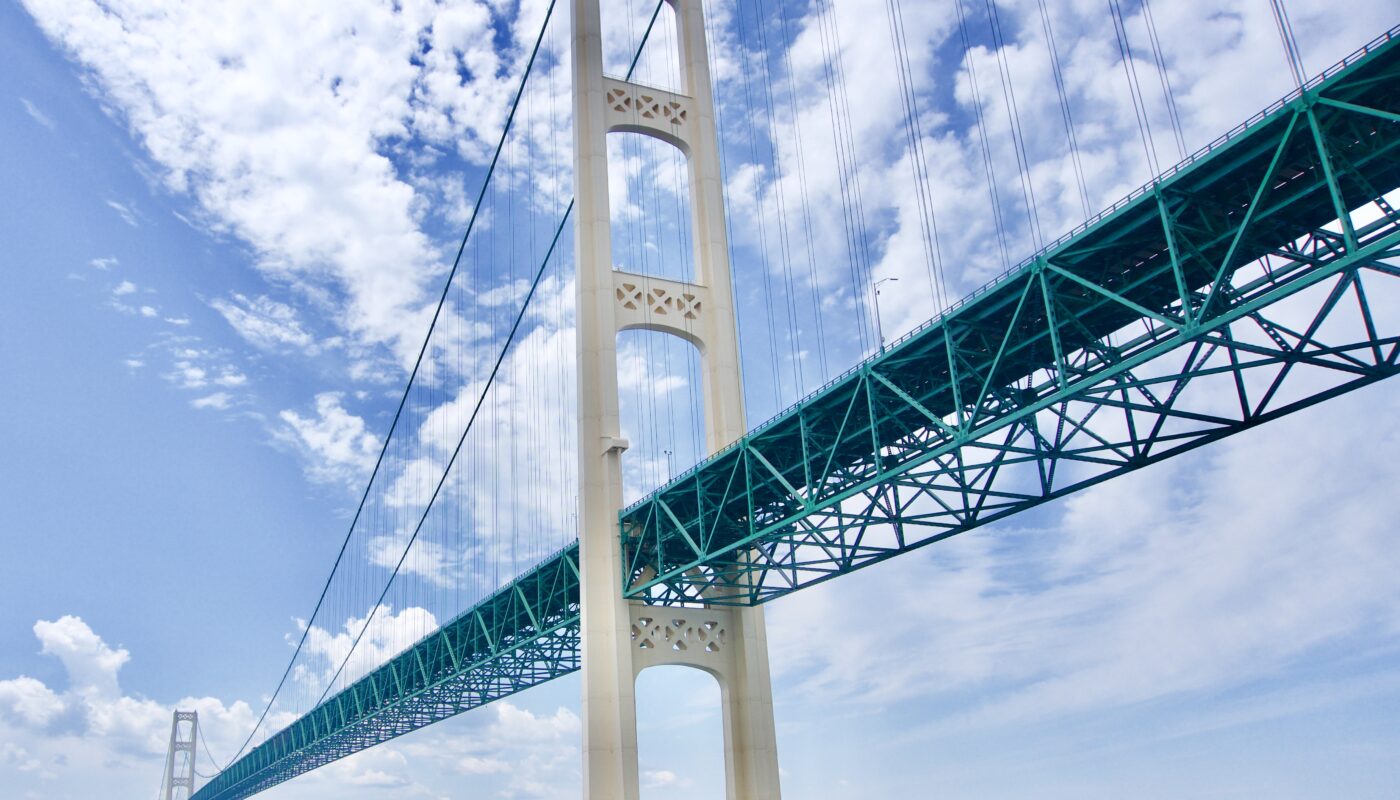
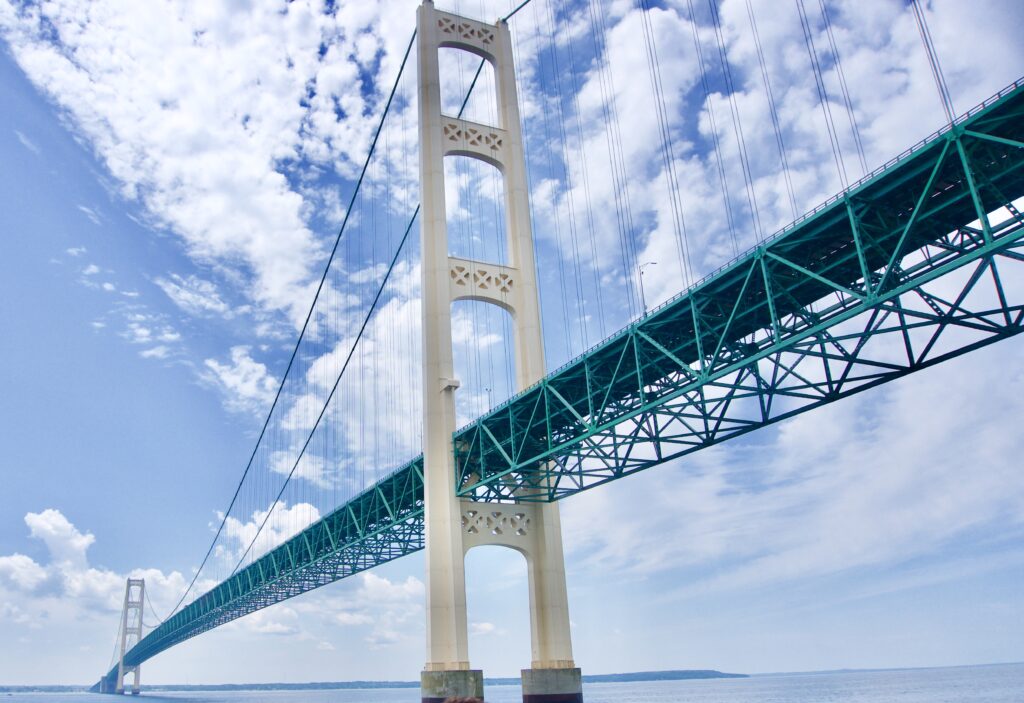
Opened in 1953, the 645-mile steel pipeline starts in Superior, Wisconsin, crosses underneath streams and rivers, and passes through the reservation of the Bad River Band of Lake Superior Chippewa. It even splits into two parallel pipelines and beats a 4-mile underwater path on the bottomlands alongside the Mackinac Bridge in the Straits of Mackinac, between Michigan’s Upper and Lower Peninsulas.
In October 2012 an environmental reporter named Jeff Alexander, a researcher named Beth Wallace, and the National Wildlife Federation published “Sunken Hazard,” a startling assessment of the risks of a Line 5 rupture in the Straits to Great Lakes waters and communities. In the years since, Line 5 has been a source of intense legal and political conflict over who has primary authority – the states or the federal government – to keep the pipeline operating, or shut it down.
In separate state and federal courts, U.S. District Court Judge Robert J. Jonker of the Western District of Michigan and Michigan Circuit Court Judge James Jamo are now poised to rule on that issue.
A bundle of other court decisions also are anticipated in 2026 that will affect operations of Line 5.
- The Michigan Supreme Court is set to rule on the thoroughness of the state decision to approve a new tunnel Enbridge proposed to transport oil and gas liquids across the Straits for another 99 years.
- The U.S. Supreme Court is hearing arguments in an appeal by Enbridge to excuse a deadline the company missed in 2019. If the company wins, the decision could transfer the state’s lawsuit to federal court and extend litigation for several more years.
- And in northern Wisconsin, Enbridge is appealing a federal judge’s order in 2023 to shut down Line 5 by next June because its expired easement means the pipeline is now trespassing across the Bad River Band of Lake Superior Chippewa’s reservation. Enbridge has proposed a new 41-mile route around the reservation that state and federal authorities have approved and that the tribe is appealing.
The expected court rulings arrive amid a new era of energy demand and supply unfolding in Michigan, the other Great Lakes states, and in Ontario. New industrial sectors, especially data centers and electrified vehicles, are increasing demand for energy. New supplies from cleaner renewable technologies, storage batteries, and small modular nuclear reactors are making their way to market.
Meanwhile the Trump administration is busy helping old energy sectors – closed nuclear plants, old coal-fired generating stations, natural gas turbines – stay in business. One consequence is that Great Lakes rivers, lakes, wetlands, habitat, and drinking water have become more vulnerable to pollution, land degradation, economic disruption, and harm to human health.
Line 5 is among the installations receiving assistance from the Trump administration. The president signed an executive order in January 2025 declaring an energy emergency and ordering all agencies to “expedite the completion of all authorized and appropriated” energy infrastructure. The order directs the U.S. Army Corps of Engineers to speed up review of permit applications to develop wetlands for energy projects. The Corps is reviewing such permits for Line 5 operations in Wisconsin and Michigan.
The Department of Justice in September also filed a legal brief in support of Enbridge’s arguments to keep Line 5 in operation.
In effect the confrontation to shut down Line 5 or keep it open is a rare convergence of law, energy supply, environmental protection, industrial influence, state and native American sovereignty, and powerful economic and political trends that affect Great Lake waters, land, and millions of residents.
The Great Lakes are held in public trust… You can’t convey a grant to a private corporation for primarily a private purpose unless you determine there’s no detriment to the public interest.
JAMES M. OLSON, ENVIRONMENTAL ATTORNEY
Arguments in the Disputed Pipeline
Opponents of Line 5, led by Michigan Attorney General Dana Nessel, and aided by state and regional environmental groups, say the impending court decisionscould confirm that core legal principles of state sovereignty over its waters have primacy over federal law in managing Great Lakes waters and land.
Michigan’s case is based on two state laws – the 1955 Submerged Lands Act and the 1970 Michigan Environmental Protection Act. Both laws rest on the “public trust doctrine,” which holds that water, air, and natural resources are managed for the benefit of all and that the state government – through management, permitting, regulation, and enforcement – is required to protect them from harm.
The public trust doctrine forbids states from granting a corporation access to a public trust resource for private purposes unless they determine the project either improves or does not harm or diminish the public interest. The U.S. Supreme Court, in a seminal decision in 1892, affirmed that each state in its sovereign capacity has title to all submerged lands within its borders and holds these lands in public trust.
Attorney General Nessel argues that the public trust was violated when Michigan granted the developers of Line 5 a single payment of $2,450 for the easement in 1953 to cross the bottomlands of the Straits of Mackinac without determining whether the pipeline would improve or harm Great Lakes waters. She also argues that the pipeline’s operation has changed substantially since 1953, making it more vulnerable to disastrous leaks or a rupture, which violate the easement’s original definitions and restrictions. A decision in favor of her argument would force a rare shutdown in the U.S. of an operating oil pipeline because of its risks to water, the environment, and Great Lakes shoreline communities. A decision against her would, for the first time, extinguish a state’s authority to prevent such a serious threat.
“The Great Lakes are held in public trust,” said James M. Olson, a Traverse City-based environmental attorney and founder of Flow Water Advocates, which has been active in litigation opposing Line 5. “You can’t convey a grant to a private corporation for primarily a private purpose unless you make a determination that it’s either an improvement of the public trust or there’s no detriment to the public interest.”
Calgary-based Enbridge and the U.S. Department of Justice counter Michigan’s position with equally determined arguments to keep Line 5 operating. Their argument is based on two federal laws and a separate legal principle known as the “foreign affairs doctrine.”
Federal lawyers and the company argue that the federal Pipeline Safety Act, initially enacted in 1968, gives the Pipeline and Hazardous Materials Safety Administration (PHMSA), a unit of the Department of Transportation, exclusive authority to regulate Line 5. Enbridge also cites the Transit Pipelines Treaty, signed by Canada and the U.S. in 1977, that blocks any measures that would impede, divert, or interfere with the transit of oil and gas through pipelines in either country.
Lastly, Enbridge argues that the foreign affairs doctrine limits states’ involvement in matters affecting the flow of oil across the Canadian-U.S. border.
“We remain committed to protecting and defending the continued operation of Line 5 in accordance with federal law, interstate commerce regulations, and international treaty obligations,” said Ryan Duffy, an Enbridge spokesman, in an email message. “These frameworks recognize the essential role Line 5 plays in meeting the energy needs of the Great Lakes region and supporting its economic vitality.”
A significant rupture would cause an Exxon-Valdez scale oil spill spreading through Lakes Huron and Michigan, the heart of the largest freshwater seas in the world.
JEFF ALEXANDER & BETH WALLACE, AUTHORS OF “SUNKEN HAZARD”
A Lone Pipeline Shutdown
Only once in the U.S. has an operating oil pipeline been shut down permanently. That occurred in Santa Barbara in 2015 when a pipeline that transported oilfrom offshore drilling platforms ruptured, causing a major oil spill. The pipeline never restarted.
Enbridge has long asserted that Line 5 will not sustain anything similar. But its record of operation in Michigan became a primary issue in 2010 when a separate Enbridge pipeline ruptured in southern Michigan causing 1 million gallons of oil to spill into the Kalamazoo River and its tributaries. That accident led the National Wildlife Federation (NWF) to commission “Sunken Hazard,” the investigative report that found substantial reasons to worry about Line 5, and elevated the twin sections of pipeline that cross the Straits of Mackinac to public attention.
“If either of those pipelines leaked, the resulting oil slick would likely devastate some of the lakes’ most bountiful fisheries, wildlife refuges, municipal drinking water supplies and one of the region’s most popular tourist attractions: Mackinac Island,” wrote Jeff Alexander and Beth Wallace, the report’s co-authors. “A significant rupture would cause an Exxon-Valdez scale oil spill spreading through Lakes Huron and Michigan, the heart of the largest freshwater seas in the world.”
— Keith Schneider