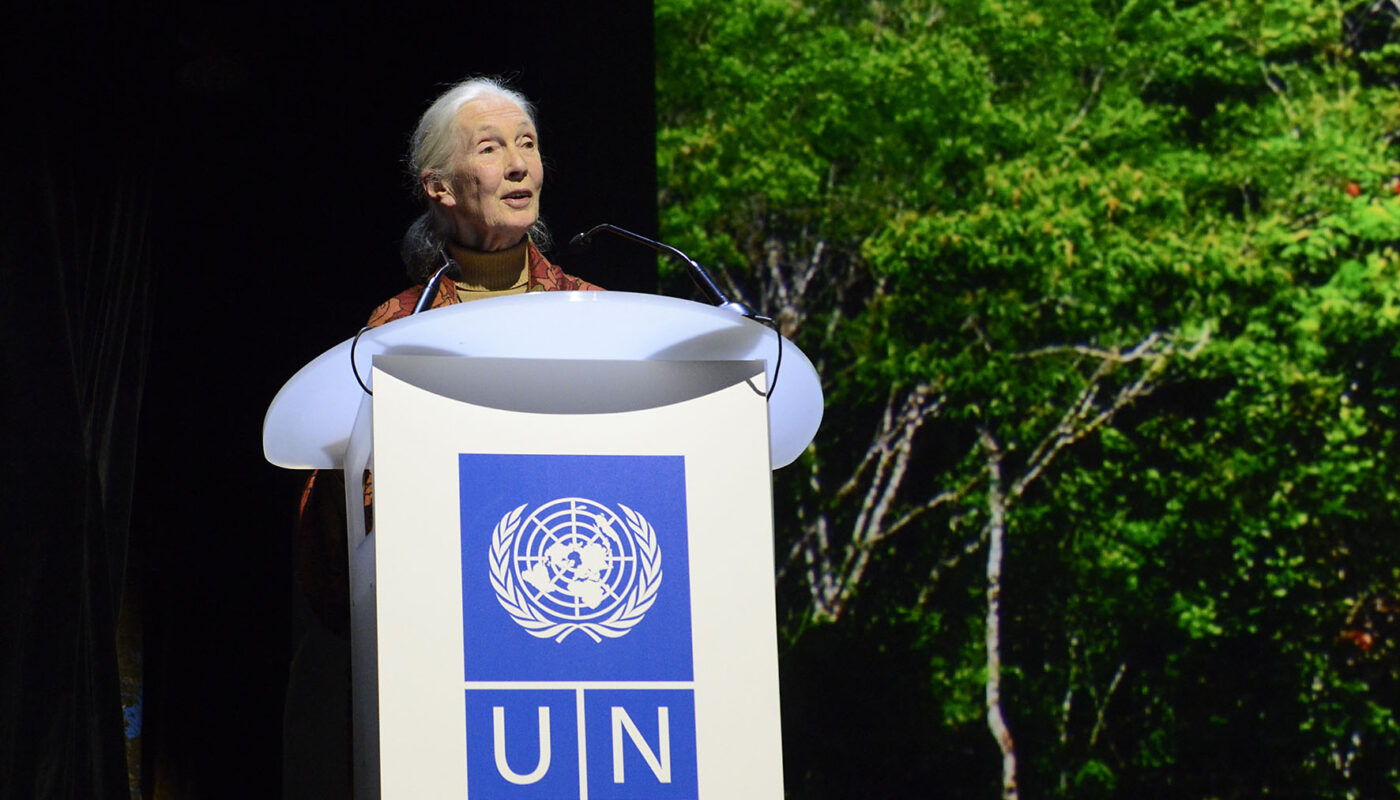
For just one mournful yet brilliant day — the first day of October 2025, the day Jane Goodall died — the deepening menace of our era was eased by the shining example of her life. People around the world took time to simultaneously grieve her passing and exult in her enduring achievements as scientist, conservationist, and protector of wildlife.
For once, there was no dissent. Jane Goodall fully merited the public’s laurels. She spent many years in one of the remotest corners of Africa enduring isolation, torrential rains, heat, and insects. She had patiently gained the trust of a troop of wild chimpanzees strong enough to tear her apart. And her work inspired legions of youth around the world.
Along with her breakthrough research on primates, she was a truly great eco-activist, responsible for protecting all manner of threatened plants and animals on six continents, saving forests in Africa, and assuring that miles of streams around the world remained clean.
These and so many other exploits explain the homage paid to Jane Goodall. Arguably the simplest reason she was universally admired was the tender way she delivered her message of courage, persistence, love, and hope in the service of Mother Earth. Indeed, Goodall was an especially effective communicator, just like every one of history’s other great environmentalists. John Muir. Teddy Roosevelt. Rachel Carson. Marjory Stoneman Douglas. David Brower. Stewart Udall. Bill McKibben.
“What’s the point of fighting, raising money and exhausting ourselves if we don’t have hope for the future?” she told one audience. “My job is to give people hope.”
She surely did that. As an environmentalist and an environmental journalist I closely followed Goodall’s career and life, and I was honored to write her New York Times obituary.
As a columnist for Circle of Blue, I have taken time since her death to study the work that none of the tributes written and broadcast across legacy and social media noted: Goodall’s portfolio of extensive projects to protect wild habitat that also ensured Indigenous people had access to clean water.
Water a Priority
Much of this work was conducted through the Washington-headquartered Jane Goodall Institute, which she founded in 1977 and which grew to encompass regional offices now operating in 23 other countries. And through the Roots & Shoots program, which she started in 1991 to encourage young people in 75 nations to take on projects that, among other objectives, harvested rainwater in water-scarce communities, conducted beach and river clean-ups, restored habitat, and campaigned against plastic debris contaminating oceans. In one such endeavor young Girl Scouts from New Jersey planted cattails along local waterways to help filter pollutants, improve local spaces for wildlife, and reduce pollution runoff.
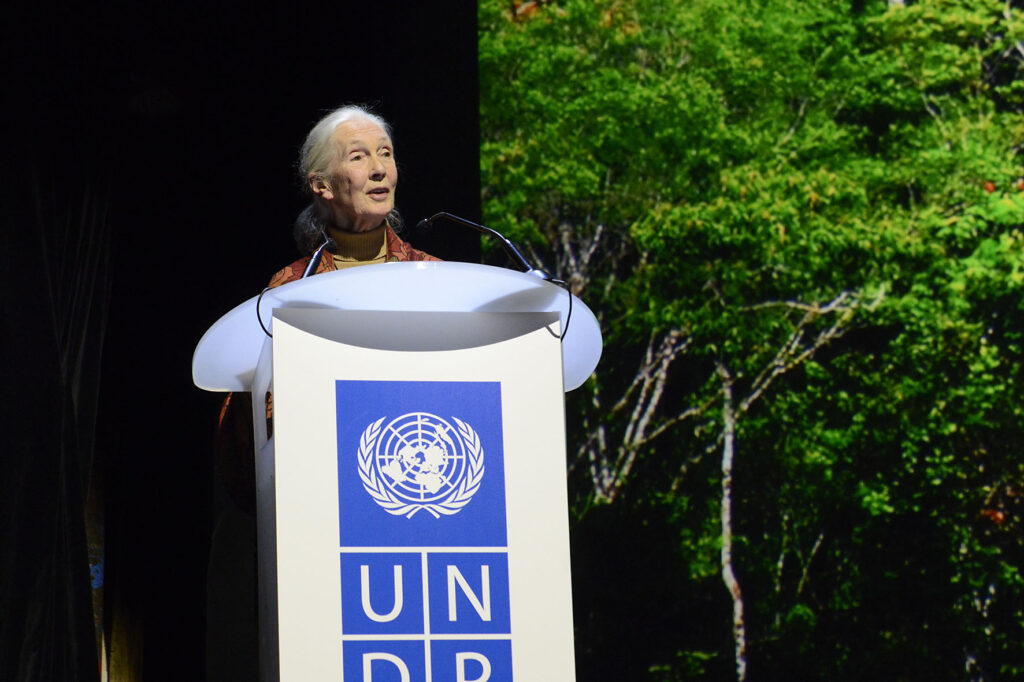
As the Institute’s leader, Goodall’s vision was expansive. Alarmed by the rapid development and population growth around Gombe National Park in Tanzania, where she conducted her famous research on wild chimpanzees, Goodall formed TACARE in 1994 to halt the destruction of forests around Lake Tanganyika, which caused soil erosion and water pollution. In the 31 years since its start, the Lake Tanganyika Catchment Reforestation and Education Project raised considerable sums of money and hired local groups to slow tree-cutting to protect watersheds, improve access to clean water, and promote less damaging crop and livestock production practices.
The sustainable model Goodall developed for TACARE was based on pulling education, direct action, and community engagement together in order to protect habitat and water quality. In the 1990s she added expertise on the consequences of climate change. Deforestation and the warming climate, she warned, affect cycles of rainfall that supply water to the world’s aquifers.
Goodall’s strategic model has been embraced by over 100 communities across Tanzania and inspired similar programs in Burundi, Uganda, Democratic Republic of Congo, Guinea, and Senegal.
She was tireless in promoting her vision of a safer planet, raising over $1 million in 2022 from her appearances and speeches. And she was a strong fundraiser. Last year the Bezos Earth Fund, established in 2020 by Amazon founder Jeff Bezos, awarded the Jane Goodall Institute $5 million to expand conservation in the Congo Basin. The grant supports community-led efforts, local capacity building, biodiversity monitoring, and the development of sustainable livelihoods. Its goal is to safeguard ecosystems, protect biodiversity, and empower local communities as stewards of the environment.
Goodall Principles at Work
There’s much to admire about Goodall’s long life, and how she pursued environmental activism, education, and results. And there’s much she left for the world to hold dear.
I’m taken by the principles that guided her work.
She was clear that forests and water systems are connected. Damage to one harms the rest.
She proved that ecological conservation requires attention to securing human necessities — especially clean water, ample food, and clear paths to earning durable incomes.
She engaged young people as essential assets in solving the century’s most significant environmental challenges — water scarcity, water pollution, habitat destruction, and climate change.
And she displayed profound respect for life on Earth, and compassion for people and animals most threatened.Jane Goodall was 91 at her death. Her life is a blessed reminder of the convergence of intelligence, grace, fearlessness, and personal responsibility to make the world a better place. Hers was the creed that underlies all of environmentalism and every environmental leader I know: “You cannot get through a single day without having an impact on the world around you,” Goodall said. “What you do makes a difference. You have to decide what kind of difference you want to make.”
— Keith Schneider