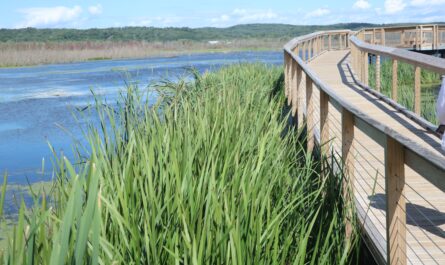

the Michigan Land Use Institute was started in Benzonia. (Photo/Keith Schneider)
WHETHER they pulled tires out of the Bronx River in White Plains, set up recycling booths in Chicago or marched in San Francisco, the millions of Americans who celebrated the first Earth Day in 1970 were bound by two principles: the environment was a mess, and the Government needed to do something about it.
This week, America marks Earth Day’s 25th anniversary. But that cracking sound heard across the country is more than the breaking up of old notions about environmental protection. It also is a shattering of the dominance that the large national conservation groups have exerted over America’s environmental priorities and laws.
In effect, Earth Day 25 ends an era of cohesiveness in identifying environmental problems and marshaling extraordinary popular support. The next era of environmentalism is starting with a cacophony of competing claims about the earth’s condition, vicious rivalries within the environmental movement, surprising weakness in Government leadership and an influential counterforce that is pushing Congress to dismantle many of the protections enacted over the last quarter century.
By some measures, the new era is off to a promising start. America’s lakes and rivers are cleaner, the air is clearer, and tens of millions of acres have been added to the nation’s protected wilderness areas. Last year, in an act suffused with symbolism, the Government removed the bald eagle from the list of threatened and endangered species. And as Gregg Easterbrook notes in his new book “A Moment on the Earth” (Viking 1995), it isn’t much of a reach to argue that environmentalism is the most enduring and successful liberal movement of the 20th century. What Hasn’t Happened
Pollution has not ended, though, and more than that, it is more complicated, vexing and persistent than anybody knew. Species are disappearing. The great virgin forests of the Pacific Northwest continue to fall. And while scientists disagree about their relative importance, global warming, ozone depletion and acid rain remain onerous.
The laws that compelled wood and paper companies to reduce damage to forests and forced chemical companies to remove many unsafe pesticides have been around for two decades, more than enough time to identify some unexpected weaknesses.
Property owners have complained about the enforcement of environmental laws. While elderly couples are hammered by Federal wetlands regulators in Maine, Maryland and Florida, a huge copper smelter in Michigan’s Upper Peninsula and big refineries in Texas obtain waivers from government authorities to pollute almost at will.
Columbus, Ohio, documented how a simple plan to pave a parking lot behind its maintenance garage turned into a more than $2 million toxic waste cleanup after trace levels of antifreeze and other contaminants were found in the soil.
Such examples became the fuel for a political freight train to rewrite environmental laws. The most baffling aspect of the Congressional debate has been the virtual silence of the Clinton Administration, which took power at least in part on the popularity of the message in Vice President Al Gore’s book, “Earth in the Balance,” that rescuing the environment should be “the central organizing principle for civilization.”
All the Administration’s talk of bold steps to raise energy taxes, to reduce damage from mining and grazing on Federal lands and to give environmental improvement equal status with economic gains is only a distant memory now. The White House was slow to put its team into place, and opponents on Capitol Hill sensed its lack of resolve. And the Administration’s languor has brought at best only muted protest from the Natural Resources Defense Council, the Sierra Club and other major groups.
The leadership vacuum among conservationists in Washington is being filled quickly by local and regional groups, many of them professionally staffed and bursting with ideas at odds with the national groups’. In the Pacific Northwest, the Native Forest Council is calling for an end to timber cutting in the national forests. The Gulf Coast Tenants Organization in Louisiana is fighting pollution problems affecting minority groups in urban centers of the South.
The movement of authority and ideas from mainstream environmental groups to regional and local organizations has made for a much richer debate.
For instance, conservative free market organizations have joined with liberal policy centers to identify and challenge the tax breaks and subsidies for agriculture, energy, transportation, and construction. These groups assert that any chance of progress is hopelessly gridlocked because of contradictory incentives. While policies for environmental protection are mostly punitive, the Government rolls out billions of dollars to encourage development and industrial activity that add to the deficit and wreak havoc on natural resources.
Other groups advocate incentives for environmentally useful ideas, a notion tried in the 1970’s and largely ended in the 1980’s. Why not pay farmers to grow kenaf, a quick-growing fiber crop, as the raw material for paper? Why not direct more research money to non-chemical farming instead of subsidizing agribusiness?
Such ideas could result not only in more effective environmental protection at lower costs, but also address public concerns like the safety of food, the clear-cutting of forests, and the stability of rural economies.
The new debate already has fostered a critical change in legislative approaches. The better-safe-than-sorry principle of environmental lawmaking appears to be over. House Republicans and numerous Democratic allies approved legislation last month designed to subject new environmental statutes and regulations to much more rigorous cost and scientific accounting.
Editorialists criticized the House “risk assessment” bill as an example of reactionary opportunism that will protect neither the earth nor the public. And even some Fortune 500 business executives said the measure would gum up Government further with a new and expensive bureaucracy of regulation reviewers.
Some think it is worth trying, however. Paul Portney, vice president of Resources for the Future in Washington, said that not to try a new approach — perhaps a better version of the House risk assessment bill — is a recipe for further public disenchantment.
At the very least, he said in an interview, legislative mistakes like the inordinately expensive 1980 Superfund law should be much harder to make. Enacted on the theory that abandoned chemical waste dumps could expose millions of people to toxins, the Superfund law set up stringent procedures for removing poisons from such sites. The law’s major benefit is that it has essentially ended the practice by industrial companies of haphazardly dumping their most dangerous wastes. Hauling and Burning
But no one anticipated that the primary material to be treated at Superfund sites was soil, much of it only slightly tainted, and very little of it actually coming in contact with people. Nor did lawmakers take into account the usefulness or the cost of hauling, burning or treating tens of millions of tons of contaminated soil.
Among Superfund’s many unanticipated downsides was discouraging redevelopment of old industrial sites, an outcome that harmed urban working people by removing job opportunities.
Another principle that is crumbling on the eve of Earth Day 25 is that more regulations make better regulation. If that were true, then the 1976 Resource Conservation and Recovery Act, a thicket of regulations designed to manage garbage and toxic wastes, would be an unqualified success. It’s not.
While the act led to the closings of thousands of local dumps, some of them leaking, the law also encouraged the construction of new incinerators, immense landfills and hazardous-waste treatment centers, most of them in the backyards of the rural and poor.
As the country sorts out which environmental regulations make sense, long-ignored issues are gaining prominence.
In the current Atlantic Monthly, Bill McKibben makes an eloquent case that population growth and land use issues are among the biggest and most difficult environmental problems now. Mr. McKibben describes how the Northeast is enjoying the best environmental conditions in 100 years as great expanses of farmland have been reforested. The renewal owes a lot to time and nature, and to the web of environmental laws that Congress is now reassessing.
But protecting the landscape from the assaults of urban sprawl will demand something more than, and different from, the standard regulatory prohibitions.
Of all the legacies of Earth Day 1970, the most valuable was the ethic that America has a responsibility to protect its natural heritage. Now, having succeeded in changing the world, the environmental movement itself is endangered. If development and land use issues attain the prominence of the anti-toxics, anti-nuclear and wilderness preservation campaigns of the last 25 years, then addressing them will mean throwing away some old orthodoxies. The movement that changed the nation’s environmental ethic a generation ago is reshaping itself, and the most important aspect of that effort is a new openness to what works and what doesn’t in environmental protection.