Archive for June, 2012

In Hunt For China’s First Shale Gas Wells, An Encounter With The Police

Tuesday, June 19th, 2012

Liu Zhongqi, a farmer near Weiyuan, confronts PetroChina managers about damage to his farm from a new shale natural gas well. Photo/Keith Schneider

XINCHANGZHEN, China - The default position when confronted by the police, in the United States or anywhere else, is to follow directions and be respectful. So when two police officers in a white and blue van blocked our vehicle, then deliberately strolled over to the driver’s side window to ask for my passport and the national identification card of my translator, I reminded myself that they’re just cops. Do as they say.

It was Thursday afternoon, hot and muggy in a central Sichuan Province valley west of Weijuan, a city of 200,000 people. I’d come 140 kilometers south from Chengdu to find this valley, heavily settled by dusty roadside towns and dense corn fields and rice paddies, to see China’s first two producing shale gas wells.

In the United States, horizontal drilling and high pressure hydrofracking in deep gas- and oil-bearing shales is generating a production and economic boom that is rewriting what we thought we knew about energy supplies. In November 2009, during his visit to Beijing, President Obama and Chinese President Hu Jintao signed an agreement to dispatch American technical expertise to help China understand and develop its shale oil and shale gas resources.

A young police officer reviews my passport in Sichuan Province. Photo/Keith Schneider

A month later, on December 8, 2009, PetroChina, in partnership with Royal Dutch Shell, started drilling the first shale gas well here, designated Wei-201. It was completed on July 31, 2010, according to a sign at the well site.  On May 5, 2011, the two companies started a second well, Wei-201H3 (see pix below). It was finished on October 2, 2011. Wei-201H3 is also the first shale gas well in China to use horizontal drilling technology.

If China succeeds in developing its shale reserves — they are said by the U.S. Department of Energy to be even larger than the American shale gas reserves – the beneficial consequences to climate emissions, global energy security, and the Chinese and U.S. economies would be profound. That scenario would also place the Wei-201 and Wei-201H3 wells in the pantheon of historic sites for seminal breakthroughs in energy production, something akin to Stagg Field at the University of Chicago, where the first nuclear chain reaction occurred on December 2, 1942.

Later this summer, in a report for Circle of Blue, I’ll disclose the details of China’s shale gas development that I collected during the week I spent in Sichuan Province. Naturally, as part of that research, I was intent on seeing the historic energy development sites with my own eyes.

A blue and white sign on the main highway points visitors west, directing them to proceed about .8 of a kilometer along a narrow and deeply rutted dirt road to the two well sites, which are about a quarter-mile apart. It was plainly clear, though, that not everyone is welcome.

About fifteen minutes after I arrived, in the company of Wu Jing Yang, my 26-year-old  researcher and translator, six brand new and spotless white and black Toyota SUV’s rolled up on us. The vehicles swept into a half circle and stopped. The doors opened simultaneously and out stepped 13 PetroChina managers, each of them wearing Communist red jump suits with yellow/gold piping. I counted a dozen men and one woman. The leader, a man named Li, questioned Wu Jing, asking her why we were there and whether she regarded herself as a Chinese citizen. He eyed my camera and ordered me to stop using it. I listened to their increasingly urgent conversation while making eye contact with the other PetroChina managers. They grinned at me and seemed almost embarrassed by their supervisor’s belligerence.

“Tell him there’s a sign directing us in here,” I said to Wu Jing. “There’s nothing around that says we can’t be here.”

Just about then I heard a commotion behind me. An old fish and rice farmer, carrying an herbicide sprayer on his back, had walked over from his rice paddy and was confronting two of the PetroChina managers. “What company are you from?” he demanded. Wu Jing disengaged from her conversation with Li to translate. “Since this well was put here, my fish have gotten some sort of sores on them. My land isn’t producing as much. I tried to call to report these conditions. Nobody will help.”

As the farmer’s voice rose, insistent and indignant, supervisor Li’s face hardened and his eyes flashed anger. “You must leave now!” Li said to me and the farmer. “You are not allowed here.”

The farmer left first and I followed him to his rice paddy. I learned his name was Liu Zhongqi, and that like other residents of the neighborhood of stone and wood houses closest to the well, he wasn’t happy. The development of the well and the construction of the 4-acre wellpad was viewed as a big disruption in their community.

Supervisor Lee saw my conversation with Liu and stormed over in a gust of waving arms and verbal bluster. He demanded I leave.  I complied and headed to the Wei-201 well to take pictures. It is located about a quarter-mile to the west and is reachable through a narrow road and tunnel that runs beneath an unopened freeway under construction in the region. About five minutes after we arrived at the well, another PetroChina employee rolled up on a motor bike and asked us to leave.

I replied by asking him where he was from (the area, he said),  how long he’d worked for PetroChina (nine years),  and how much gas the well produced daily now (he wasn’t sure). He smiled and then pointed down the road. “You can’t be here,” he said. Then he took his cell phone out of his jumpsuit pocket and dialed the police.

The two officers met us in the center of the village. Their police van blocked the muddy road. One officer directed us to follow them back to the station house in town, about a 15 minute drive. On the way over, I removed the photo card from my camera just in case they got aggressive and took the camera.

I needn’t have worried. They escorted us to a second floor office, where sunlight streamed in from a big west-facing window. A third young officer took my passport and Wu Jing’s I.D. card, methodically filled in boxes on a single sheet form, and engaged Wu Jing in lighthearted chatter. His only question for me was why I was in the area. I replied that the two wells were significant to China’s economy and energy supply, and that the world was interested. Wu Jing translated and he seemed satisfied with that response. The officer handed my passport across the desk and pronounced us free to leave.

It was plain to me that he and his colleagues had met their mission — to accede to the demands of PetroChina, a state-owned and influential company, to temporarily remove us from the well sites. On the way out I asked another officer if I could return to the village to talk to some of the residents. He said that would not be a problem. “But no pictures,” he warned. Yes sir, I said. We shook hands.

– Keith Schneider

The police blocked the road and directed us to follow them to the station house. Photo/Keith Schneider


Wei-201H3, the first horizontally drilled shale gas well in China. Photo/Keith Schneider

Bill, Monica, and Hillary: A Chinese Artist’s Homage

Sunday, June 17th, 2012

Bill Clinton hoists a lush Monica Lewinsky to lust land. A friend asked,"He's not that well built is he?" Photo/Keith Schneider

CHENGDU, China — Peter Marsters, a colleague, friend, and Fulbright Fellow studying at Sichuan University, led me to the basement of the Shangri-La Hotel here the other night. “You have to see this painting of Bill Clinton and Monica,” he said.

The back story is that a Chinese artist and friend of the hotel owner painted an homage to Bill, Monica, and one of America’s great political sex scandals. The hotel owner displays the painting in a lower level hallway of one of Chengdu’s best hotels that’s said to be near the entrance to a brothel.

I had no time to verify or vouch for the accuracy of the back story. But the painting, about six feet tall, is genuine. I especially admire the Hillary figure scrambling in the rear — beseeching, aghast, embarrassed.

– Keith Schneider

TIC – This is China

Sunday, June 17th, 2012

A popular ad for toilets seen around Chengdu in 2012. Photo/Keith Schneider

CHENGDU, China — There’s no place that I’ve been in China — and I’ve visited 13 provinces — where cell phone service isn’t excellent. Cell phones connect in deep mountain highway tunnels in Sichuan, in the dry mountainous valleys of Gansu, and in the subways of Beijing, Chengdu, and Shanghai.

But the Internet? Awful everywhere. Slow. Blocked. Unreliable.

How does a nation so intent on taking its place at the head of global leadership deliberately bypass the Internet, the biggest and most important global market of them all?

The answer: TIC. This is China.

China confounds. But after spending 100 days here in the last 20 months, interviewing hundreds of Chinese during five research trips, the illogical features of this swarming society appear utterly logical. What makes no sense to a westerner gradually develops cogency. It’s what I’ve come to call TIC. This is China. To wit:

The Street
China’s driving culture is berserk. It’s an authentic expression of survival of the fittest. China’s dining culture, on the other hand, is a joy. People you’ve just met treat their guests to sumptuous meals attended by wait staff ready to assist with every need. So here’s the confounding part.

Outside the dining, trucks have the right of way over cars. Cars over motorcycles and scooters. And all motorized vehicles have command over people. Mothers with small children in tow will be run over if they get caught in the broad boulevards when the light turns. In heavy traffic if there’s a space, vehicles will rush to fill it, like water flowing to a dry spot. Crossing the street, with or without the light, is a clear and present danger. Drivers will run you over.

Inside, hosts shower their guests with food and attention.

When the meal ends, hosts get into their cars. Guests leave on foot. If the walking guests cross one of China’s broad boulevards and happen to cross the path of a driving host they could get run over. TIC: This is China.

The Toilet
China’s toilet culture is bizarre. Clearly, the wretched condition and stupefying stench of public Chinese toilets represents 1) China’s tolerance for filth, and 2) the country’s distaste for regular bathroom scrubbing. Most strange: you never know what horror awaits if you need to take a leak. Outside Batou, Inner Mongolia, we stopped for lunch in a clean restaurant at the center of a bustling desert town. The toilet: so unspeakably bad I couldn’t use it. On the other hand, in Heilongjiang, we stopped at a gas station. I prepared for the worst and was stunned when the toilet, managed by an old man and his mate, was clean, and smelled so fresh I thanked them. TIC: This is China.

Breakfast
The filthiest hotel room I’ve ever encountered in 40 years of travel on four continents was in Xinxiang, a big city in Henan Province in central China. The hallways were covered in a film of coal dust. The carpet in the room, cigarette burned and stained with all manner of brown and black smudges, was covered with crumbs and micro-litter and ashes. A vaccum hadn’t touched that floor in weeks.

For the grand price of 350 RMB, almost $60 and one of the most expensive room charges we experienced on this trip, breakfast was included. I told my Chinese researcher there wasn’t a chance I’d attend the breakfast, which generally is served in China buffet style. She laughed. It’ll be alright, she said. Turns out it was. In fact it was the best hotel breakfast we encountered in 17 days on the road.

In Qingdao, we checked into a much better and cleaner hotel where room charges were 25 percent less. The breakfast, though, was meager. Some soup. A few colorless vegetables that were cooked too long. Boiled eggs. Go figure. TIC.

Translation
English translations are always fun in China. On this trip, I visited the Heilongjiang provincial government’s headquarters in Harbin. The building was fronted by a granite monument and a sign promoting virtue, hard work, and “pragmaticalness.” (see pix below)

Food Safety
Chinese friends never have to convince me about the doubts they already have about the quality and purity of the food. Every trip I endure two weeks of stomach churning discomfort, the result of my delicate American intestinal flora and fauna meeting spices and odd foods I only encounter here. You go to seafood restaurants in Qingdao where the chefs display 50 different plates of prepared foods, not one of which you recognize as something you’d ever seen eaten.

Food safety, nevertheless, has elevated to one of the top public concerns in China because of a spate of contamination incidents involving baby formula, pork products, dairy products, and grain. Still, with a country so disturbed by the safety of its food, you wonder why street food is so popular? People line up ten deep for street barbecue, steamed fish, vegetables, and a host of offerings I didn’t recognize but looked as though they’d been wriggling and crawling at some point in their development. TIC

– Keith Schneider

English translations are fun in China, such as this government sign in Harbin, the capital of Heilongjang. Photo/Keith Schneider

Chengdu’s Modern Beauty — Bustling, Not Bursting

Wednesday, June 13th, 2012

20120613-232214.jpg

CHENGDU, China — Sichuan University, one of China’s best, held its graduation today. The campus, which is green and shady and is woven into this giant city’s central business district, much the way NYU’s campus is sewed into lower Manhattan, was abuzz with young energy.

Not far away, the Fuann River (see pix below) flows through the city, contained in an engineered channel bordered on each side by river-length walkways, parks, and shade trees. At night, the city’s many tall and modern office buildings are lit with LED colors that cascade and swirl, defining the edges of some buildings in thin reds and blues, and bursting upon others in electric purple and yellow and orange.

Thousands of people stroll the riverside walks. The parks are full of dancers, women line dancing to Chinese rock, part of their daily exercise. The young men moonwalking to Chinese and American rap.

One of the irrefutable personal measures of a great city is how well it treats runners. I pack running shoes and shorts on my trips and exercise almost daily with a good run. In the United States, New York, Chicago, San Francisco, Boston, Washington, Portland, and Seattle rank high by this measure. All have incorporated trails and parks and safe running routes into their recreational infrastructure and quality of life.

Overseas, Sidney, Barcelona, and Copenhagen rank high in my running index.

China’s big cities don’t generally measure up as running meccas. The air is usually terrible. The traffic is heavy and dangerous. On the other hand, there’s always interesting stuff going on to keep your mind busy. And drivers are so aggressive that it’s really easy to get hit if you’re not vigilant. Beijing is big and traffic-choked and its linear parks are either too distant or crowded to run in. Running on the streets of Harbin and Shenfang in northeast China was similar. Parks were few and busy streets kept my mind alert. Tianjin also was dusty and paved to excess.

Still, there are three cities that meet the Keith index for a good city run. Qingdao, a coastal city, is beautiful and has a 40-km walking/biking trail that skirts the rocky Pacific shoreline. A riverfront walkway lines both sides of the Huangpu River in Shanghai’s Bund business district.

And the third is here in Chengdu, where parks are more numerous, the Fuann River walk is first rate, and the shaded campus of Sichuan University a treat to run through. Near downtown is the Quanzhi Lanes (see pix below) a neighborhood of narrow pedestrian-only streets full of good restaurants and interesting shops.

This my second visit in a year to Chengdu. It’s pretty clear to me that this orderly, impressive, and prosperous city will soon join Beijing, Shanghai, and Hong Kong as a must-see destination for travelers to China.

– Keith Schneider

20120613-235000.jpg

20120613-235132.jpg

20120614-000606.jpg

Qingdao, A Beautiful Pacific Coast City, Beckons To Be China’s Cleanest

Sunday, June 10th, 2012

20120610-153000.jpg

QINGDAO, China — The Pacific Ocean tugs at the rocky shoreline on this city’s eastern boundary. Rugged claw-peaked mountains are sentinels to the north and west. Qingdao lays out on a plain of flat ground and rolling hills between the natural barriers, a just-built urban center of high rise office and apartment towers, 10-lane boulevards, and a goal of achieving stature as a model Chinese “eco-city.”

I am spending a couple of days in this city of more than 8 million residents, the second largest in coastal Shandong Province, to conduct the initial research on urban environmental progress, energy efficiency, and water conservation that Circle of Blue and the Wilson Center are doing in collaboration with China’s Ministry of Environmental Protection. It’s a quick Qingdao hello (pronounced Ching-tow, the last rhymes with how) to meet contacts and get a feel for the more intensive research I’ll complete when I return in early August.

In the context of China’s smoggy cities, choked with traffic, hampered by a flood of chemical and biological emissions of every sort into the air and water, Qingdao is doing pretty well. Much of the household fuel switching from air-polluting coal to cleaner natural gas for cooking and heating was completed within the last decade. Qian Yi, a professor and dean of the Qingdao University of Science and Technology, told me that city officials shut down 100 to 120 old and polluting industrial plants from 2006 to 2010, including a number of really dirty metal plating factories.

Big investments in water treatment plants also are being made. A new subway network is under construction. And Qian, and two of his university colleagues that I met, insisted that the principles of environmental protection were steadily becoming cultural values in a seaside metropolis that is replacing heavy industry with travel and tourism as its primary economic sector (see pix second below.)

“Things are getting better,” he said.

But considering the gains in air and water quality, parks modernization, recreational infrastructure, energy efficiency, and quality of life in American cities, Qingdao has a long way to go. In America’s big cities, we have blue skies now and water clean enough to attract housing and parks back to shorelines that 35 years ago stunk to high heaven.

The same is possible here and in other Chinese cities. But it’s going to take a lot of work. Even on the air quality days that Qingdao authorities consider “good,” the sky is dirty grey and you see what you’re breathing. The surface freshwater resources — rivers and lakes — are all polluted well beyond the American standard of “fishable and swimmable.” This city, like others I’ve visited in China, has the unmistakable scent of raw sewage in the air.

Thousands of hectares of cropland around the city are contaminated with heavy metals because for decades rice and vegetable farmers irrigated with industrial waste water from the city’s chemical and metal fabricating plants. Qian Yi tells me he’s helping to lead a big project here to scrub the metals out of the dirt, but it’s slow work involving planting and harvesting non-food grasses and woody plants that suck up the contaminants.

Another big problem is aquaculture. Shandong’s coast is lined with big fin fish farms (see pix below). The aquaculture producers, he says, treat the dozens of species of farmed fish with growth hormones, antibiotics, and other compounds to speed their development and protect against some diseases.

Moreover, so many floating farms produce so much seafood that the seawater is contaminated with the wastes of tens of millions of finned creatures, though shellfish production is much cleaner, he says.  Even the tides are not sufficient to carry the filth away. Since 2008, coastal waters north of Qingdao in the Bohai Sea have been inundated with dangerous toxic algae blooms.

When I return I’ll try to determine the levels of heavy metals in the city’s food crops, and seek data on the contaminants in the aquaculture products. Qingdao has an office of food safety that Qian says is charged with making periodic assessments and issuing warnings.

“We’ve ignored the balance between the environment and the economy,” he says. “We need to do better.”

– Keith Schneider

20120610-162215.jpg

20120610-162245.jpg

Outside Shenyang Lessons in Rice, Water, and Farming

Friday, June 8th, 2012

20120609-082411.jpg

SHENYANG, China — The rice paddies start immediately beyond the borders of Liaoning’s provincial capital, a growing city of 8.1 million residents. Like a whirling turbine, the city flings 10-lane boulevards and 30-story apartment towers ever farther into the countryside. I’m out tracking down new irrigation systems, part of my research on Chinese grain production for Circle of Blue. Finding the rice and evidence of China’s new investment in modern irrigation infrastructure is a 50-minute cab ride from center city.

Water supply and water quality are two of the big impediments to farm production in this northeast China province. A year ago, provincial farm authorities completed construction of a concrete branch irrigation canal, replacing a mud-banked canal, that supplies farmers with water from the Lioahe River. But as we rode out to Fahaniu Village, where the canal was installed, I also learned that over the past two decades the township we were visiting had lost half its cropland to urban development.

My guide this day is Li Qinglu, a retired chemical engineer and former professor who at 68 has spent the last eight years becoming expert in agriculture, water, and in cultivation practices to prevent northeast China’s extensive grasslands from literally turning to dust. He’s also become one of Shenyang’s prominent environmentalists.

Li and his wife, Huang Jingli, are partners in a 50-mu farm (a bit more than three acres) in Fahaniu Village that produces vegetables, rice, and fish. Much of the work is done with hand implements. Their friend and farm manager, Li Jiazhen, is busy when we arrive planting in one of the small gardens. I see Jiazhen slowly stepping backwards, hoe in hand, scooping out softball-size holes in the soil. His wife, Qu LiJuan, is in front, clutching to her belly a small aluminum bowl filled with bean seeds. She steps forward, one foot, then another, dropping a single pea-size seed into the hole, and then pushing soil to cover it with her toe. The choreography of their line dance, and the sound of soil being dug and moved, is simple and in rhythm — the pull of the hoe, step, the drop of the seed, step, the toe-swipe of the soil cover, step. I have the clear sense that this same duet of spring (see pix below) has occurred on this land for centuries.

The sound of modern agriculture — water surging in concrete canals — is close by. The Chinese Central government has called for grain production to rise over 50 million metric tons – a roughly 10 percent increase — from 2010 to 2020. The government is counting on the farmers of Liaoning and three other northeast China provinces to supply most of the new grain. One of the central tools to assure that more rice, corn, soybeans, and other basic field crops are produced is to supply plant roots with adequate water through irrigation. China is now spending $1.2 billion annually in the four provinces to build hundreds of kilometers of new concrete canals, and change thousands of kilometers of existing mud-lined canals into concrete waterways.

One of the irrigation rebuilding projects concluded here a year ago. We learn this from Liu Caiyun, a 32-year-old rice farmer, (see pix above) who’s kneeling and using a hand trowel to plant beans on the top of the mud walls that line her 6-mu rice paddy. I ask her about the concrete canal that supplies the water from the Liaohe River that floods her paddy. “We get a steady supply,” she tells me. “And the water is much cleaner.”

On the other side of the canal, 25 feet away, Wang Chunyun is listening to our conversation. She explains the economics of her 6-mu operation. Water costs 130 RMB per mu ($123 for six mu). Fertilzer, seed, and herbicide cost about the same for each input. She rents the land, too. In all, says Wang, who is 45 and a mother of one son, her production costs run 600 to 700 RMB per mu, $96 to $111, or $576 to $666 for the entire paddie. She produces, she says, about 3,500 kilograms of rice annually, keeping 250 kg for her family to eat, and selling the balance at 2.8 RMB per kg. Do the math and that’s 9,100 RMB in total sales or $1,444. She farms part-time and works part-time in the nearby furniture and elevator factories.

It is a beautiful morning with a cooling breeze strong enough to sway the green rice shoots. There is no sound of traffic. A white crane takes flight in the distance. Wang and Li are laughing and look years younger than their ages. To me it seems like a pretty good day. No, no, no, Wang says.

“Farming is the toughest job in the world,” she tells me. “We do the hard work but we don’t make much money.”

– Keith Schneider

20120609-082521.jpg

In New York Times, Cincinnati’s Riverfront Revival

Tuesday, June 5th, 2012

20120606-152125.jpg

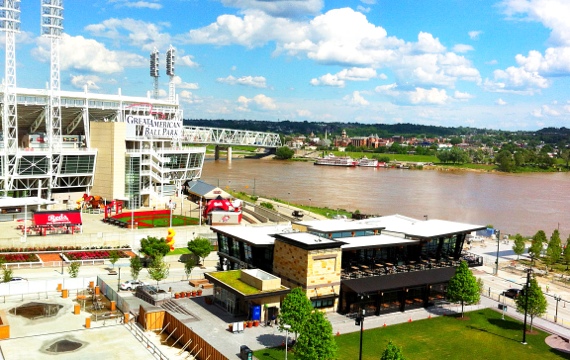
CINCINNATI – The shoreline of this Ohio River city, which thrived in the 19th century with 30 steamboat visits a day and then died in the 20th as pollution and industrial disinvestment pushed people and businesses inland, is emerging again as a new hub of civic and economic vitality.

The New York Times published my article on Cincinnati’s riverfront development, more evidence of the Ohio River Valley’s new upward economic vector. The Times piece is a shorter version of this draft.

Last year, Great American Insurance Corp. opened a $322 million, 800,000-square-foot office tower close to the river that now rules the city’s skyline. Two blocks in front of the 41-story building, the city and Hamilton County are constructing a $120 million riverfront park. It steps up from the shoreline in successive tiers of grass and stone to meet The Banks, a $600 million, 18-acre mixed-use retail, residential, and entertainment development.

In addition, Rock Gaming is building a $400 million, 354,000-square-foot casino downtown that is scheduled to open in early 2013. And in February this year the city started construction on a $112 million, 2.6-mile streetcar line that will link Cincinnati’s business center, and historic Over-the-Rhine residential and entertainment district, to the new riverside park and The Banks.

“We’re seeing a new Cincinnati coming from all of this,” said Mayor Mark Mallory, a two-term Democrat elected in 2005.  “We have a new set of activities, new places to live, new places to work. We are investing in things that grow a city.”

Market Trends
Cincinnati’s economy and its capacity to attract new residents and jobs reflects several converging market trends. The University of Cincinnati, the city’s big public university, has significantly rebuilt its campus in recent years, attracting more students and national attention, and serving as the foundation of an expanding medical research and health services industry. A growing number of independent and innovative marketing and branding companies, many focused on online markets, are developing with the help and through various collaborations and partnerships with Procter and Gamble, the city’s consumer products mainstay. And upriver from Cincinnati, billions are being invested by the energy industry to develop deep shale gas and shale oil reserves, reviving the state’s steel industry, generating a new petrochemical sector, producing thousands of new jobs, and strengthening urban economies from Pittsburgh to Cincinnati.

Digging out from decades of disinvestment is no small goal for a river city that from its founding as a western frontier outpost in 1788 grew by 1950 into an industrial powerhouse of nearly 504,000 residents. But since 1960, as the metropolitan region expanded to more than 2 million people, and globalization drained manufacturing jobs, Cincinnati, which endured three days of riots in 2001, has been losing an average of 4,000 residents annually and median household incomes are well below the state and national averages.

Still, with 80,000 downtown jobs, Cincinnati’s business core is thriving. And with nearly 300,000 residents, 10,000 of them living downtown and now on the waterfront, Cincinnati remains the third largest city along the six-state, 981-mile Ohio River, behind Louisville and Pittsburgh. Like its bigger neighbors, and several smaller Ohio River cities including Marietta, Ohio, Owensboro, Ky., and Evansville, Ind., Cincinnati is experiencing a strong revival in urban core business and residential growth, much of it prompted by development along a scenic river that state and federal water quality data shows is cleaner and more ecologically vital.

On a bright blue afternoon, just the sort of day that prompted Alexis de Tocqueville in 1831 to describe this part of the Ohio River as “one of the most magnificent valleys in which man has made his stay, ” the full sweep of Cincinnati’s new development, clearly designed as the city’s gateway, comes into full view.

Construction workers laid stone walkways and new sod in the shoreline park. Alongside, on the upriver end of an 18-acre expanse of grass, walkways, new streets, and pocket parks are the first two buildings of The Banks that opened last year. They are sleek six-story brick and glass buildings, built at a cost of $82 million, that encompass 80,000 square feet of ground floor restaurant and retail space below 300 rental apartments.

The $78 million second phase of The Banks, which is being built by Carter, an Atlanta-based real estate investment firm, is set to begin construction next year. It consists of one more mixed-use building of similar size, a $25 million expansion of an underground parking garage, and the announcement this month that Yard House, a Los Angeles company, will construct a separate 11,000-square-foot restaurant.

Piece by piece, a new neighborhood is taking shape. It combines an old riverfront economic concept based on housing, entertainment, travel, and tourism with a new 21st century focus on the value of professional sports.

Located between the two phases of The Banks is the $110 million, 158,000-square-foot National Underground Railroad Freedom Center, which opened in 2004 and was visited in February by First Lady Michelle Obama. Flanking the entire development, to the east and west, are Cincinnati’s professional sports stadiums – the Cincinnati Bengal’s $455 million Paul Brown football stadium that opened in 2000, and the $337 million Great American Ballpark for the Cincinnati Reds that opened in 2003.

Tax To Support Investment
The construction of The Banks and the 45-acre shoreline park follows more than a decade of significant infrastructure investment along Cincinnati’s riverfront, much of it financed by a one-half cent sales tax approved by the city and Hamilton County voters in 1997. Revenue from the tax supported a $322 million highway modernization that narrowed the Fort Washington Way expressway between the river and the central business district. Engineers shortened the overpasses over the sunken freeway, making it much easier for pedestrians to reach the river from downtown.

The tax also supported the new football and baseball stadiums, and the construction of a $120 million, 5,500-space underground parking garage that is designed to withstand the river’s periodic flooding and serves as the out-of-the-floodplain dry pedestal on which all of the new construction is perched.

“There was some pretty sophisticated engineering, and a lot of new structural work that had to happen in a known floodplain before we could do anything with that part of the city,” said Michael Moore, Cincinnati’s director of transportation and engineering. “These are the sort of changes that take a city a generation to plan and complete.”

Laura Swadel, a vice president at Carter, explained in an interview that putting so many built assets together along an impressive river is proving to be very attractive to businesses and residents. She said the development’s retail space is 92 percent leased, and there is a 66-person waiting list for the one- and two-bedroom market rate apartments, which rent for $1,600 to $1,700 a month.

When it’s fully built out, which will take most of this decade, The Banks will consist of 1.5 million square feet and 1,200 residential units, 400,000 square feet of retail space, and 400 hotel rooms. The cost of construction, she said, was estimated at $600 million. “We’ve found that people want to live here and spend their time in this kind of environment,” she said.

This, of course, is not a new role for the Ohio River, a source of water, resources, and transport for the population growth, jobs, and industrialization that built 20th century America. It’s just that during most of the last two generations the Ohio River Valley was warped by deindustrialization, disinvestment, depopulation, and all manner of economic and environmental deterioration. By the early 1990s one of the rare new industrial facilities under construction along the entire river was a toxic waste incinerator next door to an elementary school that was built upriver in East Liverpool, Ohio.

Those decades of decay are steadily giving way to a new era of dynamism in the Ohio River’s big cities. Unemployment in March in Cincinnati was 7.6 percent, lower than the national average.

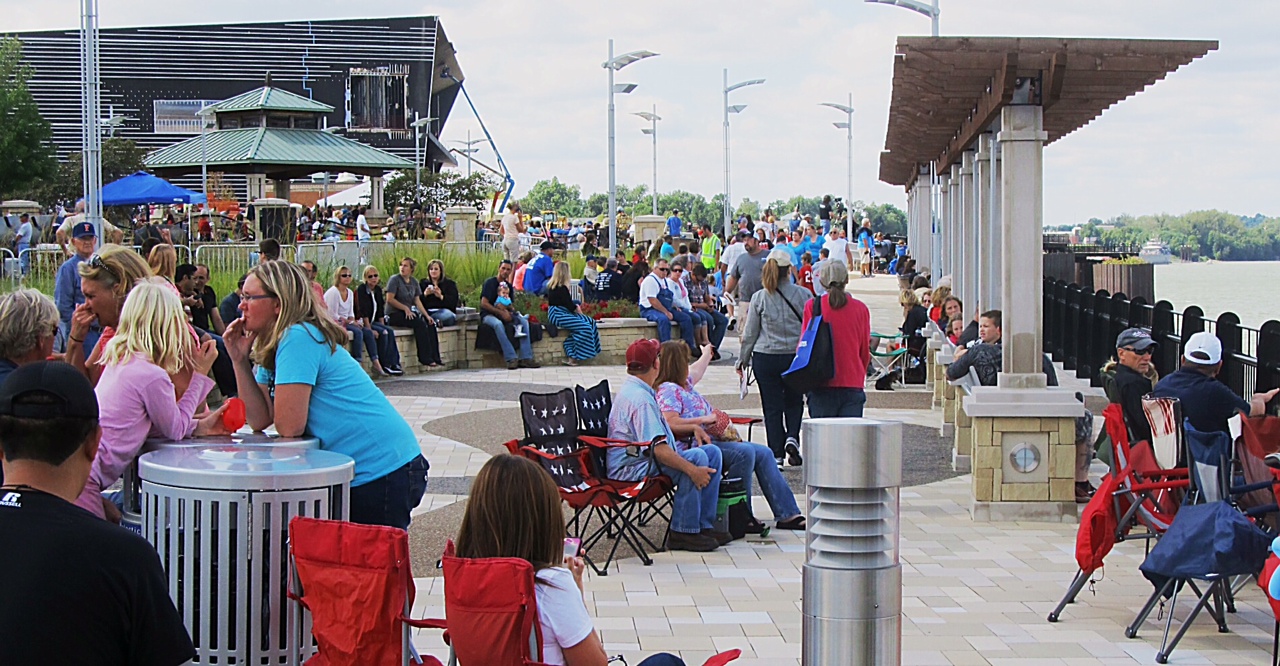
Indeed, on April 5, the Cincinnati Reds’ opening day, the city and The Banks held a block party that attracted a crowd estimated by city officials to number 140,000 fans, most of them clad in the team’s signature red and white jerseys, caps, and jackets. People crowded the new streets outside the Great American Ballpark and stood shoulder to shoulder in the district’s new bars and restaurants.

“We’d never seen anything like that in Cincinnati,” said Greg Hartmann, the president of the Hamilton County Board of Commissioners. “It was almost like we were in a different city.”

– Keith Schneider

20120606-152347.jpg

Annals of Excess in China: The $317,000 Wedding Cake

Tuesday, June 5th, 2012

20120606-140641.jpg

SHENYANG, China — Does excess consumerism represent the measure of a great nation? Or does it portend something darker, a treacherous crack opening in society?

Either way, the wedding cakes for sale at the Black Swan bakery here in Liaoning’s provincial capital are a clear reflection of 1) the astounding wealth some attain in China’s bursting economy, and 2) the indecorous way that the rich communicate their separate stature.

The biggest cake, aswirl in swans and blossoms resting on pedestals of cut crystal, sells for 1,999,999 RMB or $317,000 and change. The smaller cake to the left in pix below is 199,999 RMB or $31,745.The cake to the right is 299,999 RMB or $47,618. The clerk says it’s all because of the ingredients.

– Keith Schneider

20120606-142533.jpg

The U.S. Energy Boom and Ohio in The New York Times

Tuesday, June 5th, 2012

20120605-190549.jpg

My interest in the Ohio River Valley, as readers of ModeShift well know, is keen. Today, the New York Times published my latest piece about the billions being invested in mineral leasing for oil and gas drilling.

Tomorrow, in the NYT Business section, is another piece I did on Cincinnati’s improved economy and surging riverfront development.

You may recall this article on Owensboro Kentucky’s improved prospects for the NYT late last year.

I did this piece in April on Ohio’s soaring steel industry in the NYT:

And I laid out some of my basic thoughts about what’s happening in the six-state, 981-mile river valley here on ModeShift a few weeks ago:

My clear sense and reporting shows a region critical to the American nation and U.S. economy for 250 years that is recovering fast from two generations of disinvestment and decay. The entire river valley is emerging with a 21st economy that is based on:

1. Out of the box municipal tax increases and other urban investment policies that are improving the region’s biggest downtowns, all of which are growing again with new residents and businesses.

2. Striking gains in the fortunes of the higher education and medical sectors that have turned out to be the largest, or among the largest employers in the big and small cities.

3. Environmental protection and conservation gains that have improved air and water quality and conserved urban riverfronts and wildlands. The Ohio River Valley is impressively beautiful.

4. Global trade in farm commodity and fossil energy markets that have fostered regional booms in agriculture and oil and gas development that look to endure for years because of Asia’s (read China here) steadily rising demand.

I’ll be looking at China’s influence on the Ohio River Valley later this week.

– Keith Schneider

Production, Water Savings, and a Heroic History on China’s State-Owned Farms

Monday, June 4th, 2012

20120604-205556.jpg

HONGXINGLONG, China — When she was a very young woman Liang Jun was one of the tens of thousands of durable adults dispatched by China’s new Communist Central Government in the early 1950s with orders to break open the prairie of this cold and formidable northeast province. Until agronomists and engineers from the Soviet Union offered their assistance, and their steel-tracked grey tractors, the work of cutting open land that was bound together by the uncut roots of centuries of tall prairie grasses was done by hand, one chop and heave at a time.

Workers lived in crude grass and sod and wooden huts. Winter temperatures can plunge here to 35 degrees below Fahrenheit. Summers are hot. Women worked alongside men, their hands protected by thick cotton gloves. They wrapped white scarves around their hair and faces, the long tails streaming in the wind.

Liang Jun is in her 80s now and lives in Harbin, a provincial capital city of 10.6 million people 700 kilometers west of this modern prairie city of 40,000. She doesn’t grant interviews, farm officials told me. Her place in Chinese history, though, needs no further explanation from a western writer. She is the first woman to drive a tractor in Chinese agriculture, the first female credited with participating in the mechanization campaign that turned this province into the largest grain producer in a nation that harvests more grain than any other country on Earth, including the United States.

For a time Jun’s image graced the 1 RMB notes that today are worth a little more than 16 cents. A more permanent honor, a bronze statue of Jun driving a 1950s Soviet-era tractor, is at the center of a handsome ultramodern glass and aluminum museum that honors the machines and productive prairie agriculture the Chinese developed here and on 113 other state-owned farms in Heilongjiang Province.

More than a year ago, as a researcher and writer at Circle of Blue, I reported on the urgent water shortage developing in the Yellow River Basin, which lies west of Heilongjiang. The provinces of the Yellow River Basin produce 20 percent of the country’s grain and 70 percent of its coal, China’s number one source of energy.

Both sectors are the region’s largest water users. Both also are at significant risk of collapse because climate change is steadily reducing levels of rain and snowfall and draining freshwater reserves. By 2020, without significant water conservation initiatives, and as China’s demand for energy and food increases, we concluded there would be a damaging gap in the basin’s available fresh water supply amounting to 20 billion cubic meters. In other words, farmers and energy producers will be 20 billion cubic meters short of the water they need to operate.

We presented this finding to scientists and engineers at the Ministry of Water Resources in Beijing in April 2011. When I asked what they were doing in response, they told us about developing policies to significantly modernize and expand irrigation networks and water conserving technologies and practices in Heilongjiang (pronounced hail-long-jong) and three other northeastern provinces — Liaoning, Jilin, and eastern Inner Mongolia. I replied that we’d be back.

Here we are, accompanied by Wu Jing Yang, our accomplished and indefatigable researcher and translator. It’s our fourth day in northeast China, a region visited by few foreigners and even fewer Americans. The complete findings will be available online later this summer.

I learned that this region, a land now of rice paddies full of growing green shoots and enormous fields of just plowed and planted corn and soybeans, is in the third great chapter of its farm development. Over the next five years, the Central government will spend almost 8 billion RMB ($1.3 billion) in Heilongjang to build new concrete canals, end the leaks in old ones, buy drip irrigation equipment, install state-of-the-art low-flow sprinklers, and take other measures to bring water to plant roots while also not testing the boundaries of the province’s water supply, which is generally plentiful but can also be unstable.

The goal is to increase yields at least 20 percent over the next half-decade, a goal that has domestic food security significance here, and global market importance in the United States, where farmers are enjoying the highest commodity prices of their lives.

It’s interesting stuff. A lot of what the Chinese government wants to do with water conservation and new irrigation practices on small farms has been developed and proven out on some of the world’s biggest farms, including the 264,000-acre YouYi Farm here, the largest in China. Yields on the mechanized and irrigated farm, about the size of a small American county, are equal to and often exceed the top American farms. More than 80 percent of its 1-million-ton harvest of rice and corn, and 150,000-ton sugar beet crop, is exported to other provinces, said the farm executives I met.

The YouYI Farm is owned and managed by the Central government in a state farm system unique to this province, and now the world with the collapse of the Soviet Union and its state farms. More than 120,000 people work on the YouYi farm and its related production and processing enterprises that form, quite literally, a world of their own. The 3,300 acres of sugar beets raised in immense irrigated fields are processed in the town’s sugar mill. Same for rice and corn. Layers upon layers of farm managers provide employment for top technical graduates, some of them the grandsons and granddaughters of the first generation farmers that include Liang Jun.

The schools, hospital, equipment repair shops, housing, community center, hotels, and other public institutions are managed by the regional farm oversight office here, housed in a grand granite and glass building. The city of wide concrete boulevards, bright street lights, magnificent parks, brand new high rises and shopping centers rises unexpectedly after a trip through dusty villages over cracked and crowded roads, past fields of new rice and corn where weeding is still done by hand.

In one way or another everybody connected to the YouYi Farm is descended from Liang Jun.

– Keith Schneider

20120604-205959.jpg