Archive for October, 2011

A Civic Pact: Owensboro’s Next Development Strategy

Tuesday, October 25th, 2011

owensboro-construct

The privilege to spend six months studying an American community is rare in journalism. Nevertheless that was the assignment from Citistates last spring. Immerse yourself in Owensboro, Kentucky and emerge with a clear sense of where the community is, and where it might consider going in the 21st century.

Last week, in a series of public events, Citistates described the findings in What’s Done, What’s Next: A Civic Pact. The project found a number of big impediments to Owensboro’s progress — particularly its recent tilt to Tea Party austerity. But that, and several more negative trends — poverty, obesity, rising rates of meth addiction, diminishing median incomes, to name a few –  are a reality check for a city and county that view themselves as distanced from the mainstream, but really aren’t.

Owensboro and Daviess County’s most recent narratives, in fact, are an exception. Local governments are actually leading – understanding the globally competitive context, visualizing the local response, then deciding and managing specific actions.

Working collaboratively with each other, as well as with schools, colleges, business organizations, and non-profits, the city and county have gathered the raw materials of a mission-oriented community environment that allows entrepreneurs and their staffs to flourish. The result, already emerging, has led to more home-grown businesses where effective executives are rewarded with opportunities to move up in the organization instead of out to a different job in another place.

Great communities are distinguished by their ability to instill such value-based incentives, which reward hard work and provide favorable conditions for people to succeed. The United States in the first years of the century has temporarily lost that ability. Owensboro offers invaluable lessons about how to recover that skill. It is steadily empowering its young people and its business owners to be adept in an unpredictable era of transformation.

Owensboro, it turns out, is an example of hope for a sore and confused nation. It is trying something new in order to spark something different. Here are recommendations, several of which were also made in previous Owensboro planning documents, to blow more oxygen into the fire of change that Owensboro has started.

Citistates made some recommendations — see below — that together form a new narrative for this small city and rural county. Chapter Three of A Civic Pact, which includes a more comprehensive discussion on each recommendation, is here.

Thank you to Rodney Berry, Kathy Stroble and Shelly Nichols for all the help in setting up interviews and providing guidance. And thank you to the Hager family and the board of the Public Life Foundation of Owensboro for making the project possible. Thanks also to my Citistates colleagues Curtis Johnson and Neal Peirce, who edited the manuscript and provided expert feedback.

These suggestions are not all-inclusive. They don’t, for instance, deal with the medically uninsured, or alterations in Medicare and Medicaid that are likely in the next generation, and will affect Owensboro’s growing population of seniors, and the region’s less economically fortunate.

These recommendations, rather, focus on what Owensboro’s residents and leaders can achieve over the next generation in what Mayor Ron Payne calls “this little city on the move.”

1. Undertake a New Community Strategic Plan – A new strategic planning initiative is needed to propel the city and county to the next stage of its progress as a center of opportunity.

2. Cultivate and Recruit Women to Serve as Elected and Appointed Leaders – Almost 52 percent of Daviess County’s adults are women and that percentage is not reflected in elected positions in the city or county governments.

3. Strengthen Internal and External Marketing and Communications - More focused outreach is vital to show citizens why a publicly-funded program of education, downtown development, and innovation makes sense in strengthening the economy over the next generation.

4.  Establish a Joint City-County Office of the Ombudsman — Thin out the cross-cutting permitting process while also providing the fairness and access that citizens expect.

5. Establish and Fund the Owensboro Promise – Provide every graduate of the six Owensboro, Daviess County, and Catholic high schools scholarships for tuition and fees to attend a two- or four-year college in or outside Kentucky.

6. Establish the Owensboro Top 20 Young Achievers Program – Provide the most talented young adults the chance to be part of Owensboro’s future and to stay connected in an elite mission-oriented group.

7. Foster Local Foods and Develop More Recreational Infrastructure – Healthier cities note their success as a marketing advantage in promotional campaigns.

8. Generate More Diversity in Civic Life and Improve Business – Recruit investment and development capital from Asia, and especially from China.

9. Promote New and Cleaner Energy Sources - Owensboro’s city-owned utility should serve as an innovator in carbon reduction technology, conservation, efficiency, solar development and other cutting edge thinking about energy production and consumption.

10. Strengthen Transportation Hubs, Build a Streetcar Line – Owensboro’s opportunities over the next two decades are significant in air, ground, and river transportation.

11. Put a Brake On Sprawl - Replace the love affair with big surface parking lots with a marriage to homes and businesses, recreation, and education infrastructure that is reachable on foot, on a bike, public transit, or a very short car ride.

12. Promote Events and Bluegrass Music – Design and develop a new music center that houses the International Bluegrass Music Museum.

– Keith Schneider

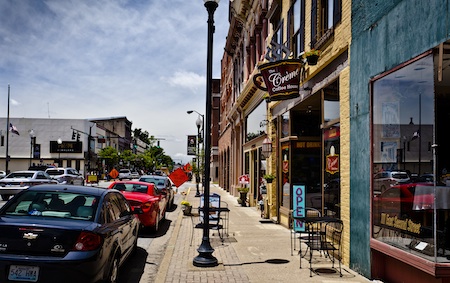
owensboro-downtown

Benzie County’s Gorgeous Leaves of Fall

Thursday, October 13th, 2011

fall-benzie-2011-1

The anguish of fall is upon us in northern Michigan. The astonishing colors, temporary as they are, are brushed onto this magnificent place I’ve called home for two decades. Yesterday, on one of the last road bike rides of the year, I took this gallery of shots with my iPhone. Every corner on our two-lanes, virtually empty of traffic these days, a billboard of reds and oranges and yellows unfolds, the colors deepening with the sinking sun. fall-benzie-corn-2011-5-300

The “leaves” of fall have multiple meaning for those of us fortunate enough to live here. The spectacle of nature’s color palette applied to leaves that weeks ago were just green is one translation, of course. Bfall-benzie-2011-31ut leaves also apply to the knowledge of the approaching cold rains and dark afternoons of November when your own personal weather forecast also gets a little dank and gloomy.

For me, November is the hardest month. It’s night by late afternoon. I’m not ready to layer sweaters over heavy shirts over tee shirts and pull on heavy socks and pants to stay warm, but I do. My bike goes up on the wall of the garage, unmoving until May. The days draw steadily colder until the first snow flies and the ice appears on the small inland lakes. The six weeks or so between October and December’s earnest snow, when the cross-country skies are waxed and readied, are a time of writing and reading and watching college football.

The leaves, in short, mark the season of passing. And for all the color and joy they bring, I’m no different than most people around here. I know cold short days approach. Windows shut. The season of sun and sweat give way, at least until December, to places where nothing flutters in a fresh wind.

– Keith Schneider

fall-benzie-house-2011-4-450

On Beautiful Fall Day Central Lake Is Shuttered For Business

Saturday, October 8th, 2011

center-lake-fall-2011

CENTRAL LAKE, MI – There is no sprawl in Central Lake, a northern village of 942 residents in magnificent  Antrim County. At this time of year rows of feed corn await harvest and the green white pine and multi-colored hardwood forests pour down the hillsides to the deep blue waters of the lake that gives the village its name. (see pix above and below)

Central Lakes possesses an asset all-too rare in American communities – a clear center. But there are a number of empty storefronts, and a closed pizza restaurant and bar, that signal the economic emergency that has engulfed this region and much of the rest of Michigan has gotten no easier and actually looks to be getting worse. There is  no scenario of aspiration evolving in the governing sector. The dark windows reflect a persistent inability to reckon with the era of stalemate and stagnation that is scarring this state and the rest of the United States.

One seemingly insurmountable problem here, as in so many other places, is that residents and the people they elect to state and national office are consistently unable and unwilling to make a fateful choice. That is the decision between the grim consequences of austerity, and the commanding logic of investment, entrepreneurism, and imagination. People are confused about the appropriate role of the public sector in encouraging private sector development. They hear from one party that government is the problem. They hear next to nothing from the other.

And because people don’t know they also can’t fathom the complexities of winning the fierce contests in two arenas that require highly developed levels of definition and understanding.

The first contest is external. Technology, foreign competition, and terrorism have unnerved Americans. The nation’s customary feeling of command and control has been disrupted. Taking its place is a state of reaction that whipsaws between fear and thoughtless decisions that are eroding the country’s self-confidence. The nation’s two century-old democracy suddenly seems immature, and its leadership both ineffective and reckless.

The second confrontation is internal. How does a community like Central Lake reach agreement on a development and business retention strategy when all people want to do is rant about ideology. And while the clashes escalate the town arrives at the same economic dead end of argument and grievance that has damaged so many other places in the United States. Paraphrasing New York Times journalist Tom Friedman, Central Lake is not just facing a few tough years. It may be contendingwith a bad century.

To be fair, it’s understandable that Central Lake citizens and a good number of its elected officials exercise caution and seemed so ready to hug tightly to the old patterns and economic ideals of the 20th century. For a long time those tools worked. The prevailing market conditions shaped a national purpose, a big target of where to aim, and a clear picture of what economic success looked like.

That picture, which came to be known as the American Dream, was first introduced at the 1939 New York World’s Fair in the General Motors-sponsored Futurama exhibit. Futurama was a huge diorama of a highway-heavy, congestion-free, car-dependent, time-efficient, leafy green all-American suburban pattern of development that no one had ever seen before.

A Pattern of Civilization Fit For One Century That No Longer Works
The exhibit was a smash. Visitors were transported in egg-shaped seats on a soaring conveyor belt across a landscape of innovation, creativity, and optimism. What astute observers recognized was that GM’s new American geography needed enormous public investments in the roads, sewers, education, research, planning, and industrial infrastructure to make it reality.

The shining and mobile American way of life displayed by GM, moreover, was eminently achievable. It fit the essential market opportunities of its time – cheap energy, low cost land, moderately rising population, competitiveness in core industries, rising family incomes, growing government wealth, and the willingness of taxpayers to invest in the nation’s future.

Over the next two decades voters elected to Congress and the White House lawmakers of both parties who cooperated in steadily enacting big and expensive bills – the GI bill to educate veterans, lending bills to put them in new homes, the 1956 Highway Act to start the Interstate system, water and sewer spending bills, research grants for engineering – that changed the way America looked and functioned.

The problem Central Lake and the rest of the country confronts is that the American way of life no longer fits the times. All of the underlying market trends that produced the drive-through economy have flipped. Energy prices are high and steadily rising. Land is expensive. Entire core industries, and millions of jobs, have moved beyond our borders. Median incomes, in real dollars adjusted for inflation, have fallen 10 percent since the late 1990s. Governments operate with enormous deficits. Taxpayers are unwilling to invest in a collaborative future.

The result is a town and a nation with fewer choices and less mobility, a nation that is uncharacteristically hesitant and afraid. And while ideologues on all sides shout past each other, and make holding office a thankless and grueling experience, the real danger in our governing circles is the entrenchment of the politics of stasis. Doing nothing. Holding the line. Not deciding. Not acting.

On a beautiful fall day, warm and clear and colorful, that outcome seems so sad.

– Keith Schneider

Central Lake, Michigan Fall 2011

Bluegrass, Mark Schatz, and the Approaching Main Stream

Tuesday, October 4th, 2011

birth-of-bluegrass-450

It wasn’t that I existed all these years without encountering bluegrass music. As a freshman at Haverford College in the 1970s I lived across the first floor of Barkley Hall from two upperclassmen –  Peter Doan and Evan Lippincott — whose vinyl collection included the 1972 Nitty Ditty Dirt Band’s Will The Circle Be Unbroken.

But not until this summer, when I arrived in Owensboro, Kentucky, where the International Bluegrass Music Museum is located, did I more fully understand the dimensions of the bluegrass music scene, its resonance with a new generation of young adults, its marvelous mix of creativity and language, melody and musicianship. The music is just plain great and getting better.

bluegrass-band-nashville2Last week I had the good fortune of being in Nashville to attend the annual International Blue Grass Music Awards show in the 119-year-old  Ryman Auditorium (see pix left), where bluegrass was born in 1945. Steve Martin, the comedian, author, banjo player, and member of the Steep Canyon Rangers, won the Entertainer of the Year award, the evening’s highest achievement. The Boxcars won the Emerging Artist of the Year award.

This year the bluegrass nation marks the 100th anniversary of the birth of Bill Monroe, the Kentucky mandolin player credited with developing the genre. There were lots of performances during the show that celebrated Monroe’s contributions and also expressed the breadth of the music. Each was superb. A fuller account  is here on Bluegrass Today.

Among the nominees — for Bass Player of the Year — was Mark Schatz, one of American bluegrass music’s best musicians and a roommate of mine during our senior year at Haverford. Twice previously, Mark won the Bass Player of the Year Award, so his bonafides in the business and among bluegrass lovers is assured.

Taking a moment here to consider the men in our Haverford suite and their exploits. One is a top commander in the Washington, D.C. Metropolitan Police Department; a second is a federal housing official in Birmingham; a third teaches English at Temple University, a fourth is a computer engineer who found success in California’s silicon valley. It’s an interesting group, then and now.

The last time I caught up with Mark was a few years ago, when he was Nickel Creek’s bass player, and the band performed a summer concert up the road from here in Interlochen, Michigan. Nickel Creek had already announced it was breaking up. One of the many things I recall from that conversation was Mark’s assurance that he’d be able to find another gig. He said it with a bright laugh.  That’s how it turned out. He’s now part of the Claire Lynch Band.

As a young college student Mark spent his time with other musicians. He played banjo and mandolin and bass, and probably a few other instruments. He’s a quiet guy and clearly prefers to speak through his fingers and the strings. He spent his first few years after Haverford playing on the streets of Boston with Bela Fleck, another accomplished musician. Both are from the Boston area. mark-schatz

Mark (see pix right) has two solo recordings, Brand New Old Tyme Way and Steppin’ in the Boilerhouse, both on Rounder Records. He’s also released two instructional bass videos on Homespun. I wasn’t able to catch him in Nashville but have kept abreast of Mark’s exploits. His older brother, Gordon Schatz, and Reed Schneider, my older brother, also are Haverford grads and close friends.

One last point about Nashville, a city of 601,000 and just behind Washington, D.C. as the 25th largest city in the United States. There’s not a lot going on in the streets by day. They’re flanked by sealed glass office towers.

But by night it’s a blast. Broadway in Nashville (see pix below) is chorus of contemporary sound. The singers at the Karaoke bars perform as well as the originals, and the street musicians are even better than that. Such energy and talent. It gives me reason to believe we’ll make it through this bizarre and dangerous era of dim American leadership. A country that capable of developing young artists will endure.

– Keith Schneider

elvis-in-nashville

Historic Preservationists Rally To Kill Clean Energy Projects

Monday, October 3rd, 2011

wind-energy

Add preservationists to the list of American interest groups determined to kill clean energy projects. Preservation Magazine published a good piece on the troubling trend in its summer 2011 issue.

Along with all of the other concerns I’ve raised about the myriad and all-too-effective campaigns at the grassroots to curtail clean energy development, add this thought. At least in clean energy development the United States has the opportunity to replace scenic vistas with energy sources that don’t pollute and are sustainable. Which is a good thing considering that the conventional energy sources add to climate warming that is damaging the forests and grasslands that form those very same scenic vistas.

In my previous work on Smart Growth, the campaigns organized by the Michigan Land Use Institute and our partners were driven in part by one undeniable fact: In every case beautiful landscapes were being replaced by parking lots and big roads and other out-of-scale projects not fit for a new era of energy scarcity, climate change, and diminishing incomes. Moreover, those new projects — Walmarts, Meijers big box stores, fast food, chain motels — drove average wages down, not up. They drained community vitality.

The clean energy sector, if it develops any scale at all, will employ high-skill people earning better wages. It fits much more readily into a natural landscape. And it responds to climate change, which I fear could be the most important threat to the nation’s economy and security because of the fury of the storms we’re seeing now.

So what are preservationists preserving when they oppose clean energy projects? Vistas that are undergoing damage due to the culture’s unyielding reluctance to pursue a cleaner and safer energy path.

Shanghai’s Planned Community, Better For Ducks So Far

Sunday, October 2nd, 2011

yong-yi

LINGANG PORT CITY: Shanghai, China — Dishui Lake, constructed where the Yangtze River meets the East China Sea, is a perfectly circular manmade lake that was meant to put people in close proximity to fresh water.

The Nanhui Dongtan Wildlife Sanctuary, which lies on Dishui Lake’s eastern bank, is a 122.5-square-kilometer (47-square-mile) expanse of tall grasses and shallow, rain-fed ponds that also tests the lure of fresh water; in this case, to recruit great flocks of migratory birds. (That’s Yong Yi, a 33-year-old environmental scientist with WWF in Shanghai, who helped establish the reserve, in the pix above.)

From 2003 to 2005, both the lake and the sanctuary were constructed from silt and mud, carried downstream by the Yangtze and captured with long rock and concrete groins that engineers extended into the river’s mouth. Shanghai’s planning officials envisioned using the new ground to build a seaside district — Lingang Port City — that was intended to attract thousands of businesses and 400,000 residents by 2020; 800,000 residents by 2050.

The idea for this new borough was to reduce crowding, build contemporary commerce centers, and encourage lower population densities in Shanghai, a city of 23 million that is tallying 1 million additional residents every two years. If Shanghai were an American state, only California and Texas have more people.

The enterprise hasn’t quite worked out the way planners in Shanghai’s city government envisioned, however. For the time being, the wildlife sanctuary has been much more successful in attracting winged residents than neighboring Lingang Port City and its lake has been in recruiting businesses and human residents — yet. (See pix at bottom.)

Shanghai city managers know how to build a 21st-century city, and they are doing so with a clear focus on environmental values and energy efficiency, in addition to improving the quality of the water supply and expanding the size and number of parks and open spaces.

Better City, Better Life
Last year, Shanghai hosted a World Expo with the green-oriented theme: “Better city, better life.” Among the innovations promoted was Shanghai’s ongoing program to establish new and planned residential and business districts outside the core central city.

Lingang Port City was one such example, featuring big runs of green space, lots of clean water on display in canals and ponds, and countless new energy-efficient homes and offices. All of these new districts will be tied to the central city and to each other via Shanghai’s clean, fast, and steadily expanding subway system, which now consists of 11 lines, 267 stations, and 410 kilometers (255 miles) of track.

In 2002, Shanghai opened a Maglev train line from the downtown area to Pudong Airport. The train, which operates on powerful magnets that lift the cars onto a thin cushion of air, travels 431 kilometers an hour (267 miles per hour) and makes the trip in less than 7 minutes — 40 minutes less than in a taxi.

The Urban Land Institute, based in Washington, D.C. and one of the premier U.S. urban planning and development research organizations, reviewed Shanghai’s master plan in 2006 and declared: “No other city in history has attempted to tackle its urban issues with such a comprehensive program of public improvements and new-town development at its periphery.”

Dishui Lake, the centerpiece of the Lingang Port City district, was intended as a showcase of the city’s master plan. With a diameter spanning 2.5 kilometers (1.5 miles) and a surface area of 5 square kilometers (2 square miles), Dishui has three sizable, grass-covered peninsulas that serve as green open space. From a birds-eye view, the peninsulas resemble continents and the lake — round as a dime and about 60 kilometers (37 miles) to the south of Shanghai’s high-rise central core — looks very much like a replica of Planet Earth. On its northern and western banks, the lake is surrounded by a constellation of new residential and office towers, the mostly uninhabited dark stars of Lingang Port City.

On the lake’s southern and eastern flank, though, lies the great expanse of freshwater ponds and grass reclaimed from the Yangtze estuary that is, for the time being, much more successful in attracting wild residents.

Big Water Cleanup
Though people have yet to show up in droves, filthy water is not one of the district’s impediments. Since 1995, Shanghai has spent $US 8.1 billion (RMB 50.3 billion) to construct a network of 52 sewage plants that now treat nearly 80 percent of the city’s wastewater, according to the Shanghai Municipal Oceanic Bureau, a city agency. In contrast, Shanghai had only five treatment plants during the late 1980s — one of which was constructed in 1921 — and 80 percent of the city’s sewage poured, untreated, into rivers and lakes.

Read more at Circle of Blue here.

– Keith Schneider

empty-dishui-street