Archive for September, 2011

Manila On 9/11

Saturday, September 10th, 2011

manila-skyline

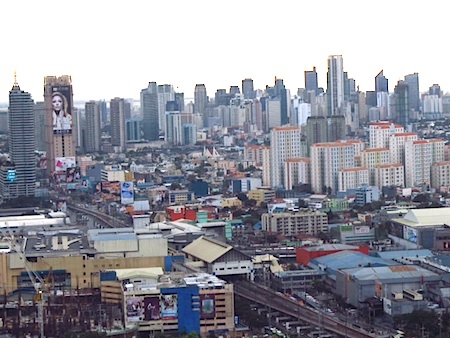
MANILA — The sun rose here to another towering and impressive Asian skyline. On the 10th anniversary of 9/11, while the world joins the United States in honoring a terrifying moment, I see skylines here and in China that describe in clear line and form just how far that day blasted us off course.

One measure is the scant alterations in the skylines of big American cities in the last decade. Another is that in Washington and most state capitals the stupid party has no clue how to stop the evil party from damaging the economy and America’s capacity to reckon with big problems. We’ve become a nation of ‘no’ — no progress, no money, no change, no chance.

Meanwhile, the growing nations of Asia are all about ‘yes.’ In Shanghai, new subway lines measuring 35 kilometers and more, take four years to construct. It takes that long to consider permits for big projects in the U.S.

Yesterday I boarded a maglev train from downtown Shanghai to Pudong Airport, a $6.50 ride at 431 kilometers per hour (267 mph) that took less than 10 minutes. A cab takes 50 minutes and costs $30.

In the U.S., the evil party views trains the same way they view gay marriage, as an ideological affront. Two of our conservative governors in the Midwest earlier this year returned to the federal government hundreds of millions of dollars to improve the regional passenger rail network.

Manila is no Shanghai, now very clearly competing with Tokyo and Hong Kong for the honor of being viewed as the capital of Asia. For that matter, Shanghai at this point is competing with New York to claim distinction as capital of the world.

Manila has its own aspirations. Demographers report that 20 million people now live in the largest metropolitan region in the Philippines. That’s more people than live in all but two American states — California and Texas. Traffic is intense 24/7. A lot of the office towers seen from my room on the 26th floor of the Malayan Plaza hotel look new. The air today is cleaner than what I breathe in Beijing and Shanghai. Donald Trump, the newspaper reported this morning, just reached agreement with a big Manila developer to put his name on a new mixed-use luxury tower.

Still, third world menaces exist here. They are reflected in the “security advisory” that greets guests on the desks of their rooms in the Malayan Plaza, which is located in a well-traveled commercial district. The advisory warns of “friendly strangers” who “can lure you into their vehicles and then offer drinks spiked with gammahydroxybutate, which induces immediate sleep and subsequent memory loss.” It advises “never walk alone at night if you can avoid it,” and to be wary of taxi drivers “who want to charge a flat rate.” Avoid wearing heavy jewelry, eat in reputable restaurants to “minimize risk in safety, security, health and sanitation,” and be ever wary of who has use of your credit card because syndicates working with retail and restaurant staff can copy the details. “The information is then transferred on to forged cards which are sold or exported.”

There’s more. Use the door latch and check all visitors to the room. And watch out for “various con artists and tricksters” seeking “loans” that quite obviously won’t be repaid.

It’s a useful recounting of safety suggestions, a kind of informal Manila street-level operating system designed for new arrivals.

I wonder if we can’t write something similar for dealing with the con artists and tricksters who’ve driven America to post 9/11 stagnation and frustration. Advisory number one: Get real, people! Gay marriage. Abortion. Guns. Lower taxes. Deficit reduction. Hate radio. That’s like cleaning up a sewage spill with a soup spoon.

– Keith Schneider

Underlying Big Decisions, An Owensboro Operating System That Works, Mostly

Thursday, September 8th, 2011

_mg_2374
I’ve been working in Owensboro, Ky. this summer on What’s Done, What’s Next: A Civic Pact, a three-part project to help the city understand the new velocity of change in the 21st century and suggest ways that will lead to prosperity and a high quality of life.

Right off the bat, it’s important to note how different Owensboro’s attitude about the future is from much of the rest of the country. Owensboro is in transition, to be sure. But its vector is pointing up, not down.

That’s not the case in too many other places. The public mood is so hollowed out that Americans have settled on a single word – “dysfunctional” – as a polite way to describe the ideological fanaticism, political ruthlessness, and economic heedlessness that has made the intrinsically messy process of governing the nation unbearable. Similarly fierce conflict and feckless results also characterize the brand of democracy that has taken hold in Frankfort, Sacramento, Lansing and most other state capitals bullied by deficits, slashed programs, and demoralizing layoffs.

Indeed dysfunction and disinvestment define much of America’s painful era of national reckoning and stagnation. But not all of it.

It turns out that American democracy still works at the local level, a select group of big and small cities and counties. The reality of day-to-day civic needs – street repair, garbage collection, emergency services, construction permits, contracts – tends to temper political combat, reward insightful and strong leaders, and replace ideology and revenge with shared values and some measure of common decency.

The local governments that are widely regarded as setting the gold standard in municipal management – Chicago, New York, Denver, Charleston, S.C., Chattanooga, Grand Rapids, to name a few – also are defying the tax-cutting, investment-starving economic logic of the times. They are spending taxpayer dollars on new transit systems, housing, schools, research centers, parks, city-wide Internet access, college scholarships, inducements to attract entrepreneurs, and any number of other public programs and civic equipment to leverage private investment. All are performing much better economically than the states they are in.

These cities, managed by capable elected and appointed officials and supported by pragmatic residents, understand that spending on public assets is one of the principal tools for encouraging a strong business sector, generating good jobs, and providing for an economic culture that provides personal safety and financial security.

That, of course, is the same formula that built America in the 20th century, but which is being abandoned in Washington and state capitals. It also is the formula that Owensboro embraced over the last six years under Democratic and Republican leadership, and which in the last two years produced almost 2,400 new jobs, more than any city in Kentucky.

That statistic, by itself, provides a persuasive argument for Owensboro to be included in the short list of small cities considered among America’s best, a distinction that Money Magazine, Forbes Magazine, and several other well-regarded periodicals already recognized over the last year.

As we learned in Chapter One of What’s Done, What’s Next: A Civic Pact, Owensboro is building its next era of economic competitiveness on these basic pillars of American progress:

1. Investing in public schools and higher education institutions to both build a durable economic sector that employs more people with good jobs in Owensboro than any other sector than health care, and to develop a skilled and educated workforce that is strengthening existing businesses and attracting new employers.

2. Building new infrastructure – roads, airport runways, port facilities, streets, downtown neighborhoods, a business incubator, parks, sports facilities, and a convention center – to enhance the competitiveness of a self-conscious community that shows clear signs of outgrowing its provincialism.

3. Promoting art and music, and providing financial incentives to attract dynamic employers who, in turn, will recruit high-I.Q. and goal-oriented employees.

4. Promoting science, health, and new research and manufacturing practices, chief among them the promising plant-based pharmaceutical contract work at Kentucky BioProcessing, to push the boundaries of innovation and elevate Owensboro’s brand as a premier place to live and do business.

Strong Leadership
Still, there is one more critical facet of Owensboro’s progress that is neither well-recognized nor well-regarded in the city or in Daviess County. And that asset is how effectively both jurisdictions have been managed in recent years, and how they’ve learned to cooperate and collaborate.

Those features of local governing have done more than produce budget surpluses in an era more commonly defined by deficit. They prompted the city and county to jointly approve a tax increase on local insurance policies in 2009 that provided $80 million in funding for far-reaching downtown development projects. They’ve enabled Daviess County to invest $6 million in a local 27-acre campus for Western Kentucky University that includes a 30,000 square foot, wired-for-the-new century classroom building that serves hundreds of students and where 40 people are employed.

Smart decision-making and surpluses also provided the wherewithal for Owensboro to provide $14.5 million in incentives and grants to enable the U.S. Bank Home Mortgage Company to expand its facilities over the last year and add 500 new jobs, although those jobs are not downtown.

Just as importantly, Owensboro’s Mayor Ron Payne, a Republican who endorsed the re-election of Democratic Governor Steve Beshear, and Daviess County Judge Executive Al Mattingly, a moderate Republican who once was an independent, are civil to each other in public, and in private are said by colleagues to have found a way to work together. That has helped accelerate the pace of decisions, an important competitive advantage that unlike big-ticket infrastructure projects, doesn’t cost anything. The two ran against each other three years before in the Owensboro mayoral race.

Describing the city and county governments as well-managed, of course, is certain to generate either dismay or howls of laughter in the quarters of the community familiar with the back-and-forth, missed opportunities, unexpected decisions, and the other actions taken by elected leaders that one or another group considers foolish.

For instance, Jeff Barber, the chief executive of the Owensboro Medical Health System, sourly recounts five months in the late summer and fall of 2009. That was the time that it took the region’s largest employer to secure from the city commission and the Metropolitan Planning Commission’s Board of Adjustment the zoning changes and conditional use permits needed to start construction on a $385 million hospital. The hospital, he said in an interview, fit the requirements of the regional land use master plan and was less than two miles from its current downtown location. “It baffled me,” Barber said.

If the same proposal to move a big downtown hospital, though, was made in Pennsylvania, Ohio, or any of a dozen Michigan cities, the public process to decide on zoning changes and permits could easily consume years, and end up with a decision to deny the new location.

See more of Chapter Two here.

– Keith Schneider

Latest in NY Times: Kids Sports As Development Tool

Thursday, September 8th, 2011

ELIZABETHTOWN, Ky. — Since 1937, when the Treasury Department established a bullion repository at nearby Fort Knox, gold has been the principal attraction of this city of 28,531 south of Louisville. Now, travel and tourism executives are counting on a $29 million youth sports complex under construction northwest of town to help fill Elizabethtown’s 1,525 hotel rooms and drive development of hundreds more.

Along with China, I’ve spent a good bit of time this summer reporting in Kentucky for a project that looks closely at Owensboro’s capacity to thrive in the 21st century. There I learned about the youth sports tournament sector, which is prompting communities to invest in their recreational sports infrastructure as an economic development strategy. This week the New York Times published my account of the trend, reported from nearby Elizabethtown.

The 150-acre Elizabethtown Sports Park, set to open next summer, will have 12 baseball and softball diamonds, 10 natural turf soccer and football fields, 2 full-size synthetic turf fields and a diamond for physically disabled athletes. The sports park also includes powerful lighting, six concession buildings, pavilions to house meeting spaces and locker rooms, four playgrounds, Wi-Fi access so events can be viewed live on the Internet and a three-mile-long running and walking path that circles the complex.

Last year, American families spent $7 billion traveling with their children to youth sports tournaments, said Don , the executive director of the National Association of Sports Commissions, a group based in Cincinnati that represents tournament organizers and hosting facilities.

The youth sports travel segment, as it is called, is a little less than 10 percent of the national leisure travel industry, estimated at $77 billion, he said — and it is growing by 3 to 5 percent annually, faster than most other segments. The industry is considered somewhat recession-proof, as families eager to provide their children with tournament-level competition are using the trips as vacations.

Among the first private developers to recognize the trend was the Walt Disney Company, which spent $100 million to turn 220 acres in at the Walt Disney World Resort in Lake Buena Vista, Fla., into a youth sports complex that opened in 1997. The park, now named the ESPN Wide World of Sports, includes a 9,500-seat baseball stadium, an arena and fields and facilities for basketball, football, soccer, tennis, volleyball and other sports.

The Elizabethtown Sports Park is publicly financed by a restaurant sales tax that was enacted in 2007. It will be one of the largest such complexes in the country, Mr. Schumacher said, with the ability to host four- and five-day tournaments that will attract hundreds of teams and thousands of spectators from across the Southeast.\n “They are going to be able to fill a lot of hotel rooms and restaurants,” he said. “Communities that have youth sports complexes understand that visitor spending is an important part of their local economies.”

About 90 miles west of Elizabethtown is Owensboro, Ky., an Ohio River city of 57,265. It was among the first communities in the Southeast to publicly finance fields and facilities to capture the youth sports travel market. In 2001, the city hosted 52 girls softball teams for a tournament in one of its parks that had undergone a $400,000 overhaul to build modern diamonds.

For more on Elizabethtown click here.

For more on the Owensboro project, What’s Done, What’s Next: A Civic Pact, see here.

– Keith Schneider

China’s First (And Still Only) Sustainable Business Magazine

Tuesday, September 6th, 2011

editor-of-magazine

SHANGHAI — The second edition summer issue of Eco-nomy, the new compendium of news and ideas about sustainable business, includes a piece from Circle of Blue’s Choke Point: China project earlier this year on the confrontation between water and energy in China. The page-long article is in Chinese, which is appropriate given that Eco-nomy is a fresh voice in Asia for describing the profitable alliances that develop when companies apply ecological principles to their business models.

The current issue includes pieces on London’s plan to turn the 2012 Olympics into the greenest games ever, Michigan-based Haworth furniture company’s two environmentally-sensitive and worker-safety oriented factories in Shanghai, and a smart piece on green marketing in China by Olgilvy and Mather’s Hannah Lane that asks whether Chinese consumers are willing to value sustainability in their purchasing habits. She is convinced they are.

I also like the solid piece on China’s challenge to ensure safe food. The latter was reported and written by Haiyan Sun, the magazine’s chief editor and co-founder, who gave birth on Saturday to a baby boy, her second child.

This week I arrived in Shanghai, my fourth trip in the last year to China, and my second to this modern supercity of 23 million people. On Tuesday I sat down with the magazine’s other co-founder and editorial director, 29-year-old Yang Sun, a business journalist from Jilin City in China’s northeast (and pictured above). The magazine’s goal, in a polluted nation where environmental principles do not yet figure prominently in mainstream values, is to show Chinese business leaders and government officials just how much more money can be made by embracing cleaner and greener practices.

That’s an essential thought in a country that is pushing its natural resources to the limits of productivity, running low on water, adding to an already astonishingly large number of people, and climbing a steep upward curve on energy production. Frankly, China’s economic and environmental security rests on its capacity to be much more inventive and efficient than the West has been in tapping its natural wealth for economic development.

“We believe that in the future sustainable practices will be most important in doing business,” Yang told me. “We are reporting best practices from around the world. We want to show there is a wave of sustainable businesses. It’s a systematic way of thinking. We have emerging companies and technologies in China. But we find that the best practices are outside China.”

Yang said the magazine developed from “The Age of Green Gold,” a book on sustainable business that she and Haiyan published last year. A Chinese executive who read the book approached the two young writers with the idea of producing a magazine, and has provided the financing for the first year of operation. The two editors developed a string of correspondents to file dispatches from around the globe. Each of the two editions have articles in Chinese and English and have been distributed at no charge to readers. Expenses run about $16,000 a month, and the magazine has established a non-profit business model.

Unfortunately Eco-nomy has not developed a Web site, which is in the design stage, Yang said. To secure a copy write the editors at tanshang2011@gmail.com.

– Keith Schneider